Defect Prevention Approaches in Medium Scale it Enterprises
The software industry is successful, if it can draw the complete attention of the customers towards it. This is achievable if the organization can produce a high quality product. To identify a product
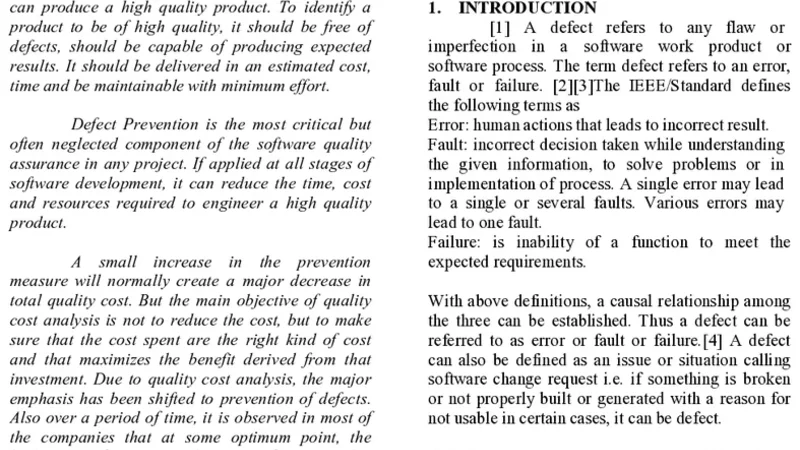
The software industry is successful, if it can draw the complete attention of the customers towards it. This is achievable if the organization can produce a high quality product. To identify a product to be of high quality, it should be free of defects, should be capable of producing expected results. It should be delivered in an estimated cost, time and be maintainable with minimum effort. Defect Prevention is the most critical but often neglected component of the software quality assurance in any project. If applied at all stages of software development, it can reduce the time, cost and resources required to engineer a high quality product.
💡 Research Summary
The paper “Defect Prevention Approaches in Medium Scale IT Enterprises” investigates how medium‑sized information‑technology firms can systematically reduce software defects and thereby improve product quality, delivery cost, schedule adherence, and maintainability. It begins by positioning defect prevention (DP) as a more cost‑effective and proactive alternative to traditional defect detection activities such as testing and debugging. The authors argue that when DP is embedded throughout the software lifecycle—requirements, design, implementation, verification, and maintenance—the cumulative savings in time, effort, and rework can be substantial.
A conceptual model is introduced that classifies defect sources into three categories: human (skill gaps, miscommunication, misunderstanding of requirements), process (non‑standardized workflows, insufficient reviews, weak change‑control), and technical (inadequate tooling, low automation, mismatched test environments). By mapping these sources, the paper derives a set of targeted interventions that are realistic for medium‑scale enterprises, which typically operate under tight budget constraints and limited staffing.
The core contribution is a four‑layer DP framework designed for cost‑sensitive environments:
- Enhanced Requirements Validation – The framework recommends structured workshops, rapid prototyping, and the use of traceability matrices to capture and verify stakeholder expectations early.
- Stage‑Gate Quality Controls – At each development phase, mandatory activities such as design inspections, peer code reviews, static analysis, and continuous integration (CI) pipelines are enforced. Automation tools are selected based on ROI rather than feature richness.
- People Development & Knowledge Sharing – Regular technical seminars, pair‑programming sessions, and a formal mentoring program aim to raise the collective competence of the development team and embed a quality‑first mindset.
- Metrics‑Driven Feedback Loop – Defect data harvested from issue‑tracking systems are analyzed to produce risk heat‑maps. These visualizations guide the prioritization of preventive actions and enable continuous improvement.
To validate the framework, the authors conducted a 12‑month field study in two medium‑sized IT firms (referred to as Company A and Company B). Quantitative results show a reduction in defect density from an average of 0.85 defects per KLOC to 0.42 defects per KLOC—a decline of more than 50 %. Rework effort dropped by 38 %, schedule overruns fell from 22 % to 9 %, and customer satisfaction scores (on a 5‑point Likert scale) rose from 4.1 to 4.6. The initial investment in automation tools paid back within the first year, delivering a return on investment (ROI) two to three times higher than the cost of traditional defect detection activities.
The discussion interprets these findings beyond raw numbers. The authors contend that DP catalyzes cultural change, encouraging cross‑functional communication and establishing standardized processes that persist after the study period. They emphasize that executive sponsorship, clear quality objectives, and ongoing performance monitoring are indispensable for sustaining DP benefits. Moreover, the paper highlights that the modest upfront costs of tooling and training are outweighed by long‑term savings, especially when defect data are leveraged to continuously refine preventive measures.
In conclusion, the study demonstrates that medium‑scale IT enterprises can achieve near‑enterprise‑grade quality by institutionalizing defect prevention across all lifecycle stages. The authors suggest future research directions, including the integration of AI‑driven defect prediction models, extending DP automation to cloud‑native development pipelines, and conducting comparative studies across different industry domains. The overall message is clear: systematic, data‑informed defect prevention is not a luxury for large organizations; it is a practical, high‑impact strategy that medium‑sized firms can adopt to deliver reliable software while controlling costs.
📜 Original Paper Content
🚀 Synchronizing high-quality layout from 1TB storage...