Multicore Applications in Real Time Systems
Microprocessor roadmaps clearly show a trend towards multiple core CPUs. Modern operating systems already make use of these CPU architectures by distributing tasks between processing cores thereby inc
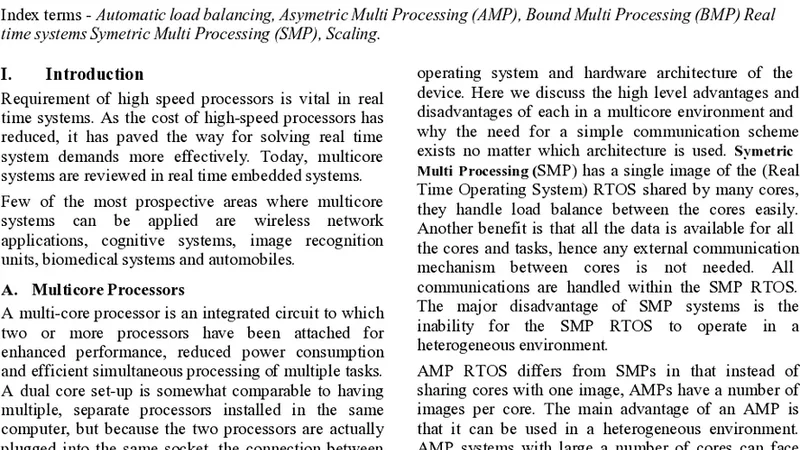
Microprocessor roadmaps clearly show a trend towards multiple core CPUs. Modern operating systems already make use of these CPU architectures by distributing tasks between processing cores thereby increasing system performance. This review article highlights a brief introduction of what a multicore system is, the various methods adopted to program these systems and also the industrial application of these high speed systems.
💡 Research Summary
The paper provides a comprehensive review of how multicore processors are integrated into real‑time systems and the benefits they bring. It begins by outlining the industry trend toward multicore CPU architectures, noting that single‑core designs are hitting physical limits in clock speed, power consumption, and thermal dissipation. This sets the stage for why real‑time applications—where deterministic response times and low latency are mandatory—must evolve to exploit parallelism.
The authors first define a multicore system, describing its typical hardware features: multiple execution pipelines, shared L2/L3 caches, inter‑core communication buses, and coherence protocols such as MESI. They explain that while these features enable higher aggregate throughput, they also introduce new sources of nondeterminism, including cache‑coherency traffic, memory‑access contention, and inter‑core interrupt routing. The paper stresses that any real‑time solution must explicitly manage these factors to preserve deadline guarantees.
Programming models for multicore real‑time applications are examined at three abstraction levels. At the lowest level, developers can manually bind threads to specific cores and control interrupt distribution using assembly or vendor‑specific extensions. At a middle level, POSIX real‑time threads (pthreads) and native RTOS APIs allow explicit priority assignment and core affinity, giving fine‑grained control while still leveraging the operating system’s scheduler. At the highest level, the authors discuss the use of parallel frameworks such as OpenMP, C++17 parallel algorithms, Intel Threading Building Blocks, and Cilk Plus. These frameworks automatically partition work and schedule tasks, but the paper warns that their default policies may violate hard‑real‑time constraints unless the programmer carefully selects granularity, synchronization primitives, and memory allocation strategies. Lock‑free data structures, memory pools, and cache‑friendly layouts are highlighted as essential techniques to avoid priority inversion and reduce jitter.
Scheduling strategies receive particular attention. The authors compare global schedulers, which view all cores as a single resource pool, with partitioned (local) schedulers that assign a fixed set of tasks to each core. Hybrid approaches that combine fixed‑priority preemptive scheduling for safety‑critical control loops with dynamic Earliest‑Deadline‑First (EDF) for best‑effort workloads are presented as a practical compromise. The paper details how modern real‑time operating systems such as VxWorks, QNX, and FreeRTOS implement these policies, and it describes additional mechanisms—cache partitioning, NUMA‑aware memory allocation, and core‑level power‑gating—that help maintain deterministic timing while exploiting the full performance of the silicon.
Industrial case studies illustrate the concepts. In automotive electronics, the authors cite an engine‑control unit that migrated from a single‑core to a four‑core architecture, achieving a 30 % reduction in worst‑case response time and a 15 % drop in power consumption. The multicore platform also enabled simultaneous execution of Advanced Driver‑Assistance Systems (ADAS) functions such as lane‑keeping and obstacle detection, which previously required separate ECUs. In aerospace, a flight‑control system using a dual‑core processor performed sensor fusion, trajectory planning, and fault monitoring concurrently while meeting DO‑178C certification requirements through rigorous timing analysis and formal verification of the scheduler. In industrial automation, a robotic arm controller off‑loaded high‑speed image processing to a dedicated core, isolating it from the motion‑control loop and thereby guaranteeing sub‑millisecond actuation deadlines.
The conclusion emphasizes that multicore real‑time systems are poised for continued growth, but several challenges remain. Reducing inter‑core communication latency, integrating power‑aware thermal management with timing analysis, and developing formal methods that can certify multicore schedulers for safety‑critical standards are identified as priority research areas. The authors propose future directions such as hardware‑assisted time‑guaranteed cores, machine‑learning‑driven dynamic scheduling, and unified security frameworks that protect both the timing and functional integrity of multicore real‑time platforms.
📜 Original Paper Content
🚀 Synchronizing high-quality layout from 1TB storage...