On the characterization of a random monolayer of particles from coherent optical reflectance
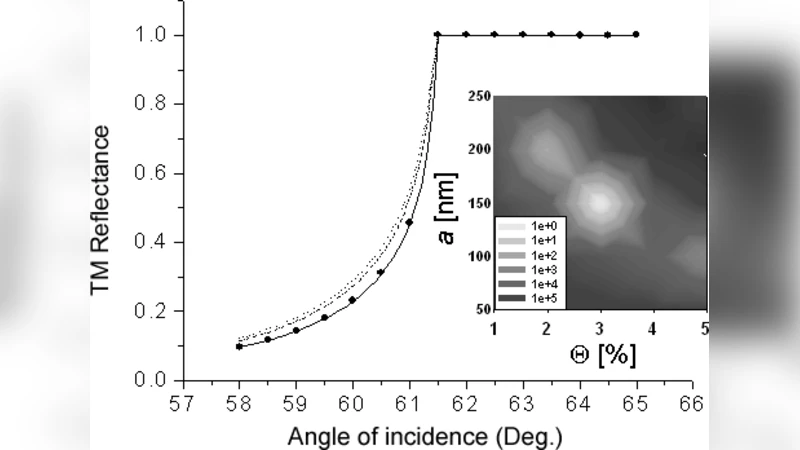
We present the viability of obtaining the particle size and surface coverage in a monolayer of polystyrene particles adsorbed on a glass surface from optical coherent reflectance data around the critical angle in an internal reflection configuration. We have found that fitting a CSM to optical reflectivity curves in an internal reflection configuration around the critical angle with a dilute random monolayer of particles adsorbed on the surface can in fact provide the particle’s radius and surface coverage once the particles are sufficiently large.
💡 Research Summary
In this paper the authors demonstrate that the particle radius and surface coverage of a random monolayer of polystyrene spheres adsorbed on a glass–water interface can be accurately retrieved from coherent optical reflectance measurements performed around the critical angle in an internal‑reflection configuration. The work builds on a previously developed coherent‑scattering model (CSM) that accounts for multiple scattering among particles and between particles and the substrate. The model uses the amplitude‑scattering matrix of an isolated sphere, which the authors evaluate with the Rayleigh‑Gans approximation under the assumption of small refractive‑index contrast and particles that are not excessively large.
Parameter extraction is carried out by minimizing a χ² merit function that compares the measured (or simulated) reflectivity R(θ) with the CSM prediction for a given pair of parameters (particle radius a, surface coverage Θ). The minimization employs a Newton‑Raphson scheme combined with singular‑value decomposition of the Jacobian matrix, allowing rapid convergence to the χ² minimum in the (a, Θ) space.
To assess the feasibility of the approach, the authors generate synthetic data by adding Gaussian noise to CSM‑calculated reflectivity curves. Two noise levels are considered: a very low relative error s = 0.01 % (σ = 10⁻⁴) and a more realistic s = 1 % (σ = 10⁻²). Simulations span particle radii from 50 nm to 350 nm and coverages from 1 % to 8 %. For the low‑noise case, the fitting recovers the nominal radius with sub‑nanometre precision (e.g., a = 150 nm → a = 149.32 ± 0.12 nm) and the coverage with a few‑thousandths of a percent uncertainty. When the noise level is increased to 1 %, uncertainties grow roughly tenfold, confirming the strong dependence of parameter precision on measurement accuracy. Notably, for particles as small as 50 nm and a 1 % coverage, the χ² contour does not close, indicating that radius and coverage become indistinguishable; this limitation is explained by the increasingly isotropic scattering of very small particles, which makes the reflectivity insensitive to radius variations.
The authors also apply the CSM to real experimental data previously reported in the literature (reference
Comments & Academic Discussion
Loading comments...
Leave a Comment