On Minimal Unsatisfiability and Time-Space Trade-offs for k-DNF Resolution
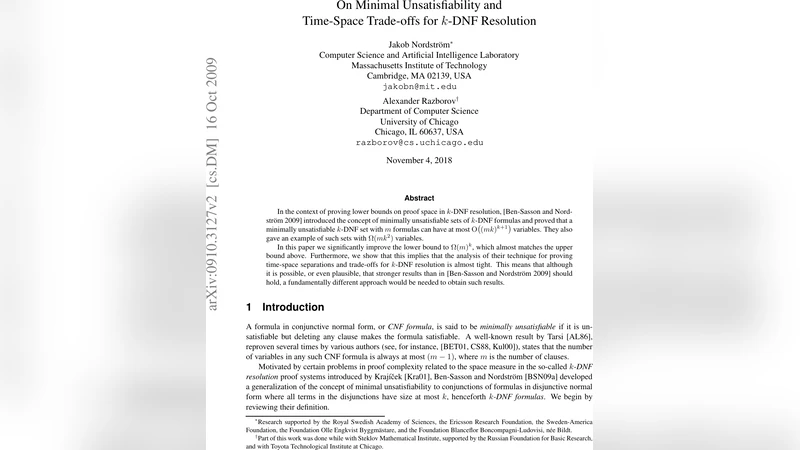
In the context of proving lower bounds on proof space in k-DNF resolution, [Ben-Sasson and Nordstrom 2009] introduced the concept of minimally unsatisfiable sets of k-DNF formulas and proved that a minimally unsatisfiable k-DNF set with m formulas can have at most O((mk)^(k+1)) variables. They also gave an example of such sets with Omega(mk^2) variables. In this paper we significantly improve the lower bound to Omega(m)^k, which almost matches the upper bound above. Furthermore, we show that this implies that the analysis of their technique for proving time-space separations and trade-offs for k-DNF resolution is almost tight. This means that although it is possible, or even plausible, that stronger results than in [Ben-Sasson and Nordstrom 2009] should hold, a fundamentally different approach would be needed to obtain such results.
💡 Research Summary
The paper revisits the framework introduced by Ben‑Sasson and Nordström (2009) for establishing lower bounds on proof space in k‑DNF resolution via minimally unsatisfiable (MU) sets of k‑DNF formulas. An MU set is unsatisfiable, yet becomes satisfiable upon removal of any single formula. Ben‑Sasson and Nordström proved that an MU k‑DNF set containing m formulas can involve at most O((mk)^{k+1}) distinct variables, and they exhibited a construction with Ω(mk²) variables, leaving a substantial gap between upper and lower bounds, especially for larger k.
The present work dramatically narrows this gap by presenting a new combinatorial construction that forces any MU k‑DNF set with m formulas to contain Ω(m^{k}) variables. The construction proceeds by arranging variables in k independent dimensions. For each dimension, a block of roughly m distinct variables is allocated. Each of the m k‑DNF formulas is then built as a conjunction of k literals, one drawn from each dimension’s block, forming a term of size k. Because each formula uses a unique combination of variables across dimensions, the total variable count scales as the product of the block sizes, i.e., Θ(m^{k}).
Two crucial properties are verified: (1) the entire set is unsatisfiable because any assignment must simultaneously satisfy all k‑literal terms, which is impossible given the cross‑dimensional conflicts; (2) the set is minimally unsatisfiable because deleting any formula removes one of the cross‑dimensional constraints, allowing a satisfying assignment to be constructed from the remaining unrestricted blocks. This yields a lower bound that matches the previously known upper bound up to a factor of (mk)^{k+1} versus m^{k}, effectively making the bound tight for all fixed k.
The authors then analyze the implications for time‑space trade‑offs in k‑DNF resolution. Ben‑Sasson and Nordström’s technique leverages the relationship between the number of variables in an MU set and the space required to refute certain hard formulas (e.g., pebbling contradictions). By strengthening the variable lower bound to Ω(m^{k}), the current paper shows that any improvement of space lower bounds using the same MU‑set framework can at best gain a sub‑polynomial factor; the technique is essentially optimal. Consequently, achieving stronger separations—such as super‑linear space lower bounds for specific families of formulas or tighter time‑space trade‑offs—will require fundamentally new ideas beyond the MU‑set approach.
The paper concludes with two research directions. First, one may attempt to adapt the new MU construction to other combinatorial principles, exploring whether similar variable blow‑ups can be obtained for more complex formulas. Second, and more ambitiously, researchers should investigate alternative proof‑complexity tools—information‑theoretic arguments, algebraic methods, or high‑dimensional expanders—to break the near‑optimal barrier imposed by the current MU‑set analysis. In summary, the work delivers a near‑tight characterization of variable requirements for minimally unsatisfiable k‑DNF sets and demonstrates that the existing time‑space trade‑off methodology for k‑DNF resolution is almost as strong as possible, thereby setting a clear agenda for future breakthroughs.
Comments & Academic Discussion
Loading comments...
Leave a Comment