The intersection of two halfspaces has high threshold degree
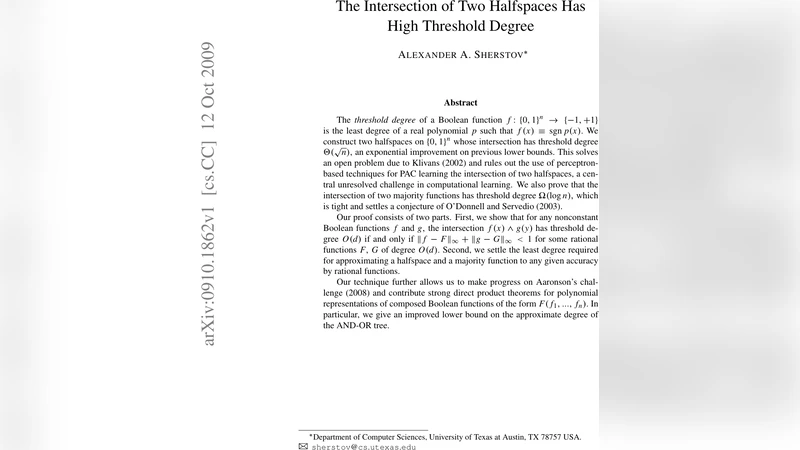
The threshold degree of a Boolean function f:{0,1}^n->{-1,+1} is the least degree of a real polynomial p such that f(x)=sgn p(x). We construct two halfspaces on {0,1}^n whose intersection has threshold degree Theta(sqrt n), an exponential improvement on previous lower bounds. This solves an open problem due to Klivans (2002) and rules out the use of perceptron-based techniques for PAC learning the intersection of two halfspaces, a central unresolved challenge in computational learning. We also prove that the intersection of two majority functions has threshold degree Omega(log n), which is tight and settles a conjecture of O’Donnell and Servedio (2003). Our proof consists of two parts. First, we show that for any nonconstant Boolean functions f and g, the intersection f(x)^g(y) has threshold degree O(d) if and only if ||f-F||_infty + ||g-G||_infty < 1 for some rational functions F, G of degree O(d). Second, we settle the least degree required for approximating a halfspace and a majority function to any given accuracy by rational functions. Our technique further allows us to make progress on Aaronson’s challenge (2008) and contribute strong direct product theorems for polynomial representations of composed Boolean functions of the form F(f_1,…,f_n). In particular, we give an improved lower bound on the approximate degree of the AND-OR tree.
💡 Research Summary
The paper investigates the threshold degree (deg±) of Boolean functions, focusing on the intersection of two halfspaces on the Boolean hypercube {0,1}ⁿ. The threshold degree is the smallest degree of a real polynomial p such that f(x)=sgn p(x) for every input. High threshold degree implies hardness for several computational models, including PAC learning via perceptrons, circuit lower bounds, and communication complexity.
The authors first establish general direct‑product theorems. Theorem 1.1 shows that for any Boolean outer function F:{−1,+1}ᵏ→{−1,+1} and inner function f:X→{−1,+1}, the composed function F(f,…,f) satisfies deg±(F∘f) ≥ deg±(F)·deg±(f). Theorem 1.2 extends this to the ε‑approximate degree deg_ε, proving deg_ε(F∘f) ≥ deg_ε(F)·deg±(f). These results generalize the known XOR‑lemma and are tight for parity and other symmetric functions.
The second major contribution is a characterization of conjunctions (AND) via rational approximation. Theorem 1.4 proves that if the conjunction f∧g has threshold degree d, then there exist rational functions p₁/q₁ and p₂/q₂ of degree O(d) that ε‑approximate f and g respectively with total error <1. Consequently, the simple construction based on rational approximations (originally due to Beigel et al.) is optimal up to a constant factor; no clever polynomial can beat the 4d bound obtained from the rational representation.
Armed with this tool, the paper studies rational approximation of two fundamental Boolean functions:
-
Canonical halfspace (the “standard” halfspace f(x)=sgn(1+∑{i,j}2^{i}x{ij})). Theorem 1.6 shows that for any constant ε∈(1/3,1), the rational degree rdeg_ε(f) is Θ(n). The upper bound follows from Newman’s classic construction; the lower bound requires a new discrete analysis that adapts continuous rational approximation techniques to the hypercube.
-
Majority function MAJₙ. Theorem 1.7 gives a tight expression for rdeg_ε(MAJₙ): it is Θ(log n) for constant ε, and grows as Θ(log n·log(1/ε)) when ε becomes very small. The upper bound is essentially known; the novelty lies in matching lower bounds derived via careful symmetrization and dual polynomial arguments.
Using these approximation lower bounds together with Theorem 1.4, the authors prove the central result (Theorem 1.8): the intersection of two independent copies of the canonical halfspace has threshold degree Θ(√n). This resolves an open problem posed by Klivans (2002), which asked whether the intersection of two halfspaces could have only logarithmic threshold degree. The √n lower bound matches the known upper bound from Beigel et al., establishing optimality. As a corollary, any PAC learning algorithm that relies on low‑degree perceptron representations (i.e., linear programming over weight vectors) cannot learn the intersection of two halfspaces in sub‑exponential time.
The paper also applies the framework to the AND‑OR tree function f(x)=∧{i=1}^n ∨{j=1}^n x_{ij}. By combining the direct‑product theorem with rational approximation of halfspaces, the authors improve the previous lower bound on its ε‑approximate degree from Ω(n^{0.66}) to Ω(n^{0.75}), narrowing the gap to the trivial O(n) upper bound.
In summary, the work introduces a powerful combination of direct‑product theorems and rational‑approximation techniques to analyze the threshold degree of composed Boolean functions. It settles the long‑standing question about the complexity of intersecting two halfspaces, provides tight rational‑approximation bounds for halfspaces and majority, and yields stronger lower bounds for classic composed functions such as the AND‑OR tree. These results have immediate implications for learning theory (ruling out perceptron‑based PAC learning of two halfspaces), circuit complexity (high threshold degree implies lower bounds for threshold circuits), and communication complexity (via the degree/discrepancy connection).
Comments & Academic Discussion
Loading comments...
Leave a Comment