Pixel multiplexing for high-speed multi-resolution fluorescence imaging
We introduce a imaging modality that works by transiently masking image-subregions during a single exposure of a CCD frame. By offsetting subregion exposure time, temporal information is embedded with
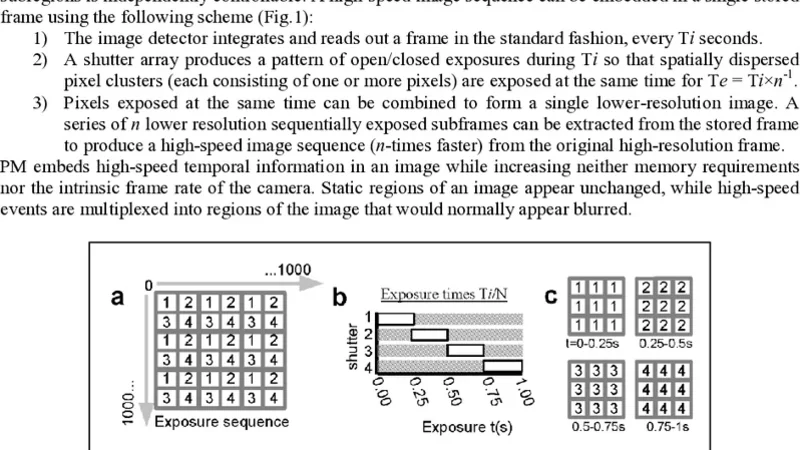
We introduce a imaging modality that works by transiently masking image-subregions during a single exposure of a CCD frame. By offsetting subregion exposure time, temporal information is embedded within each stored frame, allowing simultaneous acquisition of a full high spatial resolution image and a high-speed image sequence without increasing bandwidth. The technique is demonstrated by imaging calcium transients in heart cells at 250 Hz with a 10 Hz megapixel camera.
💡 Research Summary
The paper introduces a novel imaging technique called Pixel Multiplexing (PM) that embeds temporal information within a single CCD frame by transiently masking different sub‑regions of the sensor during exposure. Instead of exposing the entire sensor uniformly, a fast spatial light modulator (e.g., a digital micromirror device) or an electronic shutter array sequentially opens small blocks of pixels for short, staggered intervals. As a result, each block records a brief snapshot of the scene while the whole frame integrates over a longer total exposure. After acquisition, two complementary data sets can be reconstructed: (1) a full‑resolution static image obtained by summing all blocks, preserving the original spatial detail, and (2) a low‑resolution high‑speed video sequence derived from the time‑ordered blocks, providing frame rates far beyond the native camera speed without increasing data bandwidth.
The authors detail the hardware implementation, calibration procedures to correct for non‑uniform exposure, and the trade‑off between block size (spatial resolution) and temporal resolution. In their demonstration, a 10 Hz, 1‑megapixel camera is equipped with a DMD that divides the sensor into 4 × 4 pixel blocks. Each block is exposed for 4 ms in a 40 ms overall frame, effectively delivering a 250 Hz temporal sampling of calcium‑sensitive fluorescence in cultured heart cells. The resulting high‑speed sequence captures rapid calcium transients with the same fidelity as a dedicated high‑speed camera, while the summed image retains cellular morphology at megapixel resolution.
Key advantages of PM include: (i) no need for faster sensor readout or larger data pipelines, (ii) compatibility with existing imaging platforms, (iii) the ability to simultaneously acquire high‑resolution structural information and high‑speed functional dynamics, and (iv) scalability to multi‑spectral or three‑dimensional imaging modalities. The paper also discusses limitations such as the requirement for precise synchronization between the mask and sensor, potential cross‑talk between adjacent blocks, and the reduction of signal‑to‑noise ratio when block sizes become very small.
Future directions suggested by the authors involve increasing mask refresh rates, adaptive block sizing based on scene content, and integrating machine‑learning reconstruction algorithms to further improve image quality under low‑light conditions. By merging temporal multiplexing with conventional imaging hardware, Pixel Multiplexing offers a cost‑effective pathway to capture fast biological processes, industrial events, or any application where both high spatial detail and high temporal resolution are essential.
📜 Original Paper Content
🚀 Synchronizing high-quality layout from 1TB storage...