Compressed Blind De-convolution
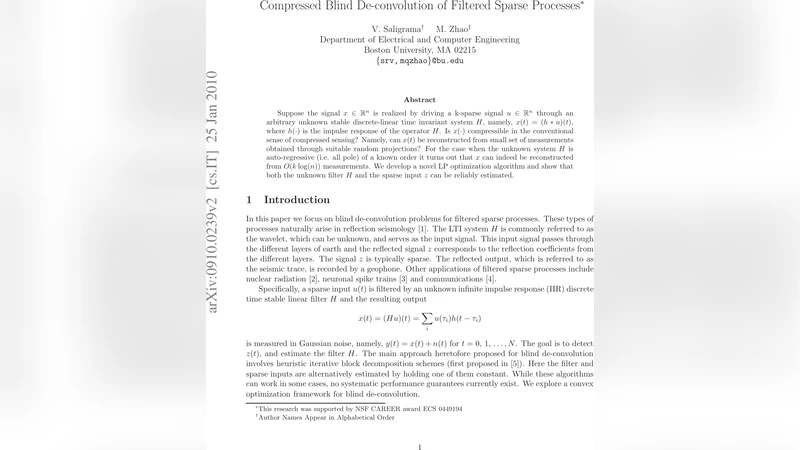
Suppose the signal x is realized by driving a k-sparse signal u through an arbitrary unknown stable discrete-linear time invariant system H. These types of processes arise naturally in Reflection Seismology. In this paper we are interested in several problems: (a) Blind-Deconvolution: Can we recover both the filter $H$ and the sparse signal $u$ from noisy measurements? (b) Compressive Sensing: Is x compressible in the conventional sense of compressed sensing? Namely, can x, u and H be reconstructed from a sparse set of measurements. We develop novel L1 minimization methods to solve both cases and establish sufficient conditions for exact recovery for the case when the unknown system H is auto-regressive (i.e. all pole) of a known order. In the compressed sensing/sampling setting it turns out that both H and x can be reconstructed from O(k log(n)) measurements under certain technical conditions on the support structure of u. Our main idea is to pass x through a linear time invariant system G and collect O(k log(n)) sequential measurements. The filter G is chosen suitably, namely, its associated Toeplitz matrix satisfies the RIP property. We develop a novel LP optimization algorithm and show that both the unknown filter H and the sparse input u can be reliably estimated.
💡 Research Summary
The paper tackles a joint blind de‑convolution and compressed‑sensing problem that arises naturally in reflection seismology and other applications where a sparse source drives an unknown linear time‑invariant (LTI) system. The authors assume that the source signal (u\in\mathbb{R}^n) is (k)-sparse and that the unknown system (H) is stable, causal, and can be modeled as an all‑pole (autoregressive, AR) filter of known order (p). The observed signal is the convolution (x = H * u), possibly corrupted by additive white Gaussian noise. Two fundamental questions are posed: (a) can we recover both the filter (H) and the sparse input (u) from noisy measurements (blind de‑convolution); and (b) can we do so from a number of measurements far smaller than the ambient dimension, i.e., in a compressed‑sensing regime?
Key methodological contributions
-
Lifted formulation – By exploiting the AR structure, the convolution can be written as a bilinear map between the AR coefficients (\theta) (the parameters of (H)) and the sparse vector (u). Introducing the rank‑one matrix (Z = \theta u^{\top}) lifts the bilinear problem to a linear one in the higher‑dimensional space of matrices. Recovery of (\theta) and (u) thus reduces to recovering a rank‑one, row‑sparse matrix (Z).
-
RIP‑Toeplitz measurement operator – Classical compressed‑sensing theory guarantees exact recovery when the measurement matrix satisfies the Restricted Isometry Property (RIP). Random Gaussian matrices have this property but are impractical for physical acquisition. The authors propose to pass the signal (x) through a second LTI system (G) whose impulse response is designed so that the resulting measurement operator (\Phi) is a Toeplitz matrix with RIP. Because a Toeplitz matrix corresponds to convolution with a known kernel, it can be implemented by simple sequential sampling, making the approach attractive for real‑time acquisition in seismology.
-
Linear‑programming (LP) recovery algorithm – With (\Phi) in hand, the authors formulate two convex programs. The first solves an (\ell_1) minimization problem on the vectorized lifted matrix (\operatorname{vec}(Z)) subject to the measurement constraints (\Phi\operatorname{vec}(Z)=y) (where (y) are the sequential measurements). An additional trace or nuclear‑norm constraint enforces the rank‑one structure. The second LP extracts (\theta) and (u) from the optimal (Z) by a simple factorization (e.g., singular‑value decomposition) and a subsequent sparsity‑promoting refinement. Both programs are standard linear programs and can be solved efficiently with off‑the‑shelf solvers.
-
Theoretical guarantees – The paper proves that if the support of the sparse input is “well‑distributed” (i.e., no long clusters of non‑zeros) and if the AR order (p) is known, then with high probability the Toeplitz matrix (\Phi) satisfies a ((2k,\delta))-RIP for (\delta<\sqrt{2}-1) provided the number of measurements (m) scales as (O(k\log n)). Under this condition, the LP solution recovers the exact pair ((\theta,u)) in the noiseless case. In the presence of Gaussian noise of variance (\sigma^2), the reconstruction error obeys \
Comments & Academic Discussion
Loading comments...
Leave a Comment