An introduction to effective low-energy Hamiltonians in condensed matter physics and chemistry
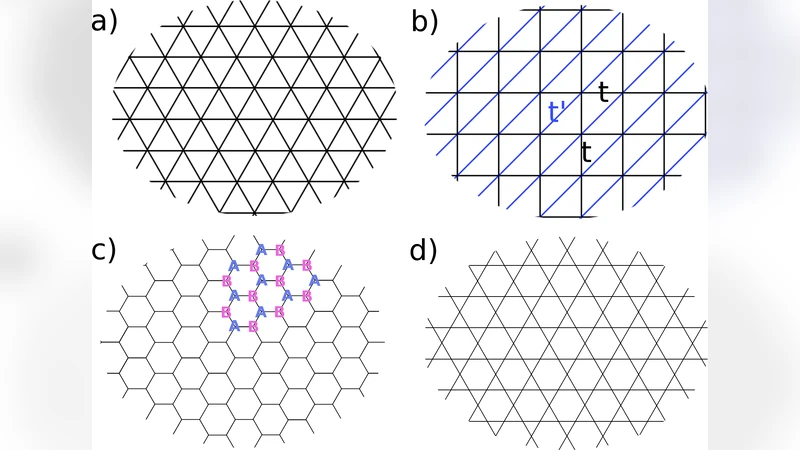
These lecture notes introduce some simple effective Hamiltonians (also known as semi-empirical models) that have widespread applications to solid state and molecular systems. They are aimed as an introduction to a beginning graduate student. I also hope that it may help to break down the divide between the physics and chemistry literatures. After a brief introduction to second quantisation notation, which is used extensively, I focus of the “four H’s”: the Huckel (or tight binding), Hubbard, Heisenberg and Holstein models. Some other related models, such as the Pariser-Parr-Pople model, the extended Hubbard model, multi-orbital models and the ionic Hubbard model, are also discussed. Finally, I discuss the epistemological basis of effective Hamiltonians and compare and contrast this with that of ab initio methods as well as discussing the problem of parametrising effective Hamiltonians.
💡 Research Summary
The manuscript serves as a pedagogical bridge between condensed‑matter physics and quantum chemistry by presenting a concise yet comprehensive introduction to low‑energy effective Hamiltonians, often called semi‑empirical models. After a brief refresher on second‑quantization formalism—creation and annihilation operators, anticommutation relations, and normal ordering—the author focuses on four cornerstone models, colloquially termed the “four H’s”: the Hückel (or tight‑binding) model, the Hubbard model, the Heisenberg model, and the Holstein model.
The Hückel/tight‑binding model is introduced as the simplest description of itinerant electrons on a lattice, retaining only on‑site energies (ε) and nearest‑neighbour hopping amplitudes (t). The author explains how these parameters can be extracted from experimental band‑structure data (e.g., ARPES) or from higher‑level ab‑initio calculations, emphasizing the model’s utility for qualitative insight into band dispersion and orbital symmetry.
The Hubbard model builds on this foundation by adding an on‑site Coulomb repulsion term U. The manuscript discusses the physics of the Mott transition, the emergence of local moments, and the strong‑coupling limit (t≪U) where charge fluctuations are frozen. In this limit, a canonical transformation yields an effective spin‑exchange interaction J≈4t²/U, naturally leading to the Heisenberg model.
The Heisenberg Hamiltonian, expressed in terms of spin operators with exchange constant J and optional Zeeman term h, is presented as the low‑energy description of localized magnetic moments. The author outlines its relevance to antiferromagnetism, quantum spin liquids, and critical phenomena, and briefly mentions analytical and numerical solution techniques (Bethe ansatz, spin‑wave theory, quantum Monte Carlo).
The Holstein model introduces a local electron‑phonon coupling g between electrons and dispersionless (Einstein) phonons of frequency ω₀. By performing a Lang‑Firsov transformation, the author shows how the model can generate an effective attractive interaction between electrons, providing a microscopic route to polaron formation and, in certain regimes, to bipolaronic superconductivity.
Beyond the core quartet, the notes survey several extensions: the Pariser‑Parr‑Pople (PPP) model for π‑conjugated systems, which incorporates long‑range Coulomb terms; the extended Hubbard model with nearest‑neighbour interaction V; multi‑orbital Hubbard formulations that capture orbital degeneracy and Hund’s coupling; and the ionic Hubbard model that adds a staggered on‑site potential Δ to study charge‑order phenomena. For each, the author highlights typical parameter regimes, physical phenomena captured, and representative material classes.
A substantial portion of the paper is devoted to the epistemology of effective Hamiltonians. The author contrasts “top‑down” ab‑initio approaches—density‑functional theory, GW, quantum‑chemical wave‑function methods—with “bottom‑up” model building, where physical intuition guides the selection of relevant degrees of freedom and interaction terms. Parameterisation strategies are discussed in depth: (i) fitting to experimental observables (spectroscopy, transport, magnetic susceptibility); (ii) mapping from high‑level calculations via downfolding or constrained random‑phase approximation; and (iii) emerging machine‑learning techniques that infer model parameters from large datasets. The author argues that a judicious combination of these methods can yield models that are both predictive and computationally tractable.
In conclusion, the manuscript provides a clear roadmap for graduate students to master the construction, solution, and interpretation of low‑energy effective Hamiltonians, emphasizing their role as indispensable tools for bridging the gap between detailed electronic structure calculations and the emergent collective phenomena observed in real materials.
Comments & Academic Discussion
Loading comments...
Leave a Comment