Communities in Networks
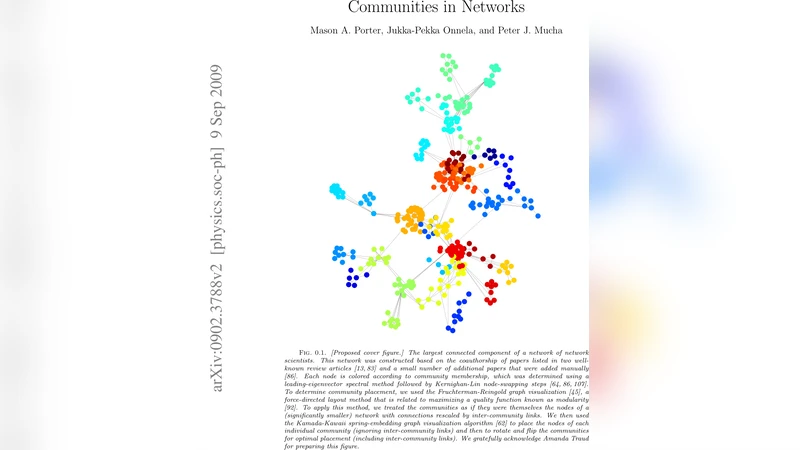
We survey some of the concepts, methods, and applications of community detection, which has become an increasingly important area of network science. To help ease newcomers into the field, we provide a guide to available methodology and open problems, and discuss why scientists from diverse backgrounds are interested in these problems. As a running theme, we emphasize the connections of community detection to problems in statistical physics and computational optimization.
💡 Research Summary
The paper “Communities in Networks” offers a comprehensive survey of the rapidly growing field of community detection, positioning it as a central problem in network science that bridges disciplines ranging from sociology and biology to physics and computer science. It begins by defining what a community is, distinguishing between structural definitions—based on edge density, modularity, and cut size—and dynamical definitions that rely on processes such as random walks, diffusion, or synchronization to reveal groups where a dynamical flow tends to stay longer. The authors argue that both perspectives are complementary and that robust community identification often benefits from integrating them.
The core of the survey is an organized taxonomy of existing methodologies. Classical hierarchical clustering (both agglomerative and divisive) is presented as a baseline, followed by spectral clustering, which leverages the eigenvectors of the graph Laplacian to embed nodes in a low‑dimensional space before applying a simple clustering algorithm such as k‑means. The authors note the computational trade‑offs of spectral methods, especially for very large graphs.
Probabilistic graph models receive extensive treatment. The stochastic block model (SBM) and its extensions (degree‑corrected SBM, mixed‑membership SBM, multilayer SBM) are described as generative frameworks that treat communities as latent blocks governing edge probabilities. Bayesian inference and variational approximations enable simultaneous estimation of the number of blocks and model parameters, thereby mitigating over‑fitting and allowing principled model selection.
Optimization‑based approaches are highlighted as the most widely used in practice. Modularity maximization, despite being NP‑hard, is tackled with scalable heuristics such as the Louvain method, its refinement Leiden algorithm, and information‑theoretic alternatives like Infomap. The paper explains how these heuristics iteratively improve a quality function, compress the graph, and repeat, achieving near‑linear time performance on networks with millions of nodes.
A distinctive contribution of the survey is its emphasis on the deep connections to statistical physics. Community detection can be mapped onto spin‑glass models where each node is a spin and edges encode pairwise interactions. Energy minimization corresponds to finding a high‑modularity partition, and temperature becomes a tunable resolution parameter: low temperatures favor fine‑grained, small communities, while high temperatures merge them into larger structures. The authors discuss phase‑transition phenomena, metastable states, and how concepts such as replica symmetry breaking provide insight into algorithmic hardness.
The paper then surveys a wide array of applications. In social networks, community detection uncovers political factions, interest groups, and diffusion pathways. In biological networks, it isolates functional modules of proteins or genes, aiding disease‑mechanism discovery. Infrastructure networks (power grids, transportation) benefit from community‑based vulnerability analysis and resilience planning. Text and image analysis exploit co‑occurrence or pixel graphs to derive topics or semantic regions. For each domain, the authors stress the importance of matching data characteristics—weights, directionality, multilayer structure—to the appropriate detection technique.
Finally, the authors outline several open challenges that define the frontier of the field. First, dynamic and temporal networks require methods that can track evolving communities while preserving temporal smoothness and detecting change points. Second, multilayer and multimodal networks demand integrated models that capture inter‑layer dependencies rather than treating layers independently. Third, detecting statistically significant small communities in scale‑free networks remains difficult due to the lack of appropriate null models. Fourth, interpretability is a growing concern: many high‑performing algorithms (e.g., deep‑learning‑based embeddings) act as black boxes, and there is a need for methods that provide clear explanations for why a node belongs to a particular community. Fifth, real‑time streaming data call for online algorithms that update community assignments incrementally without recomputing from scratch. The paper concludes that progress on these fronts will likely arise from interdisciplinary collaborations that blend statistical‑physics insights, combinatorial optimization, and modern machine‑learning techniques.
Comments & Academic Discussion
Loading comments...
Leave a Comment