Campbell diagrams of weakly anisotropic flexible rotors
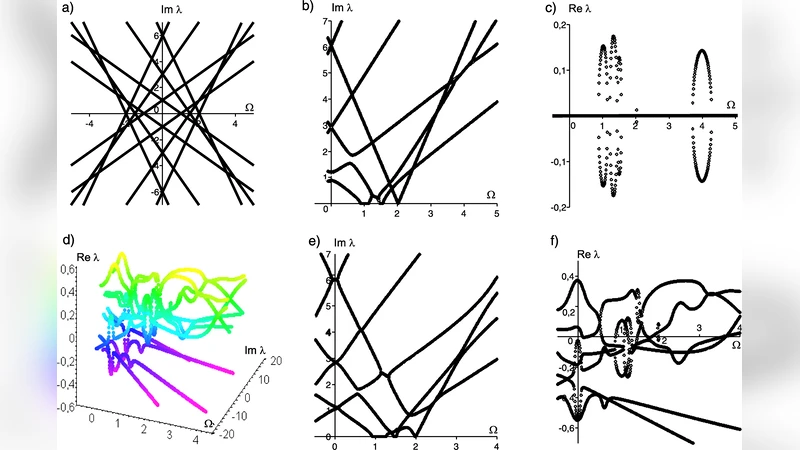
We consider an axi-symmetric rotor perturbed by dissipative, conservative, and non-conservative positional forces originated at the contact with the anisotropic stator. The Campbell diagram of the unperturbed system is a mesh-like structure in the frequency-speed plane with double eigenfrequencies at the nodes. The diagram is convenient for the analysis of the traveling waves in the rotating elastic continuum. Computing sensitivities of the doublets we find that at every particular node the untwisting of the mesh into the branches of complex eigenvalues in the first approximation is generically determined by only four 2x2 sub-blocks of the perturbing matrix. Selection of the unstable modes that cause self-excited vibrations in the subcritical speed range, is governed by the exceptional points at the corners of the singular eigenvalue surfaces–double coffee filter' and viaduct’–which are associated with the crossings of the unperturbed Campbell diagram with the definite Krein signature. The singularities connect the problems of wave propagation in the rotating continua with that of electromagnetic and acoustic wave propagation in non-rotating anisotropic chiral media. As mechanical examples a model of a rotating shaft with two degrees of freedom and a continuous model of a rotating circular string passing through the eyelet are studied in detail.
💡 Research Summary
The paper investigates the dynamic behavior of an axially symmetric rotor that is weakly perturbed by forces arising at the contact with an anisotropic stator. Three types of forces are considered: dissipative (energy‑losing), conservative (energy‑preserving), and non‑conservative positional forces (e.g., follower forces). In the unperturbed case the rotor’s natural frequencies are double‑valued (doublets) because forward‑ and backward‑travelling wave modes have identical frequencies. When plotted in the speed‑frequency plane, these doublets produce a mesh‑like Campbell diagram: a regular lattice of straight lines intersecting at nodes where the eigenfrequencies coincide.
The authors apply eigenvalue sensitivity theory to the perturbed system. They show that, at each node of the mesh, the first‑order splitting of the double eigenvalue into a pair of complex eigenvalues is governed by only four 2 × 2 sub‑blocks of the full perturbation matrix. In other words, the high‑dimensional perturbation reduces, to leading order, to the action of four small blocks that “untwist’’ the mesh. This result dramatically simplifies stability analysis for large‑degree‑of‑freedom rotors.
A central concept is the Krein signature, which classifies modes by the sign of their associated energy. When a node lies on a branch of the Campbell diagram that carries a definite Krein signature, the perturbation can generate two characteristic singularities on the eigenvalue surface:
- Double coffee‑filter – a pair of eigenvalue sheets intersect and then separate along the real axis, resembling the shape of a coffee filter.
- Viaduct – a bridge‑like connection between two sheets, where the eigenvalues pass through a narrow “bridge’’ in the complex plane.
Both singularities correspond to exceptional points (EPs) where eigenvectors coalesce. Near these EPs, even a small non‑conservative positional force can push one of the eigenvalues into the right half of the complex plane, producing self‑excited vibration at subcritical speeds (i.e., below the classical critical speed). Thus, the selection of unstable modes is dictated by the geometry of the EPs at the corners of the singular eigenvalue surfaces.
The paper draws an intriguing parallel between the rotating‑continuum problem and wave propagation in non‑rotating anisotropic chiral media (electromagnetic or acoustic). The same double coffee‑filter and viaduct structures appear in the dispersion relations of such media, indicating a deep mathematical analogy between rotating mechanical systems and static chiral waveguides.
Two mechanical examples are worked out in detail.
-
Two‑degree‑of‑freedom rotating shaft – a minimal model with mass, stiffness, and damping matrices, augmented by a 2 × 2 anisotropic coupling representing the stator contact. Numerical continuation of eigenvalues confirms that the four 2 × 2 sub‑blocks control the splitting and that EPs of the double coffee‑filter and viaduct type arise at specific speeds.
-
Rotating circular string passing through an eyelet – a continuous model described by a partial differential equation with anisotropic boundary conditions at the eyelet. Modal expansion yields an infinite‑dimensional eigenvalue problem; truncation and sensitivity analysis again reveal that only a few low‑order coupling coefficients dominate the complex splitting. The Campbell diagram exhibits the same mesh pattern, and the same types of EPs govern the onset of subcritical flutter.
Overall, the study provides a rigorous framework for predicting and interpreting self‑excited vibrations in weakly anisotropic rotors. By isolating the decisive 2 × 2 sub‑blocks and identifying the exceptional‑point geometry, engineers can assess the risk of subcritical instability without exhaustive high‑dimensional simulations. The work also opens a pathway for cross‑disciplinary research, linking rotor dynamics with the physics of chiral wave propagation in optics and acoustics.
Comments & Academic Discussion
Loading comments...
Leave a Comment