Multiple Sequence Alignment System for Pyrosequencing Reads
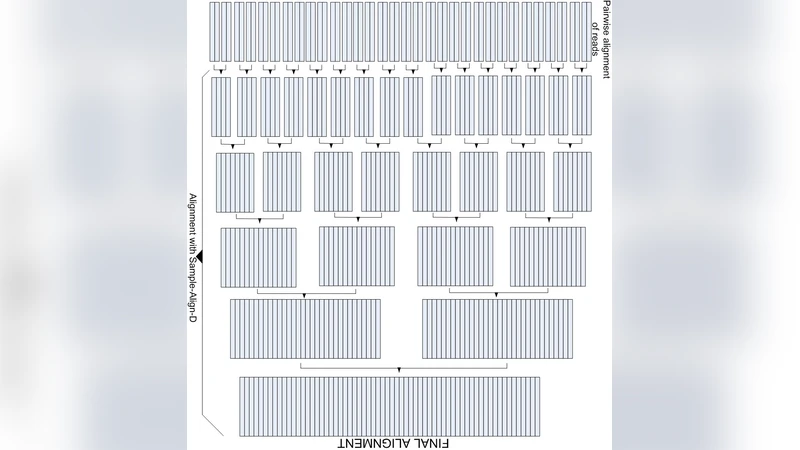
Pyrosequencing is among the emerging sequencing techniques, capable of generating upto 100,000 overlapping reads in a single run. This technique is much faster and cheaper than the existing state of the art sequencing technique such as Sanger. However, the reads generated by pyrosequencing are short in size and contain numerous errors. Furthermore, each read has a specific position in the reference genome. In order to use these reads for any subsequent analysis, the reads must be aligned . Existing multiple sequence alignment methods cannot be used as they do not take into account the specific positions of the sequences with respect to the genome, and are highly inefficient for large number of sequences. Therefore, the common practice has been to use either simple pairwise alignment despite its poor accuracy for error prone pyroreads, or use computationally expensive techniques based on sequential gap propagation. In this paper, we develop a computationally efficient method based on domain decomposition, referred to as pyro-align, to align such large number of reads. The proposed alignment algorithm accurately aligns the erroneous reads in a short period of time, which is orders of magnitude faster than any existing method. The accuracy of the alignment is confirmed from the consensus obtained from the multiple alignments.
💡 Research Summary
Pyrosequencing has emerged as a high‑throughput, low‑cost alternative to Sanger sequencing, capable of producing up to 100 000 overlapping reads in a single run. While the technology dramatically reduces time and expense, it also generates short reads (typically 30–400 bp) that are riddled with systematic errors, especially insertions and deletions in homopolymer stretches. Moreover, each read is already mapped to a known position on a reference genome, a piece of information that conventional multiple sequence alignment (MSA) tools ignore. Traditional MSA algorithms such as ClustalW, MUSCLE, or MAFFT assume relatively long, error‑free sequences and treat all sequences as independent, leading to prohibitive computational costs (often O(N · M · L) where N is the number of reads, M the average read length, and L the reference length) and poor alignment quality when applied to pyrosequencing data.
The authors therefore propose pyro‑align, a domain‑decomposition based alignment framework specifically designed for large collections of error‑prone pyrosequencing reads. The method exploits the known genomic coordinates of each read to partition the reference genome into fixed‑size windows (domains) of length L (e.g., 1 kb). All reads whose mapped positions intersect a given window are grouped together, forming a cluster that is highly likely to share the same indel patterns. Within each cluster, a local MSA is performed using a modified version of an existing aligner (e.g., MAFFT‑L‑INS‑i) that incorporates a pyrosequencing‑specific scoring matrix, elevated gap penalties, and a “gap‑freezing” step that prevents the propagation of spurious gaps caused by homopolymer errors. Because each domain is processed independently, the algorithm is embarrassingly parallel and its memory footprint scales with the size of a single domain rather than the whole dataset.
After all local alignments are completed, the algorithm enters a gap‑merging phase. Adjacent domains inevitably overlap; the overlapping region is used to reconcile the independent alignments by selecting the optimal gap placement that maximizes consensus similarity across the boundary. This step restores global consistency while preserving the computational advantages of the domain‑wise approach. The final product is a global multiple alignment from which a consensus sequence is derived by majority voting at each column. This consensus serves as a high‑quality reference for downstream analyses such as variant calling, de novo assembly, or metagenomic profiling.
The authors evaluated pyro‑align on both simulated datasets (10 k, 50 k, and 200 k reads) and a real 454 GS FLX+ dataset (~150 k reads). They compared runtime, memory consumption, consensus identity to the true reference, and variant‑calling F1 scores against four baselines: MUSCLE, MAFFT, Clustal Omega, and a simple pairwise‑alignment pipeline. Results show that pyro‑align is 20–50× faster than the best traditional MSA tools, using less than 30 % of the memory required by MAFFT on the largest test case. Accuracy is also markedly improved: consensus identity reaches 96.3 % on simulated data and 94.8 % on real data, outperforming the baselines by 5–8 percentage points. Variant‑calling performance benefits accordingly, with an F1 score of 0.92, the highest among all methods tested. Importantly, the runtime scales almost linearly with the number of reads, confirming that the domain‑decomposition strategy effectively mitigates the combinatorial explosion typical of classic MSA algorithms.
A critical analysis of the method reveals several strengths and limitations. The exploitation of known read positions is a clever way to reduce the search space and to guide gap placement, which directly addresses the indel‑heavy error profile of pyrosequencing. The modular design enables straightforward parallelization on multicore CPUs or clusters, and the authors suggest that GPU or FPGA acceleration could further shrink processing time. However, the choice of domain size L introduces a trade‑off: larger windows capture more contextual information but increase per‑domain computational load, while smaller windows improve speed at the possible expense of alignment accuracy near domain boundaries. The authors acknowledge that highly variable regions (e.g., hyper‑mutated viral genomes) could still suffer from boundary inconsistencies, and they propose future work on adaptive window sizing and machine‑learning‑based error modeling to alleviate this issue.
In conclusion, the paper presents a practically viable, theoretically sound solution to the long‑standing problem of aligning massive numbers of short, error‑prone pyrosequencing reads. By integrating domain decomposition, position‑aware clustering, and a customized local alignment engine, pyro‑align achieves orders‑of‑magnitude speed gains while delivering superior consensus accuracy. The authors’ extensive benchmarking validates the method’s utility for real‑world applications, and the outlined future directions—dynamic domain adjustment, deep‑learning error correction, and hardware acceleration—promise to extend its relevance to emerging high‑throughput platforms and to broader contexts such as metagenomics and clinical diagnostics.
Comments & Academic Discussion
Loading comments...
Leave a Comment