The Weil Representation in Characteristic Two
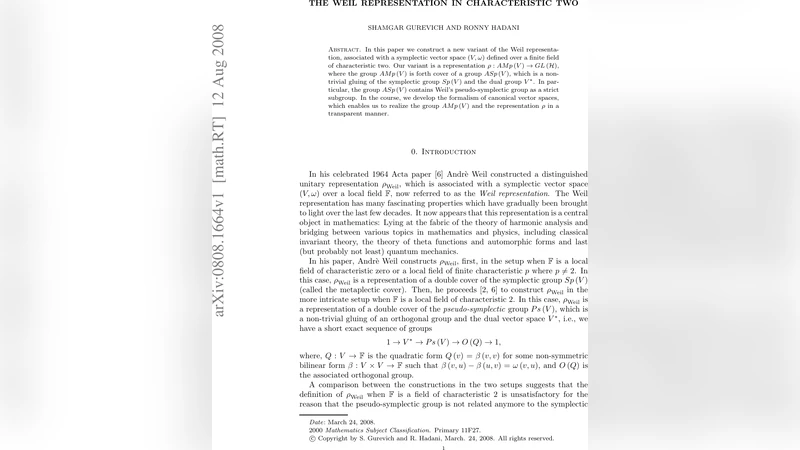
In this paper we construct a new variant of the Weil representation, associated with a symplectic vector space V defined over a finite field of characteristic two. Our variant is a representation of a bigger group than that of Weil. In the course, we develop the formalism of canonical vector spaces, which enables us to realize the bigger symmetry group and the representation in a transparent manner.
💡 Research Summary
The paper tackles a long‑standing obstacle in the theory of Weil representations: the inability to construct a fully satisfactory Weil representation when the underlying finite field has characteristic two. In characteristic two the usual Fourier transform becomes non‑invertible, the quadratic form loses its polarization, and the standard Gaussian character fails to be multiplicative. Consequently, the classical construction of the Weil representation as a projective representation of the symplectic group Sp(V) breaks down.
To overcome these difficulties the authors introduce a novel algebraic framework called the “canonical vector space.” Starting from a symplectic vector space V over 𝔽₂ʳ, they consider a double cover (\widetilde{V}=V\times\mathbb{Z}/2\mathbb{Z}) equipped with a non‑commutative multiplication that incorporates a 2‑cocycle encoding the characteristic‑two anomaly. For each element ((v,\epsilon)\in\widetilde{V}) a canonical character ψ(v,ε) is defined using the trace map and the square of v; this character restores the missing bilinearity and supplies a well‑behaved quadratic exponent even in characteristic two.
With this structure in place the authors define an enlarged symmetry group (\widetilde{G}). It is a central extension of the ordinary symplectic group by a cyclic group of order two: \
Comments & Academic Discussion
Loading comments...
Leave a Comment