Fermi at Los Alamos and the early Britains way to nuclear energy
A novel recovery of some important documents related to the Fermi course on neutron physics, held at Los Alamos in 1945, is announced. Its relevance for the effective launch of a British nuclear programme in the early postwar period, independently of the U.S. technical cooperation (precluded by the American authorities) and warmly supported by Chadwick, is discussed.
💡 Research Summary
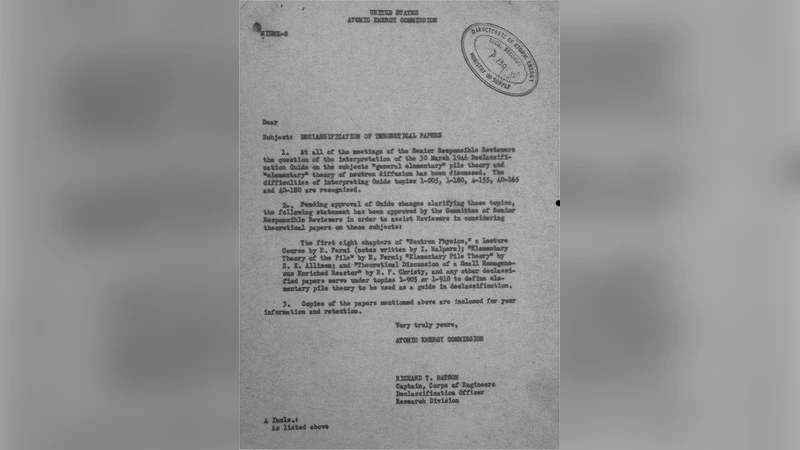
The paper reports the discovery of previously unknown documentary material concerning Enrico Fermi’s neutron‑physics course held at Los Alamos in the fall of 1945. While the “Halpern” notes—partial transcriptions of the lectures—have been known for decades and were declassified in two stages (September 1946 and 1962), the author has identified two folders in the Churchill Archive Centre in Cambridge that contain a different, more complete set of notes. Folder CHAD I 17/3 holds an AEC letter, a copy of Fermi’s “Elementary Theory of the Pile,” and the first half of the Halpern notes. Folder CHAD I 4/1 contains a full transcription made by A.P. French on 23 June 1947, a former member of the British Mission who attended the Los Alamos course as a young physicist.
The French transcription mirrors the structure of the Halpern version but is far richer in content. It includes additional calculations, experimental data, a series of exercises, and, crucially, explicit references to nuclear explosions and bomb applications in the sections dealing with chain reactions and pile physics. Certain passages reproduce Fermi’s original wording, confirming that French had direct access to the lecturer’s material, not merely to a student’s shorthand. The notes also contain detailed discussions of neutron scattering, albedo effects, and other topics that were omitted or only briefly mentioned in the Halpern version.
The significance of these documents lies in their implication for the early British nuclear programme. After the passage of the McMahon Act (Atomic Energy Act of 1946), the United States prohibited the transfer of “restricted data” to any foreign country, effectively cutting off formal technical cooperation with the United Kingdom. Nonetheless, the British Mission, led by Sir James Chadwick, remained in Los Alamos and maintained informal channels of information exchange. The French notes demonstrate that Chadwick and his team had access, as early as 1947, to the full technical content of Fermi’s lectures—including the parts that the U.S. authorities classified as “confidential.” This contradicts the common narrative that Britain’s post‑war nuclear effort was entirely hampered by American secrecy and had to start from scratch.
Chadwick’s own statements, cited in the paper, reveal his awareness of the American legislative barrier and his determination to pursue an independent British programme. The French notes supplied British scientists with a coherent, up‑to‑date treatment of neutron diffusion, pile theory, and bomb physics, enabling them to design reactors and, eventually, a weapons‑grade program without direct U.S. technical assistance. The paper argues that the French transcription was a key intellectual resource that helped bridge the knowledge gap created by the McMahon Act, supporting the “optimistic” view held by Chadwick that Britain could succeed without American help.
Beyond the historical argument, the author emphasizes the pedagogical value of the French notes. They provide a more accurate and detailed record of Fermi’s teaching style, illustrating how he combined theoretical rigor with practical examples—a resource that could enrich modern nuclear‑physics curricula. The paper calls for further comparative analysis between the French version, the Halpern notes, and the original Fermi manuscripts to uncover any additional unpublished material.
In conclusion, the newly recovered French transcription of Fermi’s 1945 Los Alamos course demonstrates that critical nuclear‑physics knowledge was already circulating within the British scientific community despite official U.S. restrictions. This finding reshapes our understanding of the early Anglo‑American nuclear relationship, highlights the importance of informal scientific networks, and offers a valuable primary source for both historians of science and educators in the field of nuclear physics.
Comments & Academic Discussion
Loading comments...
Leave a Comment