Ludwig Valentin Lorenz is the discoverer of the "Lorenz gauge"!
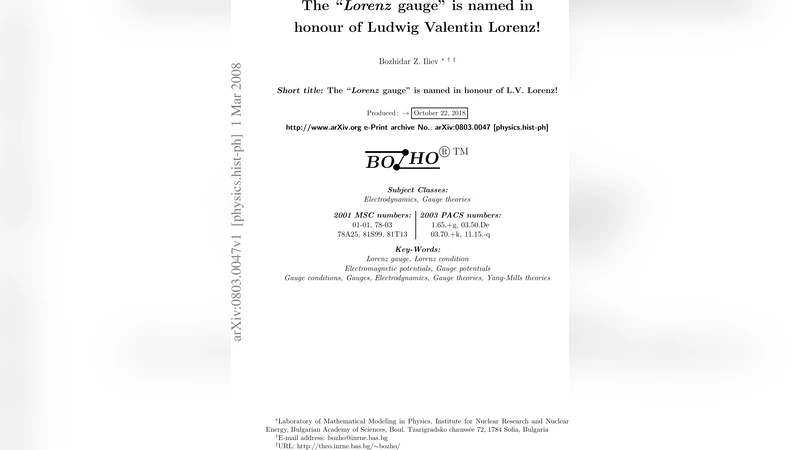
The letter reminds the historical fact that the known “Lorenz gauge” (or “Lorenz condition/relation”) is first mentioned in a written form and named after Ludwig Valentin Lorenz and not by/after Hendrik Antoon Lorentz.
💡 Research Summary
The paper by Bozhidar Z. Iliev is a concise historical note that seeks to correct a long‑standing misattribution in the terminology of electromagnetic gauge theory. The author begins by recalling the standard definition of the electromagnetic scalar and vector potentials (ϕ and A) and the freedom to impose gauge conditions on them. The most widely used condition, commonly called the “Lorentz gauge,” is written in three‑dimensional notation as ∇·A + (1/c)∂ϕ/∂t = 0 and in covariant form as ∂μAμ = 0. This condition is prized because it is Lorentz‑invariant, simplifies many calculations in classical electrodynamics, and underlies the quantization of the electromagnetic field in quantum electrodynamics.
Iliev then turns to the historical origin of this condition. He points out that the Danish physicist Ludwig Valentin Lorenz (1829–1891) published the relation in two 1867 papers: one in Annalen der Physik und Chemie (German) titled “Über die Intensität der Schwingungen des Lichts mit den elektrischen Strömen” and another in Philosophical Magazine (English) titled “On the identity of the vibrations of light with electrical currents.” Both papers contain the exact continuity‑type equation that modern textbooks attribute to Lorentz. Moreover, Iliev notes that Bernhard G. W. Riemann had already mentioned the same relation in lectures delivered in 1861, indicating that the idea was circulating among leading mathematicians and physicists of the mid‑19th century.
Despite this clear documentary evidence, the gauge condition has been widely and incorrectly referred to as the “Lorentz gauge” after Hendrik Antoon Lorentz (1853–1928), a Dutch physicist best known for the Lorentz transformations. Iliev demonstrates the prevalence of the error by presenting a systematic search of major internet databases (Google, Google Scholar, arXiv, Yahoo, AOL, Ask). Table 2.1 shows that, for the years 2005 and 2008, the phrase “Lorentz gauge” returned roughly an order of magnitude more hits than “Lorenz gauge” across all platforms, although a modest increase in the correct term’s usage is observable in the most recent three‑year window.
The paper further argues that the misnaming is not a trivial typographical slip but a systematic historical oversight that propagates through textbooks, research articles, and teaching materials. To underscore the modern relevance of the condition, Iliev briefly discusses its geometric interpretation: gauge potentials can be viewed as components of a linear connection on a vector bundle. Imposing a gauge condition such as ∂μAμ = 0 restricts the class of admissible frames (or sections) in the total bundle space, thereby linking the algebraic condition to the underlying differential‑geometric structure of gauge theories.
In the final “appeal instead of a conclusion,” Iliev urges the scientific community to restore the proper attribution. He calls for textbooks, lecture notes, and future publications to adopt the term “Lorenz gauge” and to acknowledge Ludwig Valentin Lorenz’s pioneering contribution. By doing so, the community would correct the historical record, honor the true discoverer, and promote a more accurate understanding of the development of gauge concepts in physics.
Overall, the paper combines a brief technical reminder of the gauge’s importance with a well‑documented historical analysis and a quantitative assessment of the current terminology’s misuse. Its central message is clear: the gauge condition should be named after Lorenz, not Lorentz, and the scientific literature should reflect this correction.
Comments & Academic Discussion
Loading comments...
Leave a Comment