Fractal scale-invariant and nonlinear properties of cardiac dynamics remain stable with advanced age: A new mechanistic picture of cardiac control in healthy elderly
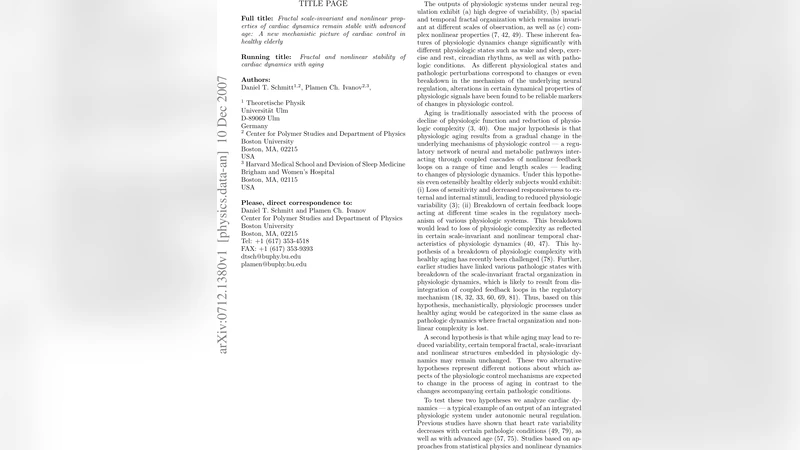
We analyze heartbeat interval recordings from two independent databases: (a) 19 healthy young (avg. age 25.7 years) and 16 healthy elderly subjects (avg. age 73.8 years) during 2h under resting conditions from the Fantasia database; and (b) 29 healthy elderly subjects (avg. age 75.9 years) during $\approx{}8$h of sleep from the SHHS database, and the same subjects recorded 5 years later. We quantify: (1) The average heart rate
💡 Research Summary
The present study set out to test the widely held notion that the fractal and nonlinear organization of heartbeat dynamics deteriorates with advanced age. To this end, the authors examined two independent, publicly available databases that together provide a broad sampling of healthy subjects across a wide age span and under different physiological conditions. The first dataset, Fantasia, contains two‑hour resting recordings from 19 young adults (mean age ≈ 25.7 years) and 16 elderly volunteers (mean age ≈ 73.8 years). The second dataset, the Sleep Heart Health Study (SHHS), comprises approximately eight‑hour nocturnal recordings from 29 elderly participants (mean age ≈ 75.9 years) and the same individuals re‑recorded five years later. By using both a short, controlled resting protocol and a long, natural‑sleep protocol, the authors increase the ecological validity of their findings and reduce the likelihood that any observed age‑related effects are artefacts of a particular experimental setting.
A comprehensive suite of quantitative descriptors was calculated for each RR‑interval time series. First, the mean RR interval (
Statistical comparisons revealed that the average heart rate (
Crucially, none of the fractal or nonlinear descriptors exhibited age‑related shifts. The DFA scaling exponent for the raw RR series, α_RR, remained around 0.9–1.0 for both age groups (p > 0.15). The sign‑based exponent α_sign and the magnitude‑based exponent α_mag were likewise stable (p > 0.2 and p > 0.3, respectively). The nonlinear fractal dimension D(k) showed no significant difference (p > 0.2). These results collectively refute the hypothesis that the intrinsic fractal organization of heartbeat intervals breaks down in healthy aging. Instead, the data support a picture in which the complex, multiscale feedback mechanisms governing cardiac autonomic control retain their structural integrity well into the eighth decade of life.
The authors acknowledge several limitations. Both databases are dominated by Western participants, limiting the generalizability of the findings to other ethnicities or cultural contexts. The five‑year follow‑up interval in SHHS, while valuable, may be insufficient to capture subtle progressive changes in cardiac control that could emerge over longer periods. Moreover, the SHHS recordings are confined to sleep, a state characterized by reduced sympathetic drive, which may mask age‑related alterations that are more evident during wakefulness or physical stress. Future work should therefore aim to include more diverse populations, extend follow‑up durations, and incorporate challenge protocols (e.g., orthostatic tilt, exercise) to probe the resilience of fractal and nonlinear cardiac dynamics under varying autonomic loads.
In summary, the study provides robust evidence that, despite a modest decline in conventional variability measures, the fractal scaling exponents (α_RR, α_sign, α_mag) and the nonlinear fractal dimension D(k) of heartbeat intervals remain remarkably stable in healthy elderly individuals. This stability implies that the underlying physiological architecture responsible for generating complex heart‑rate fluctuations is preserved with age, challenging the prevailing view of age‑related fractal degradation. Clinically, the findings suggest that assessments of cardiac health in older adults may benefit from incorporating multiscale, nonlinear metrics alongside traditional variability indices, as these may be more sensitive to pathological disruptions of autonomic control than to normal aging per se.
Comments & Academic Discussion
Loading comments...
Leave a Comment