Fibered Correspondence
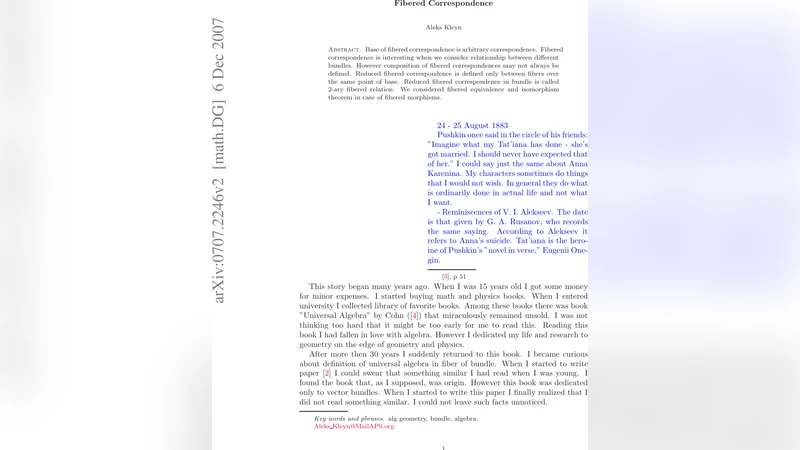
Base of fibered correspondence is arbitrary correspondence. Fibered correspondence is interesting when we consider relationship between different bundles. However composition of fibered correspondences may not always be defined. Reduced fibered correspondence is defined only between fibers over the same point of base. Reduced fibered correspondence in bundle is called 2-ary fibered relation. We considered fibered equivalence and isomorphism theorem in case of fibered morphisms.
💡 Research Summary
The paper introduces the notion of a fibered correspondence, a generalization of bundle morphisms in which the underlying base relation may be arbitrary rather than functional. Given two bundles π_E : E → B and π_F : F → B, a fibered correspondence R ⊆ E × F assigns to each point x ∈ B a relation Rₓ ⊆ Eₓ × Fₓ between the fibers over x. This framework allows a single fiber of one bundle to be related to many fibers of another, capturing many‑to‑many interactions that ordinary bundle maps cannot express.
A central difficulty is the composition of such correspondences. For two fibered correspondences R : E⇸F and S : F⇸G, the naïve composite S∘R is defined only when, for every base point x, the image of Rₓ lies inside the domain of Sₓ. In general this condition fails, so a global composition may be undefined or multivalued. To overcome this, the author defines a reduced fibered correspondence: a relation that is restricted to a single base point. Formally, a reduced correspondence consists of a family {Rₓ}ₓ∈B with each Rₓ ⊆ Eₓ × Fₓ. Because the base point is fixed, composition can be performed fiberwise, guaranteeing a well‑defined global composite. The reduced version is termed a 2‑ary fibered relation, emphasizing its similarity to ordinary binary relations but lifted to the level of fibers.
The paper proceeds to develop the elementary theory of 2‑ary fibered relations. Reflexivity, symmetry, and transitivity are defined fiberwise, and a relation satisfying all three is called a fibered equivalence. Such an equivalence partitions each fiber into equivalence classes, and the collection of these partitions yields a quotient bundle E/∼. The construction mirrors the classical quotient of a set but respects the bundle structure, preserving the projection to the base.
Next, the interaction between fibered morphisms and fibered equivalences is examined. A fibered morphism φ : E → F is a map that respects the bundle projections (π_F ∘ φ = π_E). Its kernel ker φ is the fibered equivalence consisting of all pairs (e₁, e₂) in the same fiber with φ(e₁) = φ(e₂). The image im φ is a subbundle of F consisting of all points that are φ‑images of some e ∈ E. The main result, the Fibered Isomorphism Theorem, states that the quotient bundle E/ker φ is fiberwise isomorphic to im φ. In other words, after collapsing each fiber of E along the kernel equivalence, the resulting bundle is canonically identified with the subbundle of F that φ reaches. This theorem generalizes the classical first isomorphism theorem from algebra to the setting of bundles and fibered correspondences.
The author discusses several potential applications. In the theory of group bundles, fibered equivalences can classify extensions and quotients. In topology, fibered correspondences model multi‑valued sections or relations between spaces over a common base, offering a language for describing covering relations that are not functions. Moreover, the categorical viewpoint aligns with the concept of a fibered category, suggesting that fibered correspondences could serve as morphisms in a 2‑category where objects are bundles and 1‑cells are reduced correspondences. From a computational perspective, the restriction to reduced correspondences makes algorithmic composition feasible, which may be useful in database theory, network modeling, or any domain where many‑to‑many relationships over a shared index set must be composed reliably.
In summary, the paper establishes a rigorous foundation for fibered correspondences, clarifies the conditions under which they compose, introduces reduced (2‑ary) correspondences to guarantee composability, and extends fundamental algebraic results—such as the isomorphism theorem—to this broader context. The work opens avenues for further research in both pure mathematics (bundle theory, category theory) and applied fields that require structured many‑to‑many mappings over a common base.
Comments & Academic Discussion
Loading comments...
Leave a Comment