Brownian Motion, "Diverse and Undulating"
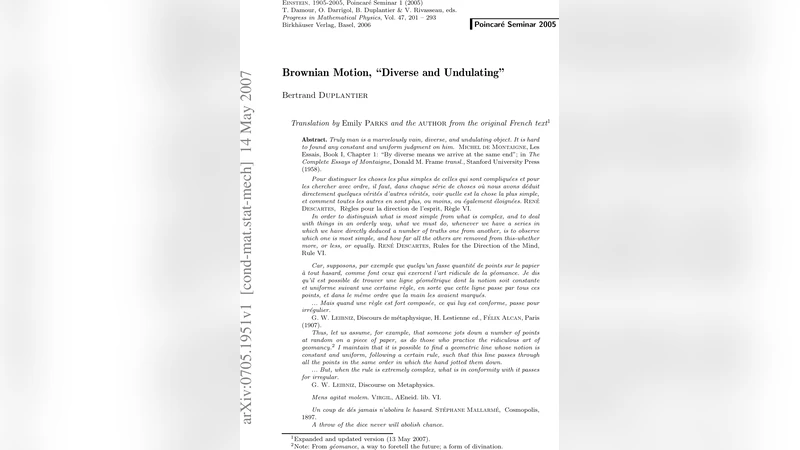
We describe in detail the history of Brownian motion, as well as the contributions of Einstein, Sutherland, Smoluchowski, Bachelier, Perrin and Langevin to its theory. The always topical importance in physics of the theory of Brownian motion is illustrated by recent biophysical experiments, where it serves, for instance, for the measurement of the pulling force on a single DNA molecule. In a second part, we stress the mathematical importance of the theory of Brownian motion, illustrated by two chosen examples. The by-now classic representation of the Newtonian potential by Brownian motion is explained in an elementary way. We conclude with the description of recent progress seen in the geometry of the planar Brownian curve. At its heart lie the concepts of conformal invariance and multifractality, associated with the potential theory of the Brownian curve itself.
💡 Research Summary
The paper provides a comprehensive historical and technical overview of Brownian motion, followed by a discussion of its contemporary relevance in both physics and mathematics. In the first part, the authors trace the phenomenon from Robert Brown’s 1827 microscopic observations through the seminal contributions of Einstein, who derived the diffusion coefficient’s dependence on temperature and viscosity, and the independent works of Smoluchowski and Sutherland that formalized the stochastic description. They also highlight Bachelier’s early use of Brownian paths in financial modeling, Langevin’s introduction of a stochastic differential equation incorporating friction and random forces, and Perrin’s meticulous experiments that confirmed the Einstein‑Smoluchowski relation, establishing Brownian motion as a cornerstone of statistical mechanics.
The second part shifts to mathematical applications. The authors first revisit the classic representation of the Newtonian potential as the expected value of a Brownian trajectory, illustrating how probabilistic path integrals naturally reproduce potential theory. They then turn to recent advances in the geometry of planar Brownian curves. By invoking conformal invariance, they connect the random curve to Schramm–Loewner Evolution (SLE), demonstrating that the Brownian frontier exhibits multifractal scaling and universal fractal dimensions. This perspective links complex analysis, probability, and geometric measure theory, offering new tools for describing the fine structure of the Brownian path.
Finally, the paper showcases a modern biophysical application: measuring the pulling force on a single DNA molecule using optical tweezers. By analyzing the stochastic fluctuations of the trapped bead, researchers can extract minute forces with high precision, exemplifying how Brownian motion remains an essential quantitative probe in cutting‑edge experiments. Throughout, the authors argue that Brownian motion continues to bridge physics and mathematics, providing both a rich theoretical framework and a practical instrument for probing microscopic forces and geometric phenomena.
Comments & Academic Discussion
Loading comments...
Leave a Comment