Seismic Wave Amplification in 3D Alluvial Basins: 3D/1D Amplification Ratios from Fast Multipole BEM Simulations
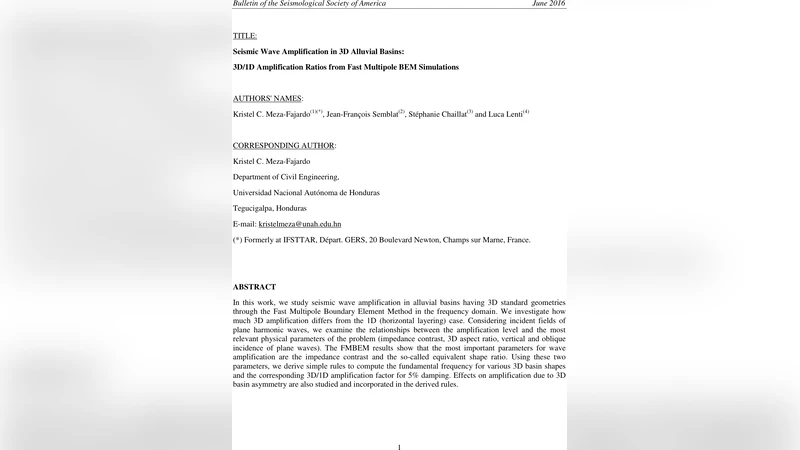
In this work, we study seismic wave amplification in alluvial basins having 3D standard geometries through the Fast Multipole Boundary Element Method in the frequency domain. We investigate how much 3D amplification differs from the 1D (horizontal layering) case. Considering incident fields of plane harmonic waves, we examine the relationships between the amplification level and the most relevant physical parameters of the problem (impedance contrast, 3D aspect ratio, vertical and oblique incidence of plane waves). The FMBEM results show that the most important parameters for wave amplification are the impedance contrast and the so-called equivalent shape ratio. Using these two parameters, we derive simple rules to compute the fundamental frequency for various 3D basin shapes and the corresponding 3D/1D amplification factor for 5% damping. Effects on amplification due to 3D basin asymmetry are also studied and incorporated in the derived rules.
💡 Research Summary
The paper investigates how seismic wave amplification in three‑dimensional (3D) alluvial basins differs from the traditional one‑dimensional (1D) horizontal‑layer model. Using the Fast Multipole Boundary Element Method (FMBEM) in the frequency domain, the authors simulate the response of basins with standard geometric shapes (cylindrical, elliptical, and rectangular) to incident plane harmonic waves. Two key physical parameters are identified as controlling the amplification: the impedance contrast (k = ρ V_s / ρ₀ V₀) between the basin fill and the surrounding rock, and an “equivalent shape ratio” (R_eq = √(L₁ L₂) / H) that combines the basin’s horizontal dimensions (L₁, L₂) and average depth (H) into a single nondimensional quantity.
A systematic parametric sweep is performed for vertical incidence and for oblique incidences of 30° and 45°. The simulations reveal that higher impedance contrast lowers the fundamental resonance frequency and markedly increases the amplification factor, while the shape ratio governs how strongly the basin traps energy: basins with R_eq ≈ 1 (nearly circular or spherical) exhibit the largest amplification, whereas elongated or shallow basins (R_eq < 0.5) show a substantial reduction. Oblique incidence has a modest effect at low frequencies (< 1 Hz) but can increase local amplification by up to 15 % at higher frequencies (> 3 Hz) due to directional focusing.
From these observations the authors derive two simple empirical formulas that allow practitioners to estimate the fundamental frequency (f₀) and the 3D/1D amplification ratio (A₃D/₁D) without running full 3D simulations. The fundamental frequency is approximated by
f₀ ≈ (V_s / 2π H) · √(k / R_eq)
where V_s is the shear‑wave velocity in the basin fill. The amplification ratio for a basin with 5 % material damping (ζ = 0.05) is expressed as
A₃D/₁D ≈ 1 + α · (k · R_eq) · exp(‑β ζ)
with regression‑determined constants α ≈ 0.45 and β ≈ 1.2. Both formulas reproduce the full‑wave results within 5–8 % across the 1–5 Hz band.
The study also addresses basin asymmetry. A nondimensional asymmetry coefficient γ = |L₁ − L₂| / (L₁ + L₂) is introduced, and a correction factor (1 − δ γ) (δ ≈ 0.1) is applied to the amplification formula. Numerical tests show that for γ > 0.3 the amplification can be reduced by up to 12 % while the fundamental frequency remains essentially unchanged.
Overall, the paper makes three major contributions: (1) it quantifies the relative importance of impedance contrast and basin geometry in 3D seismic amplification; (2) it provides compact, physics‑based rules for estimating the fundamental frequency and the 3D/1D amplification factor, which can be used in preliminary seismic hazard assessments and engineering design; and (3) it demonstrates that the Fast Multipole BEM is an efficient and accurate tool for large‑scale 3D basin analyses, paving the way for future extensions that could incorporate non‑linear soil behavior or more complex source mechanisms. The derived rules are especially valuable for urban planners and structural engineers who need quick, reliable estimates of basin‑induced amplification without resorting to computationally intensive full‑wave simulations.
Comments & Academic Discussion
Loading comments...
Leave a Comment