Generalized three body problem and the instability of the core-halo objects in binary systems
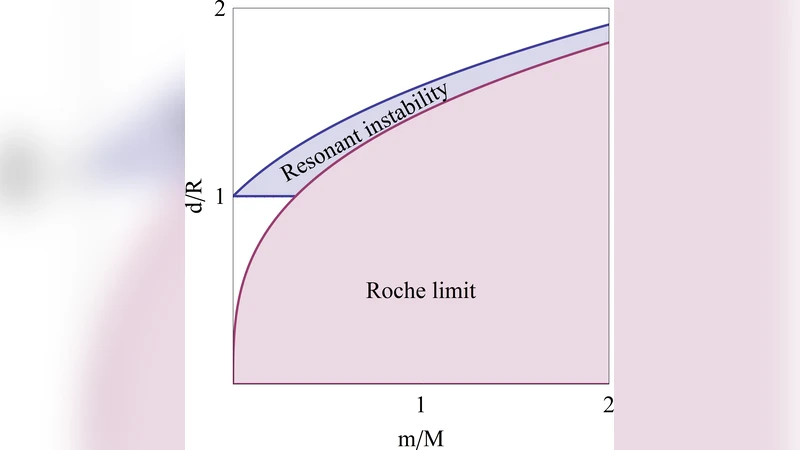
Goal of the presented research is to construct simplified model of the core-halo structures in binary systems. Examples are provided by Thorne-Zytkov objects, hot Jupiters, protoplanets with large moons, red supergiants in binaries and globular clusters with central black hole. Instability criteria due to resonance between internal and orbital frequencies in such a systems has been derived. To achieve assumed goals, generalized planar circular restricted three body problem is investigated with one of the point masses, $M$, replaced with spherical body of finite size. Mechanical system under consideration includes two large masses $m$ and $M$ and the test body with small mass $\mu$. Only gravitational interactions are considered. Equations of motion are presented, and linear instability criteria are derived using quantifier elimination. Motion of the test mass $\mu$ is shown to be unstable due to resonance between orbital and internal frequencies if $\frac{M}{d^3} < \frac{4}{3} \pi \rho < \frac{ M + 3 m \left( 1+\mu/M \right)^{-1}}{d^3}$, where $\rho$ is the central density of mass $M$, and $d$ distance between masses $m$ and $M$ (circular orbit diameter). The above result is important for core-collapse supernova theory, with mass $\mu$ identified with helium core of the exploding massive star. The instability cause off-center supernova “ignition” relative to the center-of-mass of the hydrogen envelope. The instability is also inevitable during protoplanet growth, with hypothetical ejection of the rocky core from gas giants and formation of the “puffy planets” due to resonance with orbital frequency. Hypothetical central intermediate black holes of the globular clusters are also in unstable position with respect to perturbations caused by the Galaxy.
💡 Research Summary
**
The paper presents a theoretical investigation of a previously unrecognized dynamical instability that can affect “core‑halo” objects (a dense central core µ embedded in an extended spherical body M) when they belong to a binary system with a third mass m. The author extends the classical planar circular restricted three‑body problem (RPCTBP) by replacing one of the point masses (M) with a rigid sphere of finite radius R and uniform density ρ, while placing a test particle of negligible mass µ at the geometric centre of that sphere. In a co‑rotating Cartesian frame the equations of motion for the test particle acquire additional linear restoring terms proportional to a constant k = (4/3)πGρ – ω², where ω² = G(m+M)/d³ is the orbital angular frequency for the binary separation d.
Linearising the system about the equilibrium (x = y = 0) yields a pair of coupled second‑order equations (5) whose characteristic polynomial (7) determines the eigenvalues λ. Using quantifier‑elimination techniques the author derives explicit instability criteria. The most compact form relevant to astrophysical applications is
(4/3)π ρ < (M + 3 m)/d³ (9)
which states that if the internal gravitational frequency of the sphere (set by its mean density) lies below a combination of the binary orbital frequency and the mass of the external companion, the equilibrium becomes linearly unstable. Two related inequalities (8a, 8b) are also obtained, but (9) captures the essential physics.
The author validates the analytic result with numerical integrations of the full nonlinear equations (including a non‑constant density profile) and with energy‑contour (Hill‑region) analyses. Three characteristic behaviours are identified: (a) stable oscillations of µ about the centre of M, (b) chaotic growth of the oscillation amplitude leading to ejection of µ into a bound orbit around m, and (c) complete escape of µ to infinity. Adding a simple drag term (−κ ρ ṙ) only delays the onset of the instability, confirming that the mechanism is fundamentally resonant rather than dissipative.
Astrophysical implications are explored in three domains. First, for massive pre‑supernova red supergiants, the helium core (µ) could be displaced relative to the hydrogen envelope by this gravitational resonance, providing an alternative to the hydrodynamic L = 1 instability proposed by Arnett & Meakin (2011). Second, in gas giant planets the rocky core could be expelled during growth, potentially explaining the formation of low‑density “puffy” exoplanets. Third, a central intermediate‑mass black hole (IMBH) in a globular cluster could become unstable under the tidal field of its host galaxy, leading to migration or ejection of the black hole. The paper also notes that the Earth‑Moon and Earth‑Sun systems lie safely outside the unstable regime, as the artificial black‑hole test mass would remain stable.
While the analysis is mathematically rigorous, it rests on several simplifying assumptions: (i) the extended body M is treated as a rigid sphere with either uniform or prescribed radial density, neglecting rotation, internal fluid motions, and magnetic fields; (ii) the test mass µ is assumed to be point‑like and initially exactly at the centre; (iii) only Newtonian gravity is considered, ignoring relativistic corrections that could be relevant for compact objects. Consequently, the derived criteria should be viewed as necessary conditions for instability in idealised systems rather than definitive predictions for real stars, planets, or clusters. The author suggests that future work should incorporate full hydrodynamic simulations, realistic equations of state, and observational diagnostics (e.g., asymmetric supernova remnants, anomalous core‑to‑envelope offsets in binaries, or displaced IMBH signatures).
In summary, the paper introduces a novel resonant instability mechanism for core‑halo objects in binaries, provides a clear analytic condition for its occurrence, supports it with numerical experiments, and outlines several intriguing astrophysical contexts where it might operate, while also acknowledging the need for more sophisticated modelling to assess its quantitative impact.
Comments & Academic Discussion
Loading comments...
Leave a Comment