Growth and Scaling during Development and Regeneration
Life presents fascinating examples of self-organization and emergent phenomena. In multi-cellular organisms, a multitude of cells interact to form and maintain highly complex body plans of well-defined size. In this thesis, we investigate theoretical feedback mechanisms for both self-organized body plan patterning and size control. The thesis is inspired by the astonishing scaling and regeneration abilities of flatworms. These worms can perfectly regrow their entire body plan even from tiny amputation fragments like the tip of the tail. Moreover, they can grow and actively de-grow by more than a factor of 40 in length depending on feeding conditions. These capabilities prompt for remarkable physical mechanisms of self-organized pattern formation and scaling. First, we explore the basic principles and challenges of pattern scaling in mechanisms previously proposed to describe biological pattern formation. Next, we present a novel class of patterning mechanisms yielding entirely self-organized and self-scaling patterns. This framework captures essential features of body plan regeneration and scaling in flatworms. Further, we analyze shape and motility of flatworms. By applying principal component analysis, we characterize shape dynamics during different motility modes and also identify shape variations between different flatworm species. Finally, we investigate the metabolic control of cell turnover and growth. We identify three mechanisms of metabolic energy storage; theoretical descriptions thereof can explain the measured organism growth by rules on the cellular scale. In a close collaboration with experimental biologists, we combine minimal theoretical descriptions with state-of-the-art experiments and data analysis. This allows us to identify generic principles of scalable body plan patterning and growth control in flatworms.
💡 Research Summary
The dissertation “Growth and Scaling during Development and Regeneration” presents a comprehensive theoretical and experimental investigation of how flatworms (planarians) achieve remarkable size changes, regeneration, and maintenance of body proportions. The work is organized into six main parts, each addressing a distinct aspect of the problem.
-
Introduction frames the biological challenge: multicellular organisms must coordinate cell number, type, and spatial arrangement across many length scales. Flatworms can regenerate an entire organism from tiny fragments and can expand or shrink more than forty‑fold in length while preserving functional anatomy. This motivates the search for physical mechanisms that can generate self‑organized, size‑independent body plans.
-
Scaling in Morphogen Systems reviews classical reaction‑diffusion (Turing) models and morphogen gradient theories. The author derives the conditions under which a morphogen profile can scale with tissue size, discusses “expander” molecules that act as size reporters, and evaluates several feedback schemes (expander‑dilution, expansion‑repression, etc.). The analysis shows that many existing schemes only achieve approximate scaling and often require fine‑tuned parameters.
-
Self‑Organized Pattern Scaling constitutes the core theoretical contribution. Building on the limitations identified in part 2, the author proposes a novel “self‑scaling Turing system” that couples a conventional activator‑inhibitor pair with an expander that is produced proportionally to the total tissue mass and degraded locally. This creates a global feedback loop that forces the wavelength of the emergent pattern to be proportional to the system size. Numerical simulations demonstrate that (i) a single‑source pattern is a robust attractor for a wide range of initial conditions, (ii) the pattern automatically rescales after tissue growth or after a cut, and (iii) the system remains stable under parameter variations, indicating structural robustness. Linear stability analysis and phase‑space mapping provide analytical support for these observations.
-
Flatworm Shape Dynamics and Motility translates the theoretical insights into measurable phenotypes. High‑resolution video recordings of freely moving worms are processed to extract two‑dimensional outlines. Principal component analysis (PCA) of the outline time series reveals a small set of shape modes: two modes describe smooth bending and width modulation associated with gliding driven by ciliary beating, while additional modes capture the “inch‑worming” gait based on muscular contractions. The author shows that knock‑out of specific genes leads to characteristic alterations in these mode amplitudes, linking molecular perturbations to motility defects. Moreover, inter‑species shape differences are quantified by comparing PCA coefficient distributions, providing a quantitative framework for comparative morphology.
-
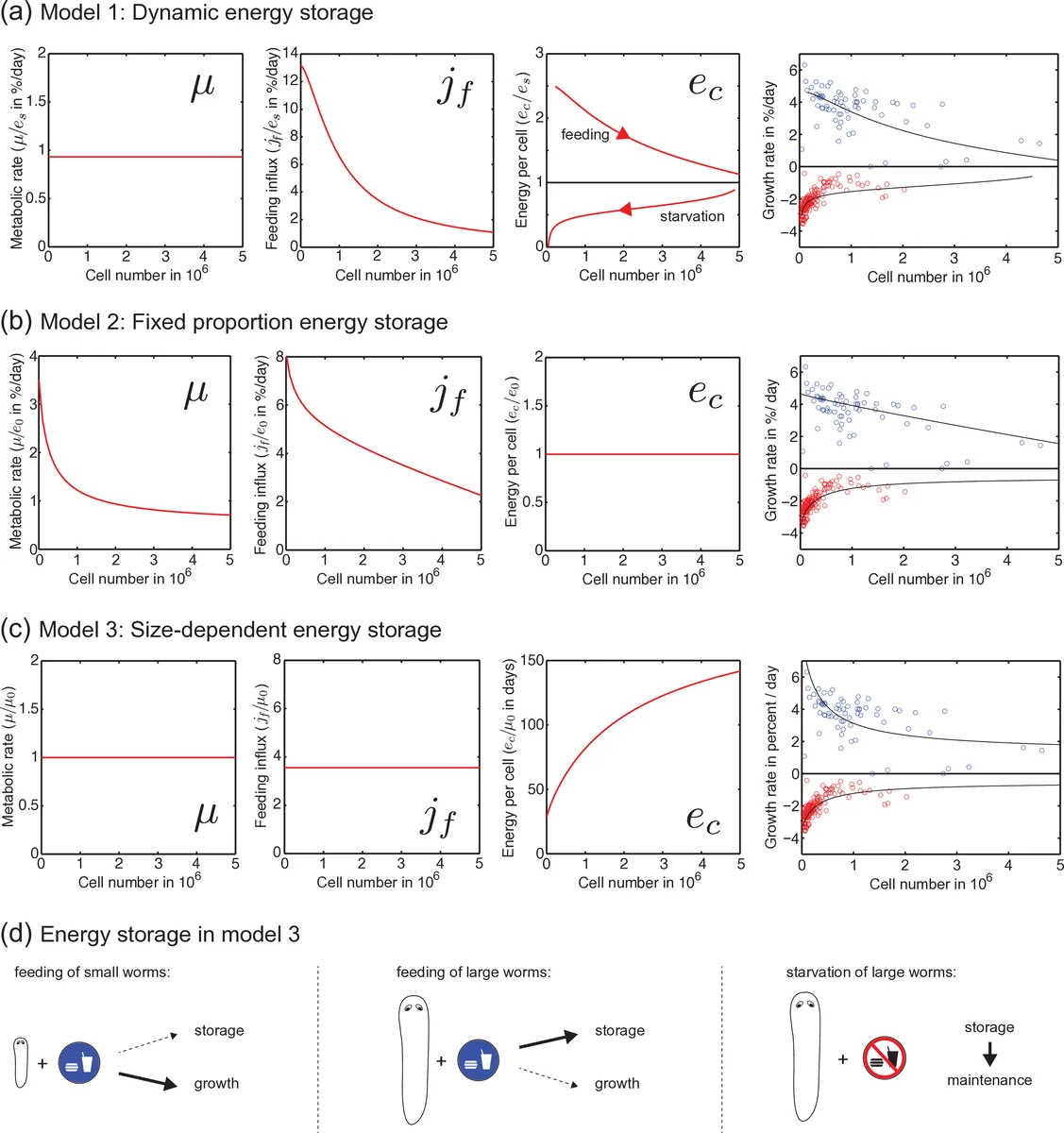
Quantitative Study of Growth and Cell Turnover addresses the metabolic side of size control. The author establishes a protocol for measuring growth curves under controlled feeding regimes, confirming that small worms change size faster than large ones and that growth follows allometric scaling laws. Three mechanistic models of energy storage are formulated: (i) dynamic storage where energy is accumulated and consumed continuously, (ii) fixed‑proportion storage where a constant fraction of intake is stored, and (iii) size‑dependent storage where storage efficiency declines with size. Fitting these models to experimental data shows that the size‑dependent model best reproduces the observed growth and degrowth dynamics. Cell turnover rates are measured at the tissue level (e.g., epidermis) using labeling techniques, and a feedback logic is proposed in which turnover and proliferation are regulated by the same metabolic signals that drive the expander in the patterning system.
-
Summary and Outlook synthesizes the findings, emphasizing that the self‑scaling Turing framework provides a unified explanation for pattern formation, regeneration, and size regulation in flatworms. The author suggests that similar expander‑based feedback could operate in other regenerative species and outlines experimental tests (e.g., perturbing expander production, visualizing its spatial distribution). Future work is proposed on extending the model to three‑dimensional tissues, integrating mechanical feedback, and applying the shape‑analysis pipeline to other soft‑bodied organisms.
Overall, the dissertation bridges abstract mathematical theory with concrete biological data, delivering a multi‑scale model that captures how flatworms maintain proportional body plans while undergoing dramatic size changes. It advances our understanding of self‑organized pattern scaling, provides new quantitative tools for morphology and motility analysis, and proposes testable hypotheses about the metabolic control of growth and regeneration.
Comments & Academic Discussion
Loading comments...
Leave a Comment