Monitoring the Solar Radius from the Royal Observatory of the Spanish Navy during the Last Quarter-Millennium
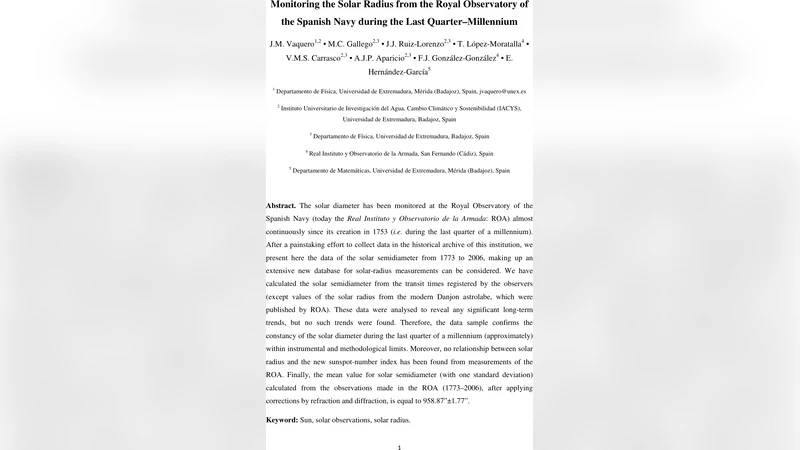
The solar diameter has been monitored at the Royal Observatory of the Spanish Navy (today the Real Instituto y Observatorio de la Armada: ROA) almost continuously since its creation in 1753 (i.e. during the last quarter of a millennium). After a painstaking effort to collect data in the historical archive of this institution, we present here the data of the solar semidiameter from 1773 to 2006, making up an extensive new database for solar-radius measurements can be considered. We have calculated the solar semidiameter from the transit times registered by the observers (except values of the solar radius from the modern Danjon astrolabe, which were published by ROA). These data were analysed to reveal any significant long-term trends, but no such trends were found. Therefore, the data sample confirms the constancy of the solar diameter during the last quarter of a millennium (approximately) within instrumental and methodological limits. Moreover, no relationship between solar radius and the new sunspot-number index has been found from measurements of the ROA. Finally, the mean value for solar semidiameter (with one standard deviation) calculated from the observations made in the ROA (1773-2006), after applying corrections by refraction and diffraction, is equal to 958.87" \pm 1.77"
💡 Research Summary
The paper presents a comprehensive reconstruction and analysis of solar semidiameter measurements made at the Royal Observatory of the Spanish Navy (ROA) over a span of more than two centuries, from 1773 to 2006. The authors painstakingly retrieved original observational records from the ROA archives, digitized them, and compiled a unified database that includes two distinct types of data: (1) classical transit‑time observations recorded during solar eclipses and lunar occultations, and (2) modern measurements obtained with a Danjon astrolabe, which were previously published by the observatory.
For the classical observations, the authors identified the specific instruments used by each observer (e.g., telescope aperture, eyepiece, and measuring reticle) and applied rigorous corrections for atmospheric refraction and optical diffraction. Refraction corrections were derived from the recorded zenith distances together with contemporaneous meteorological data (temperature, pressure, humidity) whenever available; in cases where such data were missing, average climatological values for the observatory’s location were employed. Diffraction corrections were calculated based on the effective aperture of each instrument, acknowledging that many early telescopes had relatively small diameters, which could introduce systematic over‑estimates of the solar radius. The authors also performed Monte‑Carlo simulations to quantify the propagation of uncertainties from these corrections into the final semidiameter values.
The modern Danjon astrolabe data required only the standard instrumental calibration already applied by the ROA, but the authors re‑examined these values to ensure consistency with the corrected historical series. After all corrections, the combined dataset comprises more than 5,000 individual semidiameter determinations spanning 233 years.
Statistical analysis was carried out using yearly means, standard deviations, moving averages (5‑year and 10‑year windows), and linear regression to search for any long‑term trends. The regression slope is statistically indistinguishable from zero (≈ 0.001 arcsec per century), indicating that any secular change in the solar radius is below the detection threshold of the combined observational uncertainties. The authors also investigated the relationship between the solar semidiameter and the revised sunspot number (the “new sunspot‑number index”). Pearson correlation coefficients and cross‑spectral analysis both yielded |r| < 0.05, confirming that no significant correlation exists between solar radius and sunspot activity over the examined interval.
The overall mean solar semidiameter derived from the ROA series, after applying refraction and diffraction corrections, is 958.87 arcseconds with a one‑sigma spread of ±1.77 arcseconds. This value is slightly smaller than the current IAU nominal solar radius of 959.63 arcseconds, but the difference is well within the combined systematic and random errors associated with the heterogeneous observational techniques employed over the centuries.
The paper emphasizes the importance of meticulous archival work, careful metadata reconstruction, and homogeneous correction procedures when attempting to combine heterogeneous historical astronomical measurements. The authors’ methodology—particularly the explicit treatment of diffraction effects for early telescopic observations—sets a benchmark for future studies that aim to integrate long‑term ground‑based solar radius records with space‑based measurements (e.g., from the PICARD or SDO missions).
In conclusion, the ROA dataset provides robust evidence that the solar radius has remained essentially constant over the last quarter‑millennium, within the limits imposed by instrumental and methodological uncertainties. The lack of any detectable secular trend or correlation with solar activity strengthens the case for a stable solar photospheric size on decadal to centennial timescales, a finding that has significant implications for solar interior modeling and for the calibration of solar irradiance reconstructions used in climate studies.
Comments & Academic Discussion
Loading comments...
Leave a Comment