A New Framework for Distributed Submodular Maximization
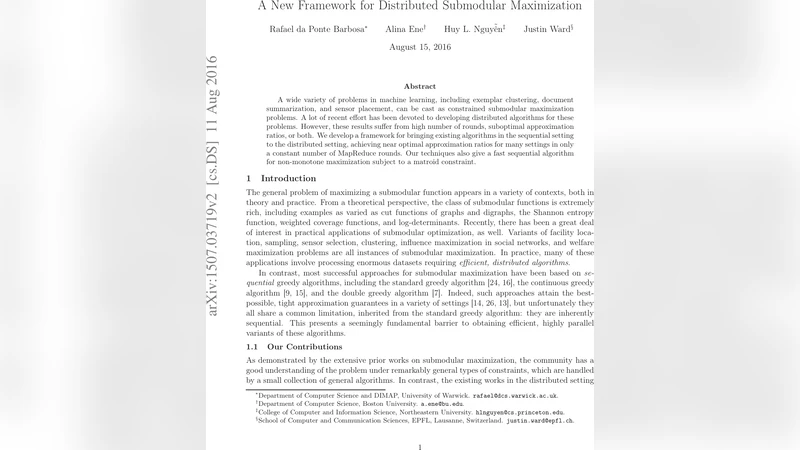
A wide variety of problems in machine learning, including exemplar clustering, document summarization, and sensor placement, can be cast as constrained submodular maximization problems. A lot of recent effort has been devoted to developing distributed algorithms for these problems. However, these results suffer from high number of rounds, suboptimal approximation ratios, or both. We develop a framework for bringing existing algorithms in the sequential setting to the distributed setting, achieving near optimal approximation ratios for many settings in only a constant number of MapReduce rounds. Our techniques also give a fast sequential algorithm for non-monotone maximization subject to a matroid constraint.
💡 Research Summary
The paper introduces a general framework for translating sequential submodular maximization algorithms into highly efficient distributed versions that run in a constant number of MapReduce (or MPC) rounds while preserving approximation guarantees that are essentially as good as the original sequential algorithms. Submodular functions, which capture a wide range of combinatorial objectives such as graph cuts, entropy, and coverage, appear in many machine‑learning tasks (clustering, sensor placement, summarization, etc.). While sequential greedy, continuous greedy, and double‑greedy methods achieve optimal or near‑optimal approximation ratios, they are inherently sequential and thus unsuitable for massive data sets. Existing distributed approaches either require many rounds (often logarithmic in the maximum singleton value Δ) or suffer from substantially weaker approximation factors.
The authors’ key insight is to abstract any sequential algorithm that satisfies a “strong greedy property” into a black‑box that returns two sets: a feasible solution (AlgSol) and a “relevant” set (AlgRel) that records the elements the algorithm examined or used internally. For the classic greedy algorithm AlgSol = AlgRel equals the greedy solution; for continuous greedy AlgSol is the rounded integral solution while AlgRel is the support of the fractional solution. Using this abstraction, the framework proceeds in O(1/ε) rounds: in each round the ground set is randomly partitioned into many shards; each shard runs the sequential algorithm locally, producing a local solution and a local relevant set. The best elements from each shard are merged into a global “good pool”. By carefully analyzing the expected marginal gains using the multilinear extension and the Lovász extension, the authors prove that after O(1/ε) rounds the global pool contains a subset whose value is within a (1‑ε) factor of the optimal solution with constant probability. The analysis hinges on Lemma 3.2 (random set expectation bound via Lovász extension) and Lemma 3.3 (probabilistic marginal gain bound), which together guarantee that the pool grows quickly enough.
The framework yields several concrete results:
-
Parallel Greedy – For any hereditary constraint I (including matroids, p‑systems, cardinality), a randomized O(1/ε)-round algorithm achieves an (α‑O(ε)) approximation, where α is the approximation ratio of the underlying sequential greedy (e.g., (1‑1/e) for monotone matroid constraints). This improves over prior work that required O((1/ε)·log Δ) rounds.
-
Parallel Continuous Greedy – By discretizing the continuous greedy process, the authors obtain O(1/ε)-round algorithms for monotone submodular maximization under matroids with approximation (1‑1/e‑O(ε)), and for non‑monotone functions with (1/e‑O(ε)). These match the best known sequential ratios while using far fewer rounds.
-
Two‑Round Hybrid Algorithms – Combining the standard greedy algorithm with any β‑approximation algorithm (Alg) that works under the same constraint yields a randomized two‑round algorithm with approximation (1‑1/m)·β·γ, where γ is the strong‑greedy constant of the greedy part. This improves on the 0.545‑approximation for cardinality constraints achieved by earlier two‑round methods.
-
Fast Sequential Algorithm for Non‑Monotone Matroid Constraints – By simulating the distributed algorithm on a single machine, the authors derive a sequential algorithm that runs in O(n ε log n)+poly(k/ε) time and achieves a (1/2+e‑ε) approximation for non‑monotone submodular maximization under a matroid, a factor Ω(k) faster than the best known sequential methods at the cost of a slightly weaker constant factor.
The computational model is the stringent MPC setting: total memory O(N), each machine’s memory O(N^{1‑Ω(1)}), and synchronous rounds where each machine can send at most O(S) words per round. The authors assume the optimal solution size is at most N^{1‑2c} for some constant c, ensuring the whole solution can fit on a single machine, a standard assumption in recent distributed submodular work.
Technical contributions include a novel use of random partitioning to preserve a constant fraction of the optimal value in each round, a clean abstraction that unifies greedy and continuous greedy, and tight probabilistic analyses that replace the logarithmic dependence on Δ present in earlier threshold‑greedy approaches. Table 1 in the paper summarizes the new guarantees across monotone/non‑monotone functions, various constraints (cardinality, matroid, p‑system), and compares them to prior art.
In summary, the paper provides a powerful, generic toolkit for converting high‑quality sequential submodular maximization algorithms into practically usable distributed algorithms with constant round complexity and near‑optimal approximation ratios. This bridges a long‑standing gap between theory (optimal sequential approximations) and practice (large‑scale distributed computation), and opens avenues for extending the approach to more complex constraints, streaming settings, or adaptive submodular problems.
Comments & Academic Discussion
Loading comments...
Leave a Comment