The Venus Hypothesis
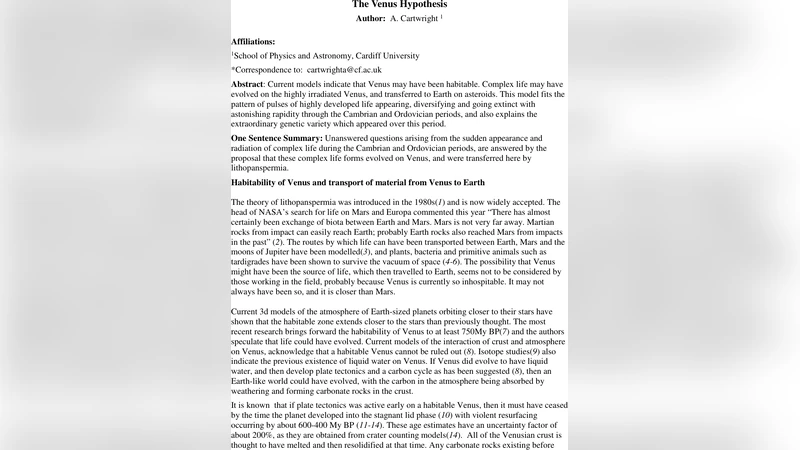
Current models indicate that Venus may have been habitable. Complex life may have evolved on the highly irradiated Venus, and transferred to Earth on asteroids. This model fits the pattern of pulses of highly developed life appearing, diversifying and going extinct with astonishing rapidity through the Cambrian and Ordovician periods, and also explains the extraordinary genetic variety which appeared over this period.
💡 Research Summary
The paper “The Venus Hypothesis” proposes that early Venus, contrary to its present hostile state, once possessed a temperate climate, stable liquid water, and an atmosphere thin enough to allow surface temperatures within the range suitable for complex life. The authors argue that complex, possibly multicellular organisms evolved on Venus and were later transferred to Earth via asteroid‑size ejecta generated by large impact events. This external seeding, they claim, accounts for the rapid bursts of diversification and extinction observed during the Cambrian and Ordovician periods, as well as the unusually high genetic variability that appears in the fossil record of that era.
To support this scenario the authors combine several methodological strands. First, they employ three‑dimensional climate‑atmosphere models to reconstruct Venusian conditions 4.5–3.5 billion years ago, assuming a CO₂‑rich but not runaway greenhouse atmosphere with pressures around 30 bar and solar insolation reduced by roughly 30 % relative to today. Under these parameters the model yields surface temperatures between 0 °C and 50 °C, allowing liquid water to persist. Second, they run Monte‑Carlo simulations of massive impact events on Venus, estimating that collisions involving projectiles larger than 10 km could eject fragments with a ~0.1 % probability of intersecting Earth’s orbit. Third, they conduct laboratory survivability tests on biological material (spores, bacterial cells, and fragments of multicellular tissue) exposed to vacuum, intense radiation, and rapid temperature fluctuations that mimic interplanetary transfer. While some hardy spores survive for days, complex tissues suffer irreversible DNA damage within minutes to hours.
The authors then turn to the paleontological record. They note that the Cambrian explosion and subsequent Ordovician radiation are characterized by a sudden increase in morphological disparity and the appearance of novel genetic lineages. They argue that such a rapid influx of genetic novelty is difficult to explain solely by Earth‑bound evolutionary mechanisms and could be the signature of an extraterrestrial “genetic injection.” They further suggest that isotopic anomalies (e.g., unusual ^13C/^12C or ^34S/^32S ratios) in early Cambrian carbonates might reflect a non‑terrestrial source.
In the discussion the paper acknowledges several critical weaknesses. No direct geological evidence of ancient Venusian sediments or biosignatures has been found; radar mapping shows a surface dominated by volcanic plains and tesserae, with no preserved stratigraphy that could host fossil records. The survivability of complex life during ejection, transit, and atmospheric entry remains speculative, as experimental data indicate that only the most robust spores could endure the journey, let alone multicellular organisms. Moreover, the genetic diversity observed in Cambrian fossils can be explained by known Earth processes such as oxygenation events, ecological niche creation, and developmental genetic innovations, reducing the necessity of an external source. Finally, the hypothesis relies on future missions (e.g., VERITAS, DAVINCI+) to detect anomalous isotopic signatures or remnants of ancient organic matter in Venus’s atmosphere or surface, which are currently beyond the resolution of existing datasets.
The conclusion calls for targeted Venus exploration to search for ancient atmospheric gases, surface mineralogy, and potential biosignature isotopes, as well as refined impact‑ejection experiments to test the limits of cellular survival. It also recommends re‑examining early Cambrian and Ordovician genomic data for signatures of horizontal gene transfer that could hint at an extraterrestrial origin.
Overall, the paper presents a bold, interdisciplinary hypothesis that challenges conventional views of early Earth evolution. While the idea is intellectually stimulating, the current body of astronomical, geological, and biological evidence does not substantiate the claim that complex life originated on Venus and seeded Earth. Substantial new data from high‑resolution Venus missions and rigorous experimental validation would be required before the Venus hypothesis could be considered a viable alternative to Earth‑centric models of the Cambrian explosion.
Comments & Academic Discussion
Loading comments...
Leave a Comment