Measurements of the Atmospheric Electric Field through a Triangular Array and the Long-range Saharan Dust Electrification in Southern Portugal
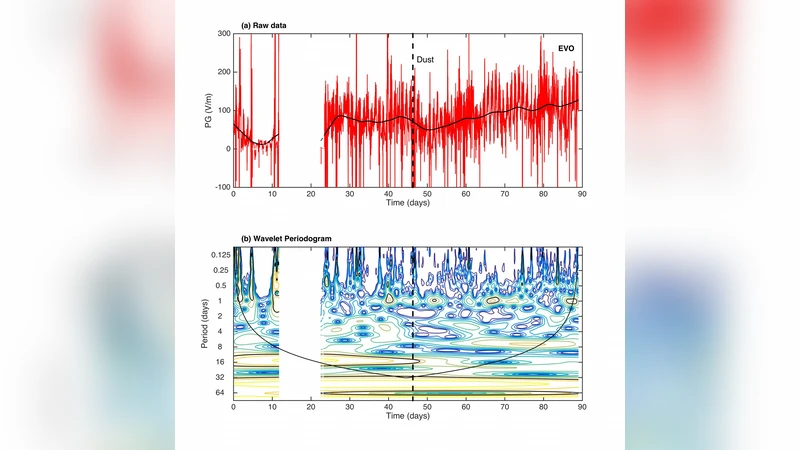
Atmospheric electric field (AEF) measurements were carried out in three different sites forming a triangular array in Southern Portugal. The campaign was performed during the summer characterized by Saharan dust outbreaks; the 16th-17th July 2014 desert dust event is considered here. Evidence of long-range dust electrification is attributed to the air-Earth electrical current creating a positive space-charge inside of the dust layer. An increase of ~23 V/m is observed in AEF on the day of the dust event corresponding to space-charges of ~20-2 pCm-3 (charge layer thicknesses ~10-100 m). A reduction of AEF is observed after the dust event.
💡 Research Summary
This paper presents a detailed field investigation of the atmospheric electric field (AEF) response to a long‑range Saharan dust outbreak, using a triangular array of three ground‑based measurement stations in southern Portugal. The campaign was conducted during the summer of 2014, with a focus on the dust event that occurred on 16–17 July 2014. Each station was equipped with a standard potential‑gradient (PG) meter sampling at 1 Hz, and the three sites were positioned at different elevations (approximately 30 m, 150 m, and 300 m above sea level) to provide spatial coverage and a modest vertical perspective.
Data preprocessing involved high‑pass filtering to remove slow variations associated with the global electric circuit, baseline correction using nighttime quiet periods, and exclusion of intervals contaminated by precipitation, cloud cover, or anthropogenic electrical noise. Satellite observations (Aqua‑MODIS) and local PM₁₀ measurements confirmed that a dense dust layer, originating from the Sahara, was advected over the study area at roughly 2 km altitude during the target interval.
During the dust passage, all three stations recorded a nearly simultaneous increase in PG of about 23 V m⁻¹ relative to the pre‑event baseline. The uniformity of the increase across the array suggests that the dust plume behaved as a coherent electrically active slab rather than a collection of isolated charged pockets. The authors interpret this enhancement as the result of a positive space‑charge layer embedded within the dust column, generated by the vertical air‑Earth current that continuously supplies charge to particles suspended in the relatively low‑conductivity dust environment.
To quantify the space‑charge density (ρ) and the effective thickness (Δh) of the charged layer, the authors employed the simple relation ΔE = ρ Δh / ε₀, where ΔE is the observed PG increase and ε₀ is the vacuum permittivity. The atmospheric conductivity (σ) was estimated from in‑situ measurements (≈10⁻¹⁴ S m⁻¹), and the fair‑weather conduction current density (J) was taken as the typical global value of ≈2 pA m⁻². Solving for ρ and Δh yields charge densities ranging from 20 pC m⁻³ down to 2 pC m⁻³, with corresponding layer thicknesses between 10 m and 100 m. These values are consistent with laboratory studies of dust particle charging and with previous low‑altitude field measurements during dust events.
After the dust plume moved out of the measurement domain, the PG returned to its pre‑event level, indicating a rapid discharge or redistribution of the space‑charge. No significant spatial gradients in the PG were observed within the triangular array, reinforcing the conclusion that the charge distribution was relatively uniform across the studied area.
The paper highlights several important contributions: (1) it provides direct observational evidence that Saharan dust can modify the atmospheric electric field hundreds of kilometres downwind of its source, (2) it demonstrates the utility of a triangular multi‑station configuration for capturing spatially coherent electric‑field perturbations, and (3) it offers a straightforward method to infer dust‑layer charge density and thickness from PG measurements combined with conductivity estimates.
Limitations acknowledged by the authors include the short duration of the campaign, the lack of concurrent lidar or radar profiling to resolve the vertical structure of the dust layer, and the reliance on assumed constant values for conductivity and current density, which may introduce uncertainties in the derived charge parameters. Future work is suggested to integrate long‑term monitoring networks with high‑resolution remote sensing (e.g., lidar, radar) and to explore the coupling between dust electrification, atmospheric chemistry, and climate‑relevant processes.
In summary, this study constitutes one of the first quantitative assessments of long‑range dust electrification using ground‑based atmospheric electric field measurements, and it opens new avenues for interdisciplinary research linking atmospheric electricity, aerosol physics, and climate science.
Comments & Academic Discussion
Loading comments...
Leave a Comment