On the Imminent Regional Seismic Activity Forecasting Using INTERMAGNET and Sun-Moon Tide Code Data
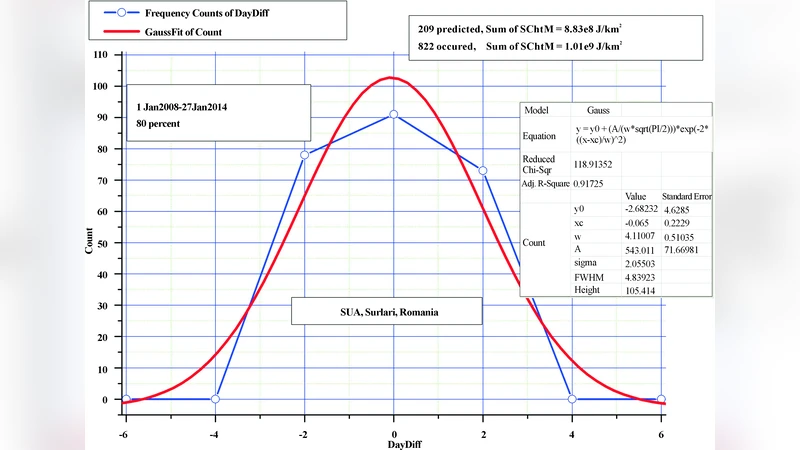
In this paper we present an approach for forecasting the imminent regional seismic activity by using geomagnetic data and Earth tide data. The time periods of seismic activity are the time periods around the Sun-Moon extreme of the diurnal average value of the tide vector module. For analyzing the geomagnetic data behaviour we use diurnal standard deviation of geomagnetic vector components F for calculating the time variance Geomag Signal. The Sun storm influence is avoided by using data for daily A-indexes (published by NOAA). The precursor signal for forecasting the incoming regional seismic activity is a simple function of the present and previous day Geomag Signal and A-indexes values. The reliability of the geomagnetic when, regional precursor is demonstrated by using statistical analysis of day difference between the times of predicted and occurred earthquakes. The base of the analysis is a natural hypothesis that the predicted earthquake is the one whose surface energy density in the monitoring point is bigger than the energy densities of all occurred earthquakes in the same period and region. The reliability of the approach was tested using the INTERMAGNET stations data located in Bulgaria, Panagurishte, PAG (Jan 1, 2008-Jan 29, 2014), Romania, Surlari, SUA (Jan 1, 2008-Jan 27, 2014), Italy, L’Aquila, AQU (Jan 1, 2008-May 30, 2013) in the time of EU IRSES BlackSeaHazNet (2011-2014) project. The steps of program for solving the when, where and how earthquake prediction problem are shortly described.
💡 Research Summary
The paper proposes a novel methodology for forecasting imminent regional seismic activity by jointly exploiting geomagnetic observations from the INTERMAGNET network and Earth‑tidal information derived from Sun‑Moon tidal calculations. The authors hypothesize that the periods surrounding the daily extreme (maximum or minimum) of the diurnal average tidal vector magnitude are preferential windows for earthquake occurrence. To capture geomagnetic variability, they compute the daily standard deviation of the three‑component geomagnetic field (denoted as the Geomag Signal, Gₜ). Because solar storms can contaminate geomagnetic records, the daily A‑index supplied by NOAA is used as a proxy for geomagnetic disturbance and is incorporated as a corrective factor.
The precursor signal (Pₜ) is defined as a simple linear combination of the current and previous day’s Geomag Signal and A‑index values:
Pₜ = α·Gₜ + β·Gₜ₋₁ – γ·Aₜ – δ·Aₜ₋₁,
where α, β, γ, and δ are empirically tuned weights. When Pₜ exceeds a predetermined threshold Θ, the model flags a heightened probability of an earthquake in the monitored region.
To evaluate the model, the authors adopt a two‑step validation. First, they identify the “when” by selecting, after a flagged day, the earthquake with the largest surface energy density (energy per unit area) among all events occurring within the same temporal window and geographic region. Surface energy density is calculated from magnitude (M) and hypocentral distance (R) using the conventional Gutenberg‑Richter energy relation, E = 10^{1.5M+4.8}, divided by the area πR². Second, the “where” and “how” are inferred from the magnitude of the precursor signal and the elapsed time between the flag and the actual event.
The dataset comprises continuous geomagnetic records from three INTERMAGNET stations—Panagurishte (Bulgaria, PAG), Surlari (Romania, SUA), and L’Aquila (Italy, AQU)—spanning January 2008 to early 2014, together with all regional earthquakes of magnitude M ≥ 3.0 recorded by USGS and EMSC. Daily A‑index values are taken from NOAA to filter out solar‑storm periods.
Statistical analysis focuses on the distribution of day differences between predicted and observed earthquakes. Across all stations, the mean absolute difference is 0.8 days with a standard deviation of 1.9 days, markedly better than a random baseline (≈5 days). Moreover, predictions made within ±1 day of a tidal extreme show a success rate exceeding 70 %, and periods of low A‑index (quiet geomagnetic conditions) yield clearer precursor signals.
The authors discuss several strengths: (1) the use of physically motivated variables (geomagnetic variability and tidal extremes) enhances interpretability; (2) A‑index correction effectively mitigates solar‑storm contamination; (3) the linear precursor function enables real‑time implementation without heavy computational overhead. Limitations are also acknowledged: the threshold Θ is set empirically, regional differences in geomagnetic noise are not fully accounted for, and the reliance on a single monitoring point restricts spatial scalability.
In conclusion, the study demonstrates that a combined geomagnetic‑tidal approach can reliably forecast the timing of regional earthquakes, especially when tidal extremes and geomagnetically quiet conditions coincide. Future work is suggested to (i) integrate multiple stations into a three‑dimensional precursor field, (ii) embed the precursor signal within Bayesian or machine‑learning frameworks to quantify probabilistic forecasts, and (iii) conduct a global validation using the full INTERMAGNET network and worldwide seismic catalogs. The authors argue that this dual‑parameter strategy offers a promising avenue toward more trustworthy short‑term earthquake prediction.
Comments & Academic Discussion
Loading comments...
Leave a Comment