Enumerations, Forbidden Subgraph Characterizations, and the Split-Decomposition
Forbidden characterizations may sometimes be the most natural way to describe families of graphs, and yet these characterizations are usually very hard to exploit for enumerative purposes. By building on the work of Gioan and Paul (2012) and Chauve et al. (2014), we show a methodology by which we constrain a split-decomposition tree to avoid certain patterns, thereby avoiding the corresponding induced subgraphs in the original graph. We thus provide the grammars and full enumeration for a wide set of graph classes: ptolemaic, block, and variants of cactus graphs (2,3-cacti, 3-cacti and 4-cacti). In certain cases, no enumeration was known (ptolemaic, 4-cacti); in other cases, although the enumerations were known, an abundant potential is unlocked by the grammars we provide (in terms of asymptotic analysis, random generation, and parameter analyses, etc.). We believe this methodology here shows its potential; the natural next step to develop its reach would be to study split-decomposition trees which contain certain prime nodes. This will be the object of future work.
💡 Research Summary
The paper tackles the long‑standing difficulty of turning forbidden‑induced‑subgraph characterisations into effective enumeration tools. By exploiting the split‑decomposition of graphs—a tree‑like representation introduced by Cunningham and later refined by Gioan and Paul—the authors translate the presence of a forbidden induced subgraph into the appearance of a specific pattern in the split‑decomposition tree. The key observation is that two vertices are adjacent in the original graph if and only if their corresponding leaves in the tree are connected by an “alternated path”, i.e., a path that uses at most one interior edge of each graph‑label attached to an internal node. Consequently, forbidding a subgraph such as a 4‑cycle, a diamond, a clique, a pendant vertex, or a bridge can be expressed as a set of local constraints on how clique‑nodes, star‑nodes, and (potential) prime‑nodes may be linked.
The authors formalise these constraints through a collection of bijective lemmas that map each forbidden pattern to a forbidden configuration in the tree. They then encode the admissible trees using the symbolic method of analytic combinatorics. Three non‑terminal classes are introduced:
- K – a clique‑node entered through one of its incident edges;
- S_C – a star‑node entered through its centre;
- S_X – a star‑node entered through one of its extremities.
Using standard combinatorial constructions (SET, SEQ, Cartesian product) they write recursive specifications such as
S_C = SET_{≥2}( Z + K + S_X )
S_X = ( Z + K + S_C ) × SET_{≥1}( Z + K + S_X ),
where Z denotes a leaf (an atom). These specifications capture precisely the degree constraints imposed by Cunningham’s reduced split‑decomposition (every internal node has degree at least three, no two clique‑nodes are adjacent, and no star centre is attached to another star extremity).
Because the split‑decomposition trees are unrooted and unlabeled, the authors employ the dissymmetry theorem (Bergeron, Labelle, and Leroux) to pass from rooted specifications to counts of unrooted trees. The theorem decomposes the class of unrooted trees into three rooted variants (rooted at a node, at an edge, or at a directed edge) and subtracts the over‑counted symmetries, yielding exact generating functions for the unrooted families.
With this machinery they treat three families of graphs:
-
Block graphs – graphs whose 2‑connected components are cliques. The tree constraints reduce to allowing only clique‑nodes; the grammar collapses to K = SET_{≥3}(Z). The resulting enumeration matches known sequences and provides a clean combinatorial description.
-
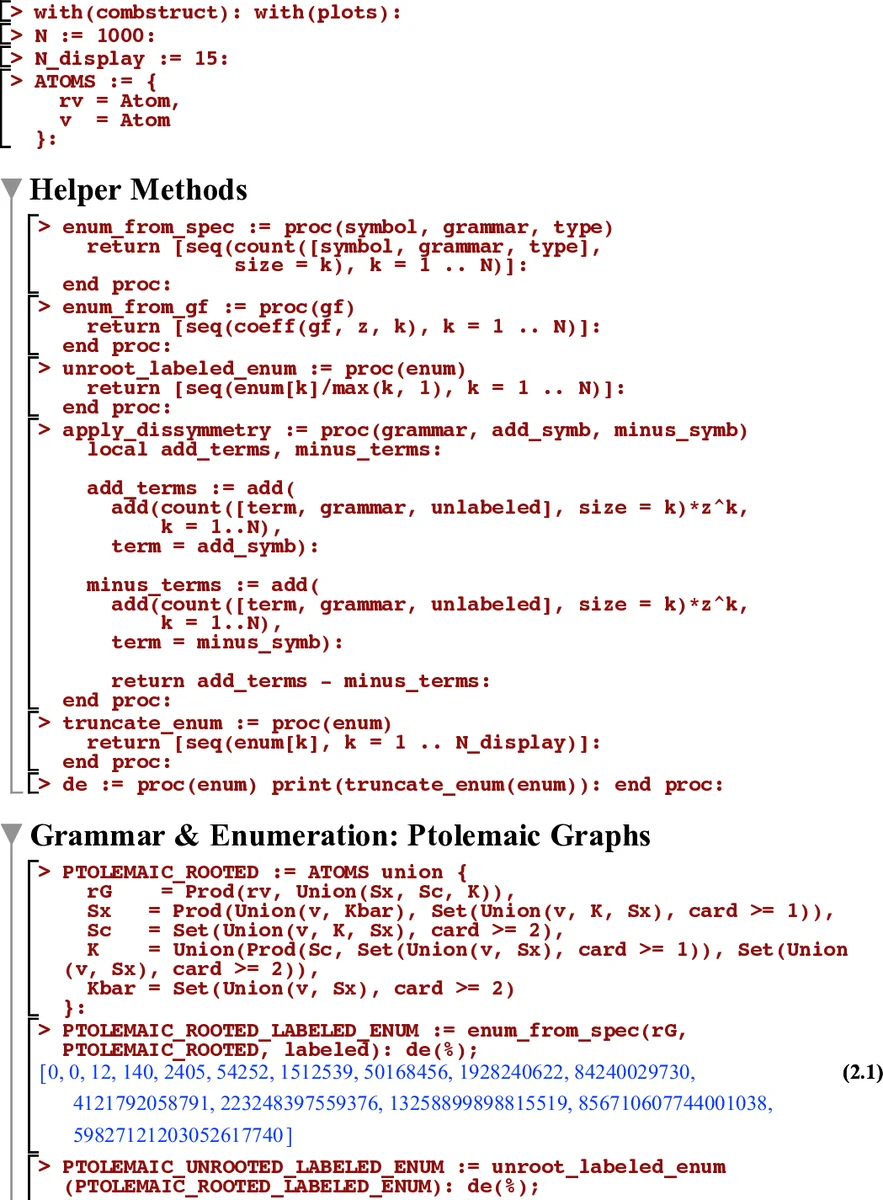
Ptolemaic graphs – the intersection of chordal and distance‑hereditary graphs. The tree must be a clique‑star tree with additional hierarchy constraints: a star‑node may not be attached to a clique‑node that already contains a star‑node in its interior, and the depth of a star relative to its surrounding cliques must be tracked. The authors introduce a “state” component to the grammar to remember whether a given subtree already contains a star centre, enabling the correct avoidance of induced C₄ and diamonds. This yields, for the first time, an exact enumeration of unlabeled ptolemaic graphs.
-
Cactus graphs – graphs where each edge belongs to at most one simple cycle. The authors consider three sub‑families: 2‑cacti (all cycles are double edges), 3‑cacti (all cycles have length three), and 4‑cacti (all cycles have length four). To model cycles they admit prime‑nodes P₃ and P₄ (the 3‑ and 4‑cycles themselves) in the tree, together with the usual clique‑ and star‑nodes. The grammar enforces that each prime‑node is surrounded only by permissible star or leaf attachments, thereby guaranteeing that no larger cycles appear. While 2‑ and 3‑cacti had known enumerations, the paper provides the first exact count for 4‑cacti.
For each class the authors derive explicit generating functions, compute the first several coefficients, and verify them against existing data (when available). They also discuss how the symbolic grammars enable further analytic work: asymptotic estimates via singularity analysis, random sampling through Boltzmann samplers, and the extraction of typical graph parameters (e.g., expected number of blocks, average degree).
The paper concludes by noting that the current work is limited to split‑decomposition trees whose internal labels are only cliques and stars (so‑called clique‑star trees). Extending the methodology to trees containing more complex prime‑nodes—such as larger cycles, complete bipartite graphs, or other prime structures—would broaden the range of forbidden‑subgraph families that can be enumerated. The authors identify this as a promising direction for future research, suggesting that the same pattern‑to‑constraint translation and symbolic grammar approach should remain applicable, albeit with more intricate combinatorial specifications.
Comments & Academic Discussion
Loading comments...
Leave a Comment