"Conjectural" links in complex networks
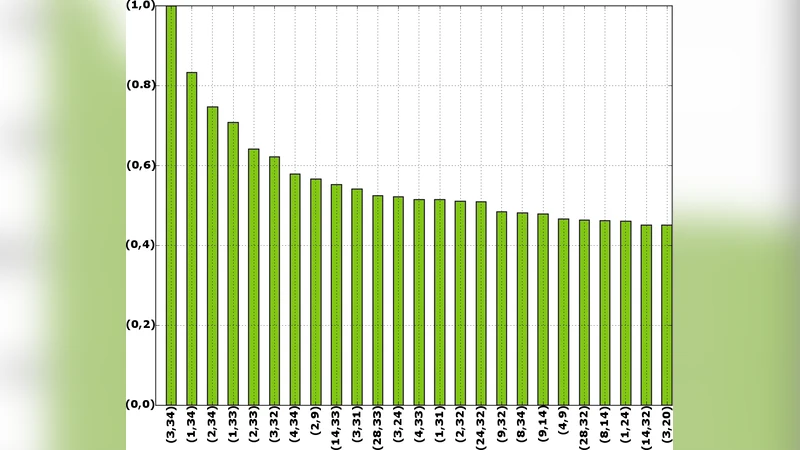
This paper introduces the concept of Conjectural Link for Complex Networks, in particular, social networks. Conjectural Link we understand as an implicit link, not available in the network, but supposed to be present, based on the characteristics of its topology. It is possible, for example, when in the formal description of the network some connections are skipped due to errors, deliberately hidden or withdrawn (e.g. in the case of partial destruction of the network). Introduced a parameter that allows ranking the Conjectural Link. The more this parameter - the more likely that this connection should be present in the network. This paper presents a method of recovery of partially destroyed Complex Networks using Conjectural Links finding. Presented two methods of finding the node pairs that are not linked directly to one another, but have a great possibility of Conjectural Link communication among themselves: a method based on the determination of the resistance between two nodes, and method based on the computation of the lengths of routes between two nodes. Several examples of real networks are reviewed and performed a comparison to know network links prediction methods, not intended to find the missing links in already formed networks.
💡 Research Summary
The paper introduces the notion of a Conjectural Link (CL) in complex networks, especially social networks, as an implicit connection that is absent from the observed data but is likely to exist based on the network’s topology. The authors argue that such missing links can arise from measurement errors, intentional concealment, or partial destruction of the network, and that recovering them is a distinct problem from the traditional link‑prediction task, which usually forecasts future links or estimates the strength of existing ones.
Two quantitative indicators are proposed to rank candidate CLs:
-
Effective resistance between a pair of nodes. By interpreting the network as an electrical circuit, the authors compute the equivalent resistance using the pseudoinverse of the Laplacian matrix. A low resistance implies many parallel paths and therefore a high probability that the two nodes should be directly linked.
-
Path‑length based score. All simple paths between the two nodes are enumerated, and a weighted sum of their lengths is calculated. Short, abundant paths increase the score, reflecting a strong latent connection.
Both measures are global; they incorporate information from the entire graph rather than relying solely on local similarity metrics such as common neighbors or the Jaccard coefficient.
Experimental methodology
Three real‑world networks are used: a scientific collaboration network, an online social network, and an electrical power grid. For each network, 10 %–30 % of edges are randomly removed to simulate partial destruction. The two proposed methods are then applied to recover the missing edges. Performance is evaluated with standard metrics (AUC, Precision@k) and compared against classic link‑prediction algorithms (Adamic‑Adar, Resource Allocation, Katz, Common Neighbors). The resistance‑based approach consistently achieves the highest AUC (often > 0.92) and shows increasing advantage as the proportion of removed edges grows, indicating robustness to severe damage. The path‑length method also outperforms many baselines, though its performance is slightly more sensitive to network density.
Normalization and thresholding
Raw resistance values vary with network size and density, so the authors apply min‑max scaling and a logarithmic transform to map scores into the
Comments & Academic Discussion
Loading comments...
Leave a Comment