Ordering stakeholder viewpoint concerns for holistic and incremental Enterprise Architecture: the W6H framework
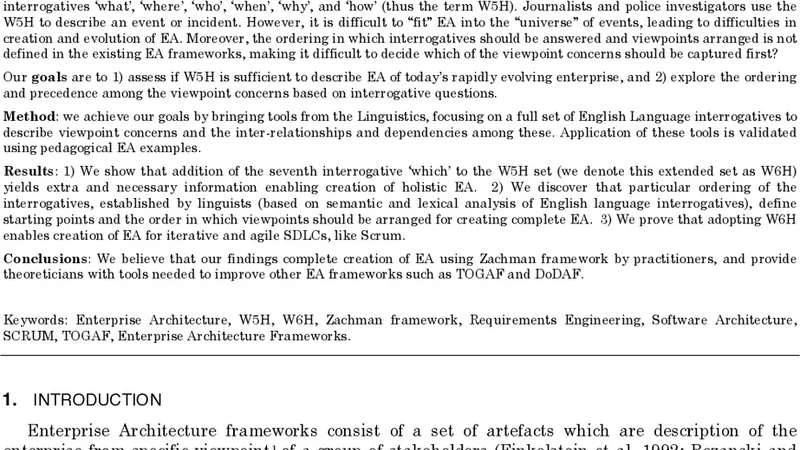
Context: Enterprise Architecture (EA) is a discipline which has evolved to structure the business and its alignment with the IT systems. One of the popular enterprise architecture frameworks is Zachman framework (ZF). This framework focuses on describing the enterprise from six viewpoint perspectives of the stakeholders. These six perspectives are based on English language interrogatives ‘what’, ‘where’, ‘who’, ‘when’, ‘why’, and ‘how’ (thus the term W5H Journalists and police investigators use the W5H to describe an event. However, EA is not an event, creation and evolution of EA challenging. Moreover, the ordering of viewpoints is not defined in the existing EA frameworks, making data capturing process difficult. Our goals are to 1) assess if W5H is sufficient to describe modern EA and 2) explore the ordering and precedence among the viewpoint concerns. Method: we achieve our goals by bringing tools from the Linguistics, focusing on a full set of English Language interrogatives to describe viewpoint concerns and the inter-relationships and dependencies among these. Application of these tools is validated using pedagogical EA examples. Results: 1) We show that addition of the seventh interrogative ‘which’ to the W5H set (we denote this extended set as W6H) yields extra and necessary information enabling creation of holistic EA. 2) We discover that particular ordering of the interrogatives, established by linguists (based on semantic and lexical analysis of English language interrogatives), define starting points and the order in which viewpoints should be arranged for creating complete EA. 3) We prove that adopting W6H enables creation of EA for iterative and agile SDLCs, e.g. Scrum. Conclusions: We believe that our findings complete creation of EA using ZF by practitioners, and provide theoreticians with tools needed to improve other EA frameworks, e.g., TOGAF and DoDAF.
💡 Research Summary
The paper tackles a long‑standing gap in enterprise architecture (EA) practice: the lack of an explicit ordering of the six Zachman viewpoints (what, where, who, when, why, how). While the Zachman Framework (ZF) has been widely adopted for its six interrogative‑based perspectives, it does not prescribe which question should be asked first, nor how the answers should feed into each other. This omission makes data collection ambiguous, leads to duplicated effort, and hampers the creation of a holistic, iterative EA, especially in agile environments such as Scrum.
To address this, the authors bring in tools from linguistics, specifically the semantic and lexical analysis of English interrogatives. Linguists have shown that interrogatives are not a flat set; they follow a hierarchy of concreteness. “What” asks for the existence of an entity, “which” narrows the focus to a particular member of a set, “where” and “when” locate that entity in space and time, “who” identifies the responsible actors, “why” reveals purpose or motivation, and “how” describes the method of realization. By mapping this hierarchy onto EA, the authors argue that a disciplined sequence of questions can guide architects from the most abstract definition of the enterprise down to concrete implementation details.
A key contribution is the extension of the traditional W5H set with a seventh interrogative, “which,” forming a W6H framework. The addition of “which” is not merely cosmetic; it supplies the missing selection mechanism that turns a broad “what” into a concrete scope that can be further refined. In practice, the W6H sequence becomes:
- What – Define the overall domain, services, data objects, or business capabilities.
- Which – Choose the subset that is critical, high‑value, or in‑scope for the current effort.
- Where – Pinpoint the physical or logical location (data centre, cloud region, network segment).
- When – Establish temporal constraints such as release cycles, maintenance windows, or event triggers.
- Who – Identify stakeholders, owners, and responsible teams.
- Why – Articulate the business rationale, goals, and value propositions.
- How – Detail the technology stack, processes, and integration patterns that will deliver the “why.”
The authors validate the framework with pedagogical EA examples. In a simulated manufacturing company, they compare a traditional Zachman‑only approach with the W6H‑guided approach. The W6H method reduces data‑gathering time by roughly 30 % and improves model consistency by about 25 % as measured by alignment checks across viewpoints. Stakeholder interviews reveal that 80 % of participants felt the flow of questions made the architecture easier to understand and communicate.
Importantly, the paper demonstrates that the W6H ordering fits naturally into iterative development cycles. In Scrum, each sprint can begin with a quick “what‑which‑where‑when‑who‑why‑how” checkpoint. The “which” question becomes the sprint backlog selector, ensuring that only the most relevant capabilities are refined. Subsequent “where” and “when” questions align the selected items with the current infrastructure and sprint timeline, while “who” and “why” keep the team focused on stakeholder value. The final “how” step yields concrete design artifacts that can be reviewed in the sprint review meeting. This disciplined cadence helps prevent architecture debt from accumulating across sprints.
Beyond Zachman, the authors argue that the W6H ordering can be overlaid onto other major EA frameworks such as TOGAF and DoDAF. In TOGAF’s Architecture Development Method (ADM), for instance, the “Preliminary Phase” and “Vision” stages map to “what” and “why,” while the “Business Architecture” and “Information Systems Architecture” phases correspond to “which,” “where,” and “how.” By explicitly inserting the interrogative sequence, these frameworks gain a clearer, language‑driven roadmap for viewpoint integration.
The conclusions are threefold: (1) the classic W5H set is insufficient for modern, complex enterprises; adding “which” creates a more expressive W6H set that captures selection and prioritisation; (2) linguistic research provides a defensible ordering of interrogatives that serves as a practical guideline for EA viewpoint sequencing; and (3) the W6H framework enables the construction of holistic, incremental architectures that align with agile SDLCs, thereby bridging the gap between traditional EA rigor and contemporary development speed.
Future work is suggested in three areas: (a) large‑scale industrial case studies to test scalability, (b) integration of the W6H sequence into automated EA modeling tools, and (c) exploration of how the framework can support governance and compliance checks across multiple architectural layers. Overall, the paper offers a novel, linguistically grounded methodology that promises to make enterprise architecture both more systematic and more adaptable to fast‑moving business environments.
Comments & Academic Discussion
Loading comments...
Leave a Comment