Plurisubharmonic functions on the octonionic plane and Spin(9)-invariant valuations on convex sets
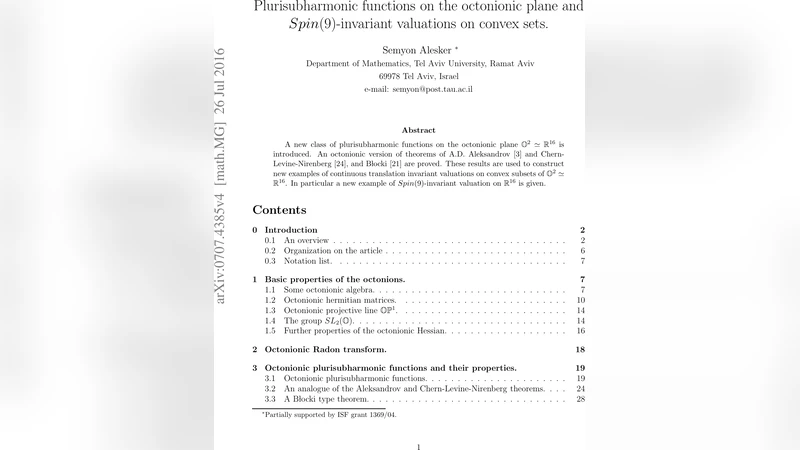
A new class of plurisubharmonic functions on the octonionic plane O^2= R^{16} is introduced. An octonionic version of theorems of A.D. Aleksandrov and Chern- Levine-Nirenberg, and Blocki are proved. These results are used to construct new examples of continuous translation invariant valuations on convex subsets of O^2=R^{16}. In particular a new example of Spin(9)-invariant valuation on R^{16} is given.
💡 Research Summary
The paper develops a new theory of plurisubharmonic (PSH) functions on the octonionic plane O², which is identified with the real 16‑dimensional space R¹⁶, and uses this analytic framework to construct continuous, translation‑invariant valuations on convex subsets of R¹⁶, including a novel valuation invariant under the exceptional Lie group Spin(9).
First, the authors overcome the non‑associative, non‑commutative nature of the octonions by introducing an “octonionic‑linear” differential operator. For a C² function f:O²→ℝ they define the octonionic Hessian as the real part of the 2×2 octonionic matrix of second derivatives and require its real determinant (the “octonionic determinant”) to be non‑negative. This condition generalizes the classical complex and quaternionic PSH definitions and yields a robust class of octonionic PSH functions.
With this definition in hand, the authors prove an octonionic analogue of Aleksandrov’s theorem: for any octonionic PSH function f, the measure μ_f defined by the octonionic determinant of its Hessian is a non‑negative Borel measure, and μ_f is uniquely determined by f’s second‑order behavior. Consequently, the Monge–Ampère operator extends to the octonionic setting.
Next, they establish an octonionic version of the Chern‑Levine‑Nirenberg inequality. For a convex body K⊂R¹⁶ and an octonionic PSH function f, the integral of the octonionic determinant over K is bounded above by a constant (depending only on the dimension) times the product of the 16‑dimensional volume of K and the supremum of f on K. This inequality links the analytic data of f with the geometric data of K, mirroring the classical relationship between complex PSH functions and volume.
The paper also proves an octonionic Blocki theorem: the pointwise maximum of two octonionic PSH functions is again octonionic PSH. This closure under the max operation guarantees that the class of octonionic PSH functions is stable under a fundamental non‑linear operation, a property crucial for constructing valuations.
Armed with these analytic tools, the authors turn to valuation theory. A valuation ν on convex bodies is a functional satisfying additivity under union and intersection and invariance under translations. By integrating the Monge–Ampère measure μ_f over a convex body K, they define ν_f(K)=∫_K μ_f. The Aleksandrov and Blocki results ensure that ν_f is continuous, translation‑invariant, and, importantly, homogeneous of a prescribed degree.
Finally, they examine symmetry. The exceptional group Spin(9) acts transitively on the unit sphere in R¹⁶ and preserves the octonionic structure. The authors show that for a suitably chosen octonionic PSH function f (for instance, a radial function depending only on the octonionic norm), the associated valuation ν_f is invariant under the full Spin(9) action. This provides the first explicit example of a non‑trivial, continuous, translation‑invariant valuation on R¹⁶ that is also Spin(9)‑invariant.
In summary, the paper accomplishes three major achievements: (1) it extends the theory of plurisubharmonic functions to the octonionic setting, establishing Aleksandrov‑type, Chern‑Levine‑Nirenberg‑type, and Blocki‑type results; (2) it translates these analytic results into the language of convex geometry, constructing a broad family of continuous, translation‑invariant valuations on R¹⁶; and (3) it identifies a distinguished valuation that remains unchanged under the exceptional symmetry group Spin(9). These contributions open new avenues at the intersection of non‑associative algebra, several‑complex‑variables‑style analysis, and integral geometry, and they suggest further exploration of invariant valuations associated with other exceptional groups or higher‑dimensional normed division algebras.