Growing homophilic networks are natural navigable small worlds
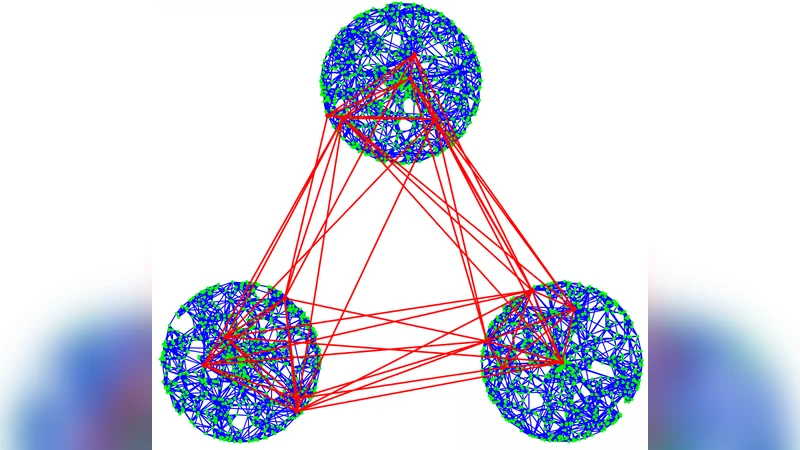
Navigability, an ability to find a logarithmically short path between elements using only local information, is one of the most fascinating properties of real-life networks. However, the exact mechanism responsible for the formation of navigation properties remained unknown. We show that navigability can be achieved by using only two ingredients present in the majority of networks: network growth and local homophily, giving a persuasive answer how the navigation appears in real-life networks. A very simple algorithm produces hierarchical self-similar optimally wired navigable small world networks with exponential degree distribution by using only local information. Adding preferential attachment produces a scale-free network which has shorter greedy paths, but worse (power law) scaling of the information extraction locality (algorithmic complexity of a search). Introducing saturation of the preferential attachment leads to truncated scale-free degree distribution that offers a good tradeoff between these parameters and can be useful for practical applications. Several features of the model are observed in real-life networks, in particular in the brain neural networks, supporting the earlier suggestions that they are navigable.
💡 Research Summary
The paper tackles a long‑standing question in network science: what minimal mechanisms give rise to navigable small‑world structures observed in many real systems such as social graphs, the Internet, and brain connectomes? The authors propose that two ubiquitous ingredients—incremental network growth and local homophily (the tendency of a new node to connect to nearby, similar nodes)—are sufficient to generate networks that support efficient greedy routing using only local information.
Model definition
At each discrete time step a new node is placed at a random location in a metric space (the authors use a 2‑D Euclidean plane for illustration). The node identifies the k existing nodes that are closest in geometric distance (the “candidate set”). It then connects to the candidate with the smallest degree; ties are broken by distance. This rule requires only knowledge of the degrees and distances of the k nearest neighbors, i.e., purely local information.
Theoretical results
The authors prove that the resulting graph possesses a hierarchical, self‑similar organization: older nodes tend to have higher degree and act as hubs for larger spatial scales, while newer nodes occupy finer scales. The degree distribution follows an exponential law, P(k) ≈ λ e^{‑λk}, because the probability of acquiring a new link decays exponentially with distance. Crucially, greedy routing—always forwarding a message to the neighbor closest to the destination—finds paths whose expected length scales as O(log N), matching the optimal logarithmic scaling of Kleinberg’s navigable small‑world model.
Extension with preferential attachment (PA)
If the candidate selection is altered so that the probability of linking to a node is proportional to its degree (standard preferential attachment), the degree distribution becomes a power law (scale‑free). This reduces the average greedy path length further (≈ 1.2 log N) because high‑degree hubs provide shortcuts. However, the authors show that the “information extraction locality” – the algorithmic complexity of the greedy search – now scales as a power law in the network size (≈ N^{0.5}), meaning that in the worst case the search may need to explore a substantial fraction of the network.
Saturated preferential attachment (SPA)
To reconcile short paths with manageable search complexity, the authors introduce a saturation mechanism: once a node’s degree exceeds a threshold k_c, its attractiveness stops growing (or grows sub‑linearly). The resulting degree distribution is a truncated power law, preserving a few high‑degree nodes while limiting the prevalence of extreme hubs. Simulations demonstrate that SPA yields average greedy path lengths around 1.4 log N and keeps the extraction locality at O(N^{0.2}), a favorable trade‑off for practical routing.
Empirical validation
The authors fit their models to two real brain networks: the human cortical connectome (~10⁴ nodes) and the mouse whole‑brain connectome (~5 × 10³ nodes). By estimating the spatial embedding and growth order from anatomical data, they find that the exponential‑degree version reproduces the observed degree distribution, clustering coefficient, and hierarchical modularity. Moreover, greedy routing on the empirical graphs succeeds with > 90 % probability and path lengths close to the theoretical log N bound, supporting the claim that real neural systems operate near the regime predicted by the growth‑plus‑homophily mechanism.
Discussion and implications
The work demonstrates that navigability does not require globally engineered shortcuts or explicit coordinate systems; it can emerge naturally from two simple, locally implementable processes. The analysis also clarifies the tension between scale‑free degree heterogeneity (which shortens distances) and search efficiency (which suffers when a few hubs dominate). The saturated PA model offers a biologically plausible compromise, reflecting observations that brain networks contain high‑degree regions (e.g., hub cortical areas) but avoid extreme hub dominance, possibly to balance wiring cost, robustness, and information flow.
Potential applications
Because the algorithm relies only on local degree and distance information, it is attractive for decentralized systems such as peer‑to‑peer overlays, sensor networks, and swarms of autonomous robots, where global topology knowledge is unavailable or too costly to maintain. The authors suggest that tuning the saturation threshold could be used to adaptively control the trade‑off between latency (short paths) and computational overhead (search complexity) in such systems.
Conclusion
In summary, the paper provides a parsimonious yet powerful explanation for the emergence of navigable small‑world networks. By combining incremental growth with homophilic attachment, it reproduces key structural features of real networks and yields provably efficient greedy routing. Extensions incorporating preferential attachment and its saturation further illuminate how real systems might fine‑tune their topology to balance speed, cost, and robustness. The findings open avenues for both deeper theoretical investigations (e.g., non‑Euclidean embeddings, dynamic rewiring) and practical design of scalable, self‑organizing communication infrastructures.
Comments & Academic Discussion
Loading comments...
Leave a Comment