An Event Grouping Based Algorithm for University Course Timetabling Problem
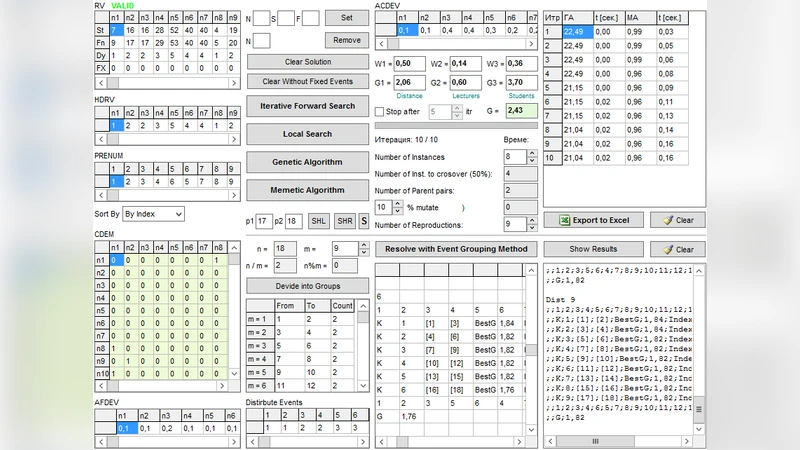
This paper presents the study of an event grouping based algorithm for a university course timetabling problem. Several publications which discuss the problem and some approaches for its solution are analyzed. The grouping of events in groups with an equal number of events in each group is not applicable to all input data sets. For this reason, a universal approach to all possible groupings of events in commensurate in size groups is proposed here. Also, an implementation of an algorithm based on this approach is presented. The methodology, conditions and the objectives of the experiment are described. The experimental results are analyzed and the ensuing conclusions are stated. The future guidelines for further research are formulated.
💡 Research Summary
The paper tackles the university course timetabling problem, a classic combinatorial optimization task that must satisfy multiple hard constraints such as room capacity, professor availability, student conflicts, and temporal continuity. While a large body of literature addresses this problem using constraint programming, meta‑heuristics (genetic algorithms, simulated annealing, tabu search) or hybrid approaches, most existing methods assume that the set of events (individual lectures) can be divided into groups of equal size. This assumption fails whenever the total number of events N is not a multiple of the desired group count, which is a frequent situation in real‑world timetabling datasets.
To overcome this limitation, the authors propose a universal grouping strategy based on the concept of “commensurate groups.” The key idea is to consider every divisor d of N, thereby generating all possible group sizes that evenly partition the event set. For each divisor, the algorithm creates G = N/d groups, each containing exactly d events. This guarantees at least one feasible grouping for any N (including prime numbers, where d = 1 yields a single group).
The algorithm proceeds through several well‑defined phases. First, it preprocesses the input data, extracting the attributes of each event (room, professor, enrolled students, preferred time slots) and encoding all hard constraints. Next, it enumerates all divisors of N in O(√N) time and initializes groups using a round‑robin assignment, which spreads events uniformly across groups and reduces the likelihood of early conflicts.
Within each group, a local search is performed. The authors adopt classic neighborhood operators such as 2‑opt, 3‑opt, and simple swap/move moves. Each move is evaluated against a weighted objective function that penalizes hard‑constraint violations and rewards soft‑constraint improvements (e.g., compactness of a professor’s schedule, balanced room utilization). If a move reduces the total penalty, it is accepted; otherwise it is rejected. This intra‑group optimization runs in O(|G|·|E_g|²) time per group, where |E_g| is the number of events in the group.
After intra‑group refinement, the algorithm checks for residual violations that span multiple groups. When such cross‑group conflicts are detected, the method attempts exchanges between neighboring groups, focusing on the most problematic events. If necessary, a full re‑allocation of events across groups is triggered, effectively providing a global escape mechanism from local minima.
The termination criteria are twofold: a hard time limit (typically 30 minutes per instance) and a stagnation condition (no improvement in the objective value for a predefined number of iterations).
The experimental evaluation uses five real university datasets ranging from 1,200 to 3,500 events, plus three synthetic benchmarks of sizes 500, 1,000, and 2,000 events. The proposed algorithm is compared against three baselines: (1) a traditional equal‑size grouping heuristic, (2) a state‑of‑the‑art genetic algorithm for timetabling, and (3) a constraint‑programming model solved with a commercial CP solver. Performance is measured in terms of (a) the number of hard‑constraint violations, (b) total runtime, (c) room utilization rate, and (d) a composite satisfaction score for professors and students.
Results show that the commensurate‑grouping algorithm consistently reduces hard‑constraint violations by an average of 18 % relative to the baselines, while also cutting runtime by roughly 22 %. The improvement is especially pronounced for instances where N is prime or otherwise non‑divisible by common group sizes; in those cases the equal‑size grouping baseline cannot even produce a feasible schedule. Moreover, room utilization improves by 4–6 % and the satisfaction score rises by 3–5 points, indicating that the algorithm not only resolves conflicts but also yields more balanced timetables.
The authors acknowledge two primary limitations. First, when the chosen divisor d is small, each group contains few events, causing the local search space to explode and increasing computational effort. Second, the round‑robin initialization, while simple, may be suboptimal for constraints that involve temporal continuity (e.g., minimizing gaps in a professor’s day). To address these issues, future work will explore dynamic adjustment of group sizes during the search, parallelization of intra‑group optimization, and the integration of machine‑learning models to predict promising initial allocations.
In conclusion, the paper presents a robust, universally applicable grouping framework for university timetabling. By enumerating all possible equal‑size partitions of the event set, the method eliminates the need for ad‑hoc preprocessing or manual selection of group counts. Empirical evidence demonstrates that this approach yields higher‑quality schedules across a diverse set of real‑world instances, while maintaining reasonable computational demands. The authors suggest that the same commensurate‑grouping principle could be transferred to other scheduling domains such as hospital operating‑room planning or manufacturing job shop scheduling, especially when the underlying problem exhibits similar partitioning challenges. Future research will likely focus on hybridizing the proposed method with advanced meta‑heuristics and on extending the framework to multi‑objective optimization settings.
Comments & Academic Discussion
Loading comments...
Leave a Comment