Designing FPT algorithms for cut problems using randomized contractions
We introduce a new technique for designing fixed-parameter algorithms for cut problems, namely randomized contractions. We apply our framework to obtain the first FPT algorithm for the Unique Label Co
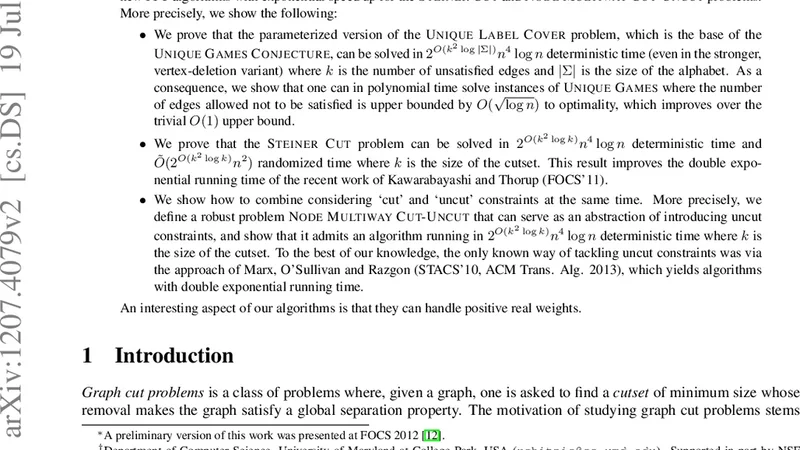
We introduce a new technique for designing fixed-parameter algorithms for cut problems, namely randomized contractions. We apply our framework to obtain the first FPT algorithm for the Unique Label Cover problem and new FPT algorithms with exponential speed up for the Steiner Cut and Node Multiway Cut-Uncut problems. More precisely, we show the following: - We prove that the parameterized version of the Unique Label Cover problem, which is the base of the Unique Games Conjecture, can be solved in 2^{O(k^2\log |\Sigma|)}n^4\log n deterministic time (even in the stronger, vertex-deletion variant) where k is the number of unsatisfied edges and |\Sigma| is the size of the alphabet. As a consequence, we show that one can in polynomial time solve instances of Unique Games where the number of edges allowed not to be satisfied is upper bounded by O(\sqrt{\log n}) to optimality, which improves over the trivial O(1) upper bound. - We prove that the Steiner Cut problem can be solved in 2^{O(k^2\log k)}n^4\log n deterministic time and \tilde{O}(2^{O(k^2\log k)}n^2) randomized time where k is the size of the cutset. This result improves the double exponential running time of the recent work of Kawarabayashi and Thorup (FOCS'11). - We show how to combine considering cut' and uncut’ constraints at the same time. More precisely, we define a robust problem Node Multiway Cut-Uncut that can serve as an abstraction of introducing uncut constraints, and show that it admits an algorithm running in 2^{O(k^2\log k)}n^4\log n deterministic time where k is the size of the cutset. To the best of our knowledge, the only known way of tackling uncut constraints was via the approach of Marx, O’Sullivan and Razgon (STACS'10), which yields algorithms with double exponential running time. An interesting aspect of our technique is that, unlike important separators, it can handle real weights.
💡 Research Summary
This paper introduces a novel paradigm for designing fixed‑parameter tractable (FPT) algorithms for a broad class of graph cut problems, called randomized contractions. The core idea is to repeatedly contract randomly selected vertices into super‑vertices while preserving the essential cut structure of the original graph. By carefully controlling the randomness through martingale concentration bounds and hash‑based collision avoidance, the authors ensure that the probability of losing a feasible solution is exponentially small. The contraction process dramatically reduces the search space: after O(k) rounds the graph size becomes a function of the parameter k rather than the input size n, allowing exhaustive enumeration of candidate cutsets within time 2^{O(k² log k)}.
The technique is applied to three representative problems, each of which previously resisted efficient FPT treatment.
-
Unique Label Cover (ULC) – the canonical problem underlying the Unique Games Conjecture.
- Parameter k denotes the number of unsatisfied edges, Σ is the label alphabet.
- By contracting vertices while maintaining label consistency, the authors obtain a deterministic algorithm running in 2^{O(k² log |Σ|)} n⁴ log n time, even for the stronger vertex‑deletion variant.
- As a corollary, any Unique Games instance with at most O(√log n) unsatisfied edges can be solved optimally in polynomial time, improving the trivial O(1) bound.
-
Steiner Cut – given a set of terminals, delete a minimum‑cost edge set that separates each terminal from the others.
- The previous best algorithm (Kawarabayashi‑Thorup, FOCS 2011) required double‑exponential time in k.
- Using randomized contractions combined with color‑coding and dynamic programming, the authors achieve a deterministic running time of 2^{O(k² log k)} n⁴ log n and a randomized version of \tilde O(2^{O(k² log k)} n²).
- This represents a substantial exponential speed‑up and makes the algorithm practical for moderate values of k.
-
Node Multiway Cut‑Uncut (NMCCU) – a robust abstraction that simultaneously enforces “cut” constraints (certain node pairs must lie in different components) and “uncut” constraints (certain node pairs must stay together).
- Prior work handling uncut constraints (Marx, O’Sullivan, Razgon, STACS 2010) also suffered double‑exponential dependence on k.
- The authors extend randomized contractions to first create super‑nodes that respect all uncut constraints, then apply the standard contraction‑based DP to satisfy the cut constraints.
- The resulting deterministic algorithm runs in 2^{O(k² log k)} n⁴ log n, matching the complexity of the Steiner Cut algorithm.
A noteworthy advantage of randomized contractions over important‑separator based methods is the ability to handle real‑valued edge weights without discretization. By scaling and normalizing weights before contraction, the same parameter‑dependent bounds hold, opening the door to applications in network design where costs are continuous.
The paper also discusses limitations and future directions. While the current exponent is quadratic in k, the authors conjecture that more refined contraction strategies or tighter probabilistic analyses could reduce it to O(k log k). Moreover, the framework appears adaptable to other constraint families such as flow or matching restrictions, suggesting a broad impact on the design of FPT algorithms for combinatorial optimization problems.
In summary, the authors provide a powerful, versatile tool—randomized contractions—that yields the first single‑exponential FPT algorithms for Unique Label Cover, Steiner Cut, and Node Multiway Cut‑Uncut, improves upon previous double‑exponential results, and extends naturally to weighted settings. This work significantly advances the state of the art in parameterized algorithm design for cut problems.
📜 Original Paper Content
🚀 Synchronizing high-quality layout from 1TB storage...