The long-term scientific benefits of a space economy
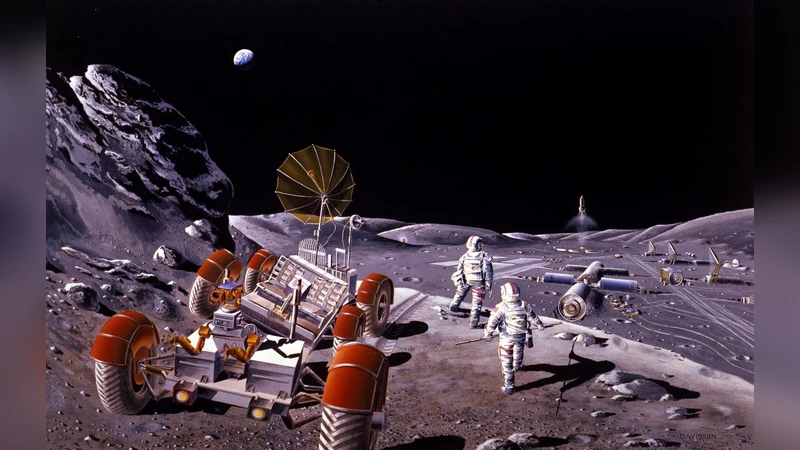
Utilisation of the material and energy resources of the Solar System will be essential for the development of a sustainable space economy and associated infrastructure. Science will be a major beneficiary of a space economy, even if its major elements (e.g. space tourism, resource extraction activities on the Moon or asteroids, and large-scale in-space construction capabilities) are not developed with science primarily in mind. Examples of scientific activities that would be facilitated by the development of space infrastructure include the construction of large space telescopes, ambitious space missions (including human missions) to the outer Solar System, and the establishment of scientific research stations on the Moon and Mars (and perhaps elsewhere). In the more distant future, an important scientific application of a well-developed space infrastructure may be the construction of interstellar space probes for the exploration of planets around nearby stars.
💡 Research Summary
The paper argues that a sustainable space economy—built on the extraction and utilization of Solar System resources such as lunar and asteroid materials, space tourism, and large‑scale in‑space construction—will generate profound, long‑term scientific benefits even when those economic activities are not primarily designed for research. First, the availability of raw materials on the Moon and asteroids would enable the on‑site manufacture of massive optical components, structural elements, and radiation shielding. This would make possible the assembly of space telescopes far larger than any that can be launched from Earth, dramatically improving angular resolution, sensitivity, and wavelength coverage across the electromagnetic spectrum. Second, in‑orbit refueling stations powered by locally produced water‑derived propellant would lower the cost and increase the flexibility of deep‑space missions, making crewed voyages to the outer planets feasible. Third, permanent research outposts on the Moon’s polar regions or on Mars would allow long‑duration experiments in low‑gravity, high‑radiation, and extreme‑temperature environments, reducing the time and expense associated with returning samples to Earth. Fourth, a mature space infrastructure would lay the groundwork for interstellar probes. With large‑scale manufacturing in space, advanced propulsion concepts such as laser‑sail, nuclear‑fusion, or high‑power electric drives could be integrated into spacecraft built and launched from lunar or asteroid bases, enabling missions to nearby stars such as Proxima Centauri. The authors emphasize a reciprocal relationship: economic incentives drive the development of robust space infrastructure, and that infrastructure, in turn, expands the scope, scale, and ambition of scientific inquiry. In the long run, a thriving space economy could usher in an era where humanity conducts unprecedented astronomical observations, conducts comprehensive planetary science across the Solar System, and eventually explores exoplanetary systems directly, thereby transforming both our scientific knowledge and our capacity for technological innovation.
Comments & Academic Discussion
Loading comments...
Leave a Comment