Complexity of Metric Dimension on Planar Graphs
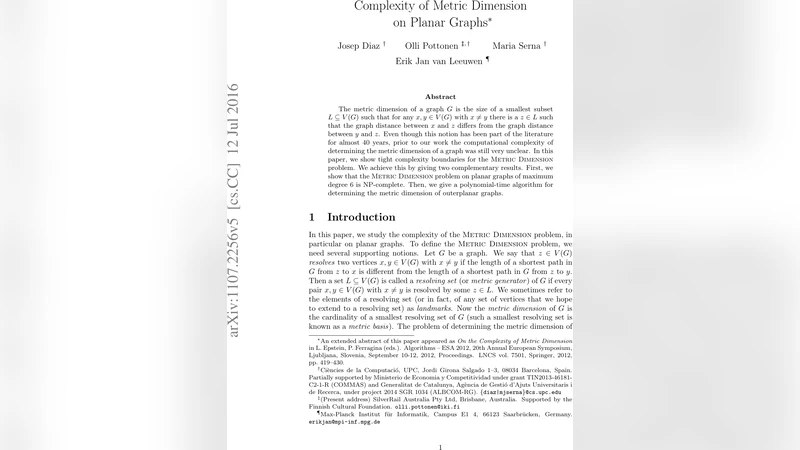
The metric dimension of a graph $G$ is the size of a smallest subset $L \subseteq V(G)$ such that for any $x,y \in V(G)$ with $x\not= y$ there is a $z \in L$ such that the graph distance between $x$ and $z$ differs from the graph distance between $y$ and $z$. Even though this notion has been part of the literature for almost 40 years, prior to our work the computational complexity of determining the metric dimension of a graph was still very unclear. In this paper, we show tight complexity boundaries for the Metric Dimension problem. We achieve this by giving two complementary results. First, we show that the Metric Dimension problem on planar graphs of maximum degree $6$ is NP-complete. Then, we give a polynomial-time algorithm for determining the metric dimension of outerplanar graphs.
💡 Research Summary
The paper settles a long‑standing open question about the computational complexity of the Metric Dimension problem on planar graphs. Metric Dimension asks for the smallest set of vertices (landmarks) such that every pair of distinct vertices in a graph is distinguished by at least one landmark via different graph distances. While the problem has been known to be NP‑complete on general graphs, its status on planar graphs remained unclear.
Hardness Result.
The authors prove that Metric Dimension remains NP‑complete even when restricted to planar graphs of maximum degree six. The reduction starts from a specially crafted variant of 3‑SAT called 1‑Negative Planar 3‑SAT: each variable appears exactly once negatively and once or twice positively, each clause contains two or three distinct variables, every three‑variable clause contains at least one negative literal, and the variable‑clause incidence graph is planar. From such an instance they build a planar graph HΨ by replacing every variable vertex with a variable gadget and every clause vertex with a clause gadget.
A variable gadget forces the solution to contain three “fixed” landmarks and a fourth landmark whose placement encodes the truth value of the variable (true, false, or undefined). The gadget is designed so that the fourth landmark can be placed in exactly three distinct positions, each corresponding to one of the three logical states. Clause gadgets are connected to the appropriate parts of the variable gadgets; they are constructed so that the only way to resolve all vertex pairs inside a clause gadget is to have the adjacent variable gadgets’ fourth landmarks placed consistently with a satisfying assignment. Consequently, a resolving set of size 4n (n = number of variables) exists in HΨ if and only if the original SAT formula is satisfiable. The construction preserves planarity and keeps the maximum degree at six, establishing NP‑completeness of Planar Metric Dimension.
Algorithmic Result for Outerplanar Graphs.
On the positive side, the paper presents a polynomial‑time algorithm for computing the metric dimension of outerplanar graphs. Outerplanar graphs have treewidth at most two, but Metric Dimension is highly non‑local: a single landmark can affect the distinguishability of vertex pairs arbitrarily far away, which defeats standard tree‑decomposition dynamic programming.
The authors therefore introduce a different decomposition based on the dual tree of the graph’s biconnected components. In this tree T, each node corresponds either to a face of the outerplanar embedding or to a cut‑vertex, and each edge corresponds to an inner edge or a bridge. Each node thus represents a separator of the original graph.
Two novel data structures are defined:
- Boundary Conditions – compact summaries of how already placed landmarks influence the yet‑unprocessed part of the graph and what requirements future landmarks must satisfy.
- Configurations – mechanisms for merging the boundary conditions coming from the children of a node into a new boundary condition for the parent. Although a face may contain arbitrarily many vertices, the authors prove that the number of relevant configurations is only polynomial in the size of the graph.
The algorithm proceeds bottom‑up on T. For each leaf, all feasible boundary conditions are enumerated. For an internal node, the algorithm enumerates all configurations, combines the children’s boundary conditions according to each configuration, and records the cheapest resulting boundary condition. Because the total number of configurations per node is polynomial, the overall running time is polynomial. The final boundary condition at the root yields the minimum number of landmarks, i.e., the metric dimension of the outerplanar graph.
Significance and Techniques.
The paper’s contributions are twofold. First, it closes the complexity gap for planar graphs by showing that even very sparse planar instances (degree ≤6) are already intractable. Second, it demonstrates that despite the non‑local nature of the problem, outerplanar graphs admit an exact polynomial algorithm via a carefully crafted decomposition and the introduction of boundary conditions and configurations. These techniques provide a new toolkit for handling other non‑local optimization problems on planar or low‑treewidth graphs, where traditional MSO‑based or bidimensionality approaches fail.
Overall, the work advances both the theoretical understanding of Metric Dimension and practical algorithmic methods for important graph classes.
Comments & Academic Discussion
Loading comments...
Leave a Comment