Memory of jamming - multiscale models for soft and granular matter
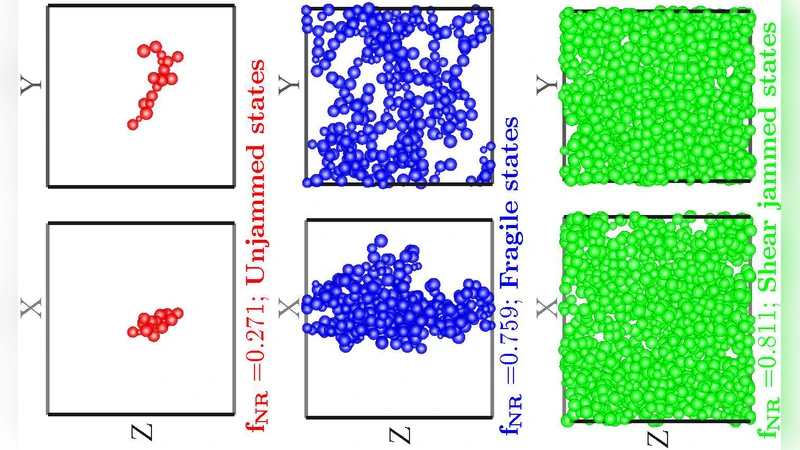
Soft, disordered, micro-structured materials are ubiquitous in nature and industry, and are different from ordinary fluids or solids, with unusual, interesting static and flow properties. The transition from fluid to solid -at the so-called jamming density- features a multitude of complex mechanisms, but there is no unified theoretical framework that explains them all. In this study, a simple yet quantitative and predictive model is presented, which allows for a variable, changing jamming density, encompassing the memory of the deformation history and explaining a multitude of phenomena at and around jamming. The jamming density, now introduced as a new state-variable, changes due to the deformation history and relates the system’s macroscopic response to its microstructure. The packing efficiency can increase logarithmically slow under gentle repeated (isotropic) compression, leading to an increase of the jamming density. In contrast, shear deformations cause anisotropy, changing the packing efficiency exponentially fast with either dilatancy or compactancy. The memory of the system near jamming can be explained by a microstatistical model that involves a multiscale, fractal energy landscape and links the microscopic particle picture to the macroscopic continuum description, providing a unified explanation for the qualitatively different flow-behavior for different deformation modes. To complement our work, a recipe to extract the history-dependent jamming density from experimentally accessible data is proposed, and alternative state-variables are compared. The proposed simple macroscopic constitutive model is calibrated with the memory of microstructure. Such approach can help understanding predicting and mitigating failure of structures or geophysical hazards, and will bring forward industrial process design/optimization, and help solving scientific challenges in fundamental research.
💡 Research Summary
The paper introduces a paradigm shift in the description of jamming in soft and granular materials by treating the jamming density (φ J) not as a fixed material constant but as a history‑dependent state variable, φ J(H). Using discrete element method (DEM) simulations of frictionless, polydisperse spheres, the authors explore two elementary deformation modes: isotropic compression (including tapping) and volume‑conserving pure shear. In isotropic compression, repeated cycles lead to a logarithmically slow increase of packing efficiency, yielding φ J that grows as φ J ≈ φ J₀ + A log(1 + M) with the number of cycles M. In contrast, pure shear induces strong anisotropy; the packing efficiency changes exponentially fast, either compacting or dilating depending on shear rate and initial packing fraction.
To rationalize these distinct kinetics, the authors propose a multiscale, fractal energy‑landscape model. The microstructure explores basins of the landscape: isotropic compression corresponds to a slow, low‑barrier exploration, while shear triggers rapid transitions over high barriers. This framework naturally yields the observed logarithmic versus exponential evolution of φ J(H).
On the macroscopic level, the constitutive description is extended by adding two scalar internal variables: the history‑dependent jamming density φ J and an isotropic fabric invariant F_v that quantifies the average coordination structure. The stress–strain relations become
P = P(φ − φ J(H)), τ = τ(γ̇, φ − φ J(H), F),
with an evolution law for φ J: dφ J/dt = f_iso(ε̇_iso) + f_shear(γ̇). The isotropic term f_iso follows a logarithmic law, while the shear term f_shear follows an exponential law, reflecting the two deformation modes. Model parameters are calibrated directly from DEM data: pressure‑volume curves, shear stress versus strain‑rate, and fabric tensor evolution.
A practical experimental protocol is presented for extracting φ J(H) from measurable quantities such as volumetric strain and shear stress during cyclic compression–shear tests. The authors demonstrate that incorporating φ J(H) dramatically improves the predictive capability of continuum models, especially for phenomena like shear‑induced dilation, compaction, and the transition from solid‑like to fluid‑like behavior.
The work has broad implications. In geotechnical engineering, the model can capture the highly hysteretic, non‑linear response of soils, improving predictions of liquefaction and failure under seismic loading. In industrial processes such as powder compaction, it offers a quantitative tool for optimizing packing density and avoiding defects. In fundamental physics, it provides a unified description of jamming, shear‑jamming, and glassy dynamics across different preparation protocols. By coupling a history‑dependent jamming density with fabric anisotropy, the authors deliver a comprehensive, multiscale framework that bridges particle‑scale rearrangements and continuum‑scale constitutive behavior, opening new avenues for both scientific understanding and practical applications.
Comments & Academic Discussion
Loading comments...
Leave a Comment