Analyzing research performance: proposition of a new complementary index
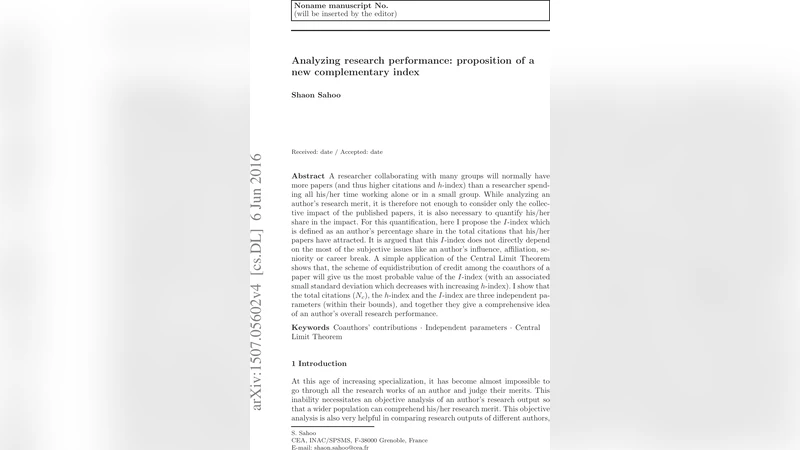
A researcher collaborating with many groups will normally have more papers (and thus higher citations and $h$-index) than a researcher spending all his/her time working alone or in a small group. While analyzing an author’s research merit, it is therefore not enough to consider only the collective impact of the published papers, it is also necessary to quantify his/her share in the impact. For this quantification, here I propose the $I$-index which is defined as an author’s percentage share in the total citations that his/her papers have attracted. It is argued that this $I$-index does not directly depend on the most of the subjective issues like an author’s influence, affiliation, seniority or career break. A simple application of the Central Limit Theorem shows that, the scheme of equidistribution of credit among the coauthors of a paper will give us the most probable value of the $I$-index (with an associated small standard deviation which decreases with increasing $h$-index). I show that the total citations ($N_c$), the $h$-index and the $I$-index are three independent parameters (within their bounds), and together they give a comprehensive idea of an author’s overall research performance.
💡 Research Summary
The paper argues that the conventional metrics used to assess a researcher’s impact—total citations (N_c) and the h‑index—are insufficient because they conflate sheer productivity with the individual’s actual contribution, especially in an era where multi‑author collaborations are common. A researcher who frequently co‑authors papers with large groups will naturally accumulate high citation counts and a high h‑index, even if his or her personal input to each work is modest. To address this shortcoming, the author introduces a third, complementary metric called the I‑index (Independence Index), defined as the percentage share of the total citations that a researcher’s papers have collectively received.
Mathematically, if a researcher has N_p papers, the i‑th paper receives c_i citations and has n_i co‑authors, the expected share of credit for that paper under an equal‑distribution assumption is z_i = c_i / n_i. The I‑index is then
I = ( Σ_{i=1}^{N_p} z_i ) / ( Σ_{i=1}^{N_p} c_i ) × 100 % = ( Σ c_i / n_i ) / N_c × 100 %.
The core claim is that the equal‑distribution scheme (i.e., assigning each co‑author an equal fraction of a paper’s citations) yields the most probable estimate of a researcher’s true contribution. Two statistical arguments support this claim. First, each author’s deviation from the average share, e_j, satisfies Σ e_j = 0. When the number of papers is large, the sum of these deviations (E_r) becomes negligible compared with Σ c_i / n_i, making the error in the I‑index essentially zero. Second, invoking the Central Limit Theorem, the distribution of the I‑index across many papers converges to a normal distribution centered on the equal‑distribution value, with a standard deviation that shrinks as 1/√h. Hence, for researchers with a high h‑index, the I‑index is a stable and reliable estimator.
The paper further emphasizes that the I‑index, total citations, and h‑index are mutually independent dimensions of research performance. While N_c captures overall productivity, the h‑index reflects the balance between quantity and citation impact, and the I‑index quantifies the researcher’s independent contribution. Together they provide a three‑dimensional profile that can differentiate between, for example, two scientists with identical h‑indices and citation counts but differing collaboration patterns—one primarily a collaborator in large teams, the other more often a sole or lead author.
The author also critiques existing composite metrics such as the ¯h‑index, noting that they introduce subjective weighting and can disadvantage junior researchers. In contrast, the I‑index requires only publicly available data (citation counts and author lists) and is computationally straightforward, making it attractive for institutions, funding agencies, and hiring committees.
To illustrate practical usage, the paper proposes two derived indices: the normalized h‑index (e_h‑index), which combines h and I to estimate the h‑value the researcher would have if working alone, and the e_hT‑index, which further adjusts for seniority. These composite scores aim to encapsulate productivity, impact, independence, and career stage in a single figure, while still allowing analysts to examine each component separately.
In summary, the manuscript presents a theoretically grounded, statistically justified metric—the I‑index—that fills a gap in bibliometric evaluation by measuring a researcher’s share of total citation credit. When used alongside total citations and the h‑index, it offers a more nuanced, fair, and transparent assessment of scholarly performance, discourages unethical authorship practices, and promotes genuine collaboration.
Comments & Academic Discussion
Loading comments...
Leave a Comment