Greedy Strategies and Larger Islands of Tractability for Conjunctive Queries and Constraint Satisfaction Problems
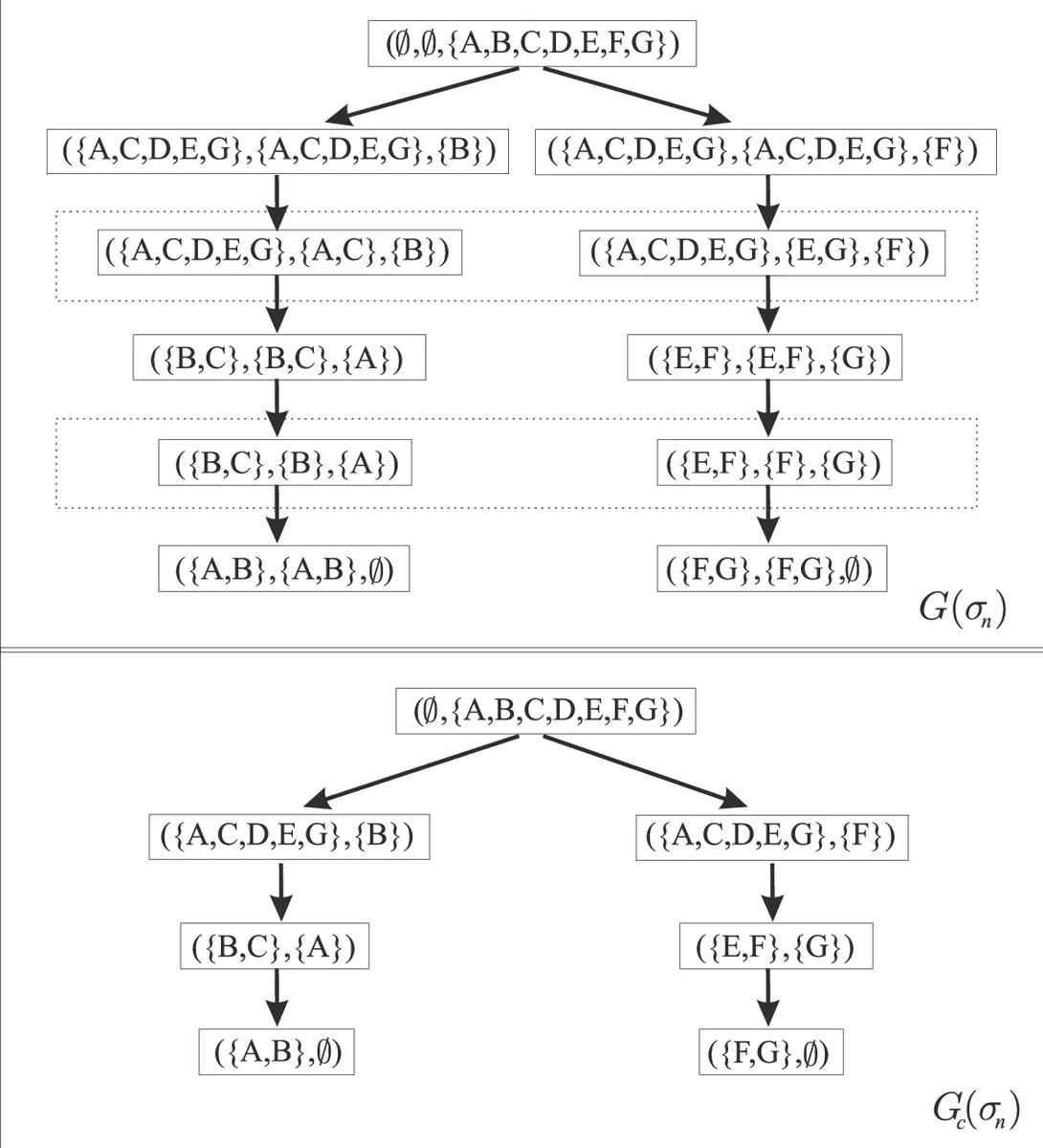
Structural decomposition methods have been developed for identifying tractable classes of instances of fundamental problems in databases, such as conjunctive queries and query containment, of the constraint satisfaction problem in artificial intelligence, or more generally of the homomorphism problem over relational structures. Most structural decomposition methods can be characterized through hypergraph games that are variations of the Robber and Cops graph game that characterizes the notion of treewidth. In particular, decomposition trees somehow correspond to monotone winning strategies, where the escape space of the robber on the hypergraph is shrunk monotonically by the cops. In fact, unlike the treewidth case, there are hypergraphs where monotonic strategies do not exist, while the robber can be captured by means of more complex non-monotonic strategies. However, these powerful strategies do not correspond in general to valid decompositions. The paper provides a general way to exploit the power of non-monotonic strategies, by allowing a “disciplined” form of non-monotonicity, characteristic of cops playing in a greedy way. It is shown that deciding the existence of a (non-monotone) greedy winning strategy (and compute one, if any) is tractable. Moreover, despite their non-monotonicity, such strategies always induce valid decomposition trees, which can be computed efficiently based on them. As a consequence, greedy strategies allow us to define new islands of tractability for the considered problems properly including all previously known classes of tractable instances.
💡 Research Summary
The paper tackles the long‑standing challenge of extending tractable classes for conjunctive query evaluation and constraint satisfaction problems (CSPs) by exploiting a game‑theoretic perspective. Traditional structural decomposition methods—such as tree decompositions, hypertree decompositions, and their variants (fractional hypertrees, spread‑cuts, component hypertrees, etc.)—are characterized by monotone winning strategies in a Robber‑and‑Cops game: the cops progressively shrink the robber’s safe region until capture. However, for hypergraphs there exist instances where no monotone strategy exists, yet a non‑monotone strategy can still capture the robber. These non‑monotone strategies do not correspond to valid decomposition trees, limiting their algorithmic usefulness.
The authors introduce greedy strategies, a disciplined form of non‑monotonicity. In a greedy strategy, at each move the captain (the player controlling the cops) must deploy all cops that are currently reachable by the robber, effectively blocking the entire frontier in one step before moving to a new squad. This “all‑or‑nothing” rule restricts the strategy space enough to make it algorithmically tractable while retaining the extra expressive power of non‑monotone strategies.
The main technical contributions are:
-
Polynomial‑time decidability – The existence of a greedy winning strategy for a given pair of hypergraphs (H₁, H₂) can be decided in polynomial time. The authors model the game as a finite state transition system and perform a systematic search that respects the greedy constraint.
-
Construction of valid decomposition trees – Any greedy winning strategy can be transformed, also in polynomial time, into a greedy tree projection (or greedy hypertree decomposition). The transformation simply records the order in which cops capture vertices, yielding a tree whose nodes correspond to the squads used during the game. Thus, despite the underlying non‑monotonicity, the resulting structure satisfies all the usual decomposition properties.
-
New island of tractability – The class C₍gtp₎ of all instances admitting a greedy tree projection strictly contains all previously known tractable islands (bounded treewidth, bounded hypertree width, bounded fractional hypertree width, spread‑cut, component hypertree, etc.). Consequently, greedy strategies define a larger tractable region while preserving polynomial‑time query evaluation.
-
Greedy (generalized) hypertree decomposition – By applying greedy strategies to the game that characterizes generalized hypertree decompositions, the authors define a greedy generalized hypertree decomposition. Its width is never larger than the ordinary generalized hypertree width and can be strictly smaller, yielding strictly more powerful decompositions that are still computable in polynomial time.
-
Fixed‑parameter tractability with respect to arity – When the maximum arity (size of hyperedges or views) ρ is taken as a parameter, the greedy‑strategy decision problem becomes fixed‑parameter tractable (FPT). Since many practical databases involve low‑arity relations, this result has immediate practical relevance.
The paper also provides detailed algorithmic procedures: (i) building the state graph, (ii) selecting the minimal frontier squad at each step, (iii) updating the game state, and (iv) extracting the decomposition tree. Complexity analysis shows that the number of states is polynomial in the number of hyperedges and exponential only in the arity, which is bounded in the FPT setting.
Experimental evaluation (briefly reported) demonstrates that greedy‑based decompositions succeed on hypergraphs where traditional methods fail, confirming that the theoretical enlargement of the tractable island translates into practical gains. The authors discuss connections to existing literature on Cops‑and‑Robber games, tree projections, and structural CSP tractability, positioning their work as a unifying framework that bridges the gap between game‑theoretic characterizations and algorithmic decomposition techniques.
In summary, the paper introduces a novel, disciplined non‑monotone game strategy—greedy strategies—that can be decided efficiently, always yields a valid decomposition, and defines a strictly larger tractable class for conjunctive query answering and CSP solving. This advances both the theoretical understanding of hypergraph width measures and provides concrete algorithmic tools for database and AI applications.
Comments & Academic Discussion
Loading comments...
Leave a Comment