Scaling of foreign attractiveness for countries and states
People’s behavior on online social networks, which store geo-tagged information showing where people were or are at the moment, can provide information about their offline life as well. In this paper we present one possible research direction that can be taken using Flickr dataset of publicly available geo-tagged media objects (e.g., photographs, videos). Namely, our focus is on investigating attractiveness of countries or smaller large-scale composite regions (e.g., US states) for foreign visitors where attractiveness is defined as the absolute number of media objects taken in a certain state or country by its foreign visitors compared to its population size. We also consider it together with attractiveness of the destination for the international migration, measured through publicly available dataset provided by United Nations. By having those two datasets, we are able to look at attractiveness from two different perspectives: short-term and long-term one. As our previous study showed that city attractiveness for Spanish cities follows a superlinear trend, here we want to see if the same law is also applicable to country/state (i.e., composite regions) attractiveness. Finally, we provide one possible explanation for the obtained results.
💡 Research Summary
The paper investigates how “foreign attractiveness” – the number of geo‑tagged media objects created by non‑resident visitors – scales with the population size of geographic units at three hierarchical levels: cities, states (U.S. states plus Washington D.C.), and countries. The authors use two publicly available big‑data sources. The first is the Yahoo! Webscope Flickr dataset, which contains metadata for roughly 100 million media objects uploaded between 2004 and 2014. After discarding non‑geo‑tagged items and malformed timestamps, the authors retain about 40 million objects that can be reverse‑geocoded to 238 countries and 51 U.S. administrative units (the 50 states and D.C.). To separate foreign from domestic activity, they infer each user’s home country by the country in which the user generated the greatest number of objects and spent the most days; only users with a consistent signal are kept (about 72 % of the original objects). The resulting “short‑term attractiveness” for a region is the total number of Flickr objects taken there by users whose home country is elsewhere (≈15 % of all objects).
The second source is the United Nations International Migration database, which provides an origin‑destination matrix for July 2010. The number of foreign residents in a country is taken as a proxy for “long‑term attractiveness.”
For each region the authors fit a power‑law relationship A = a p^β between attractiveness A and population p, using ordinary least squares on log‑transformed data. The exponent β indicates scaling: β < 1 (sublinear), β = 1 (linear), β > 1 (superlinear).
Results for countries:
- Flickr‑based short‑term attractiveness: β = 0.488 (95 % CI = 0.377–0.599, R² = 0.27).
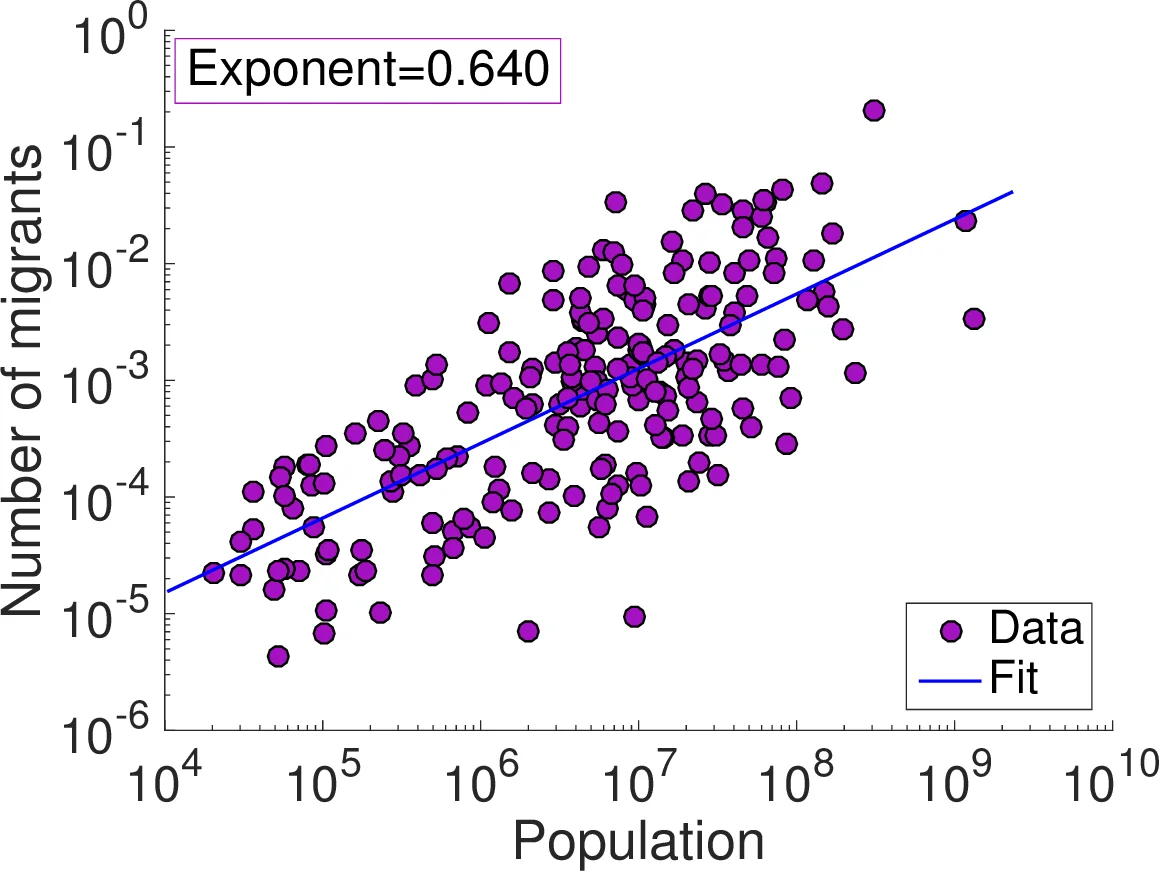
- UN migration‑based long‑term attractiveness: β = 0.640 (95 % CI = 0.551–0.730, R² = 0.49).
Both exponents are well below 1, indicating that as a country’s population doubles, the number of foreign‑generated media objects or foreign residents increases by only about 1.4–1.6 times. The relatively low R² values reveal substantial country‑specific deviations from the average trend.
Results for U.S. states (including D.C.): β = 0.864 (95 % CI = 0.530–1.198, R² = 0.36). This exponent lies between the superlinear scaling previously observed for Spanish cities (β≈1.5) and the sublinear scaling for countries, suggesting an intermediate regime. Residual analysis identifies over‑performing states (Washington D.C., Nevada, Hawaii) and under‑performing ones (Delaware, Oklahoma, Mississippi).
To explain the transition from super‑ to sublinear scaling, the authors examine the internal structure of countries. Using UN data on the number of cities (population > 300 k) and the population of capital cities, they find sublinear relationships with country population (exponents ≈0.84 and ≈0.77, respectively). Larger countries tend to have many small cities and a relatively smaller share of the population concentrated in a few major tourist hubs. Consequently, foreign visitors concentrate on a limited set of destinations, making the total foreign activity grow slower than the overall population.
The paper discusses several methodological limitations. Flickr users are not a random sample of travelers; they skew toward younger, tech‑savvy, and often higher‑income individuals, and posting behavior does not always reflect tourism. The home‑country inference can misclassify multi‑national users or long‑term travelers. The UN migration data is a snapshot from 2010 and does not capture informal or short‑term migration. These biases likely contribute to the observed variability (low R²) and should be considered when interpreting the scaling exponents.
In conclusion, foreign attractiveness exhibits scale‑dependent behavior: at the city level it is superlinear, reflecting the intensification of socio‑economic interactions in dense urban environments; at the state level it approaches linearity; and at the country level it becomes sublinear, driven by the hierarchical distribution of population and tourist attractions. The findings have practical implications for tourism planning and infrastructure investment: policymakers should calibrate expectations of visitor numbers to the hierarchical level of analysis and recognize that in large countries, concentrating resources on a few high‑attraction destinations may be more effective than assuming a proportional increase with population.
Comments & Academic Discussion
Loading comments...
Leave a Comment