Hodge Theory on Metric Spaces
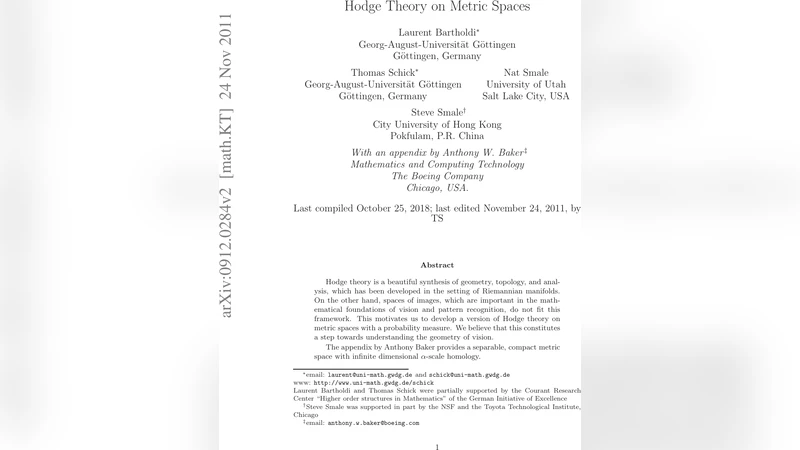
Hodge theory is a beautiful synthesis of geometry, topology, and analysis, which has been developed in the setting of Riemannian manifolds. On the other hand, spaces of images, which are important in the mathematical foundations of vision and pattern recognition, do not fit this framework. This motivates us to develop a version of Hodge theory on metric spaces with a probability measure. We believe that this constitutes a step towards understanding the geometry of vision. The appendix by Anthony Baker provides a separable, compact metric space with infinite dimensional \alpha-scale homology.
💡 Research Summary
The paper “Hodge Theory on Metric Spaces” sets out to transplant the classical Hodge theory—originally formulated on smooth Riemannian manifolds—into the much broader setting of metric spaces equipped with a probability measure. The authors begin by observing that many data domains of interest in vision and pattern recognition (e.g., collections of images, shapes, or point clouds) naturally carry a metric but lack a differentiable structure, making the traditional differential‑geometric machinery inapplicable. To overcome this obstacle they replace the exterior derivative by a discrete (difference) operator defined on L²‑functions with respect to a given probability measure μ, and they introduce its formal adjoint. Together these give a Laplacian Δ = d δ + δ d that acts on a Hilbert space of square‑integrable “forms” built from the metric.
Two structural hypotheses are imposed on the underlying space (X, d, μ): (1) regularity – X is complete, μ is fully supported (every non‑empty open set has positive mass), and μ is a probability measure; (2) a Poincaré‑type inequality guaranteeing that the discrete exterior derivative is a closed, densely defined operator on the Sobolev‑type space W¹,²(X). Under these conditions the authors construct a closed extension of d, define its adjoint δ, and prove that the resulting Laplacian is self‑adjoint, non‑negative, and has a discrete spectrum in many natural examples.
The central analytical result is a full Hodge decomposition for L²‑forms: every square‑integrable k‑form can be uniquely written as the sum of an exact form dα, a co‑exact form δβ, and a harmonic form h satisfying Δh = 0. Harmonic forms are shown to coincide with the kernel of Δ and, crucially, with the L²‑cohomology groups of the metric space. Thus the authors establish an isomorphism between L²‑cohomology and the space of harmonic representatives, mirroring the classical Hodge theorem but without any smooth structure.
Beyond the analytic core, the paper develops a combinatorial chain complex adapted to metric spaces. By using the same difference operator to define a boundary map on chains, the authors introduce an “α‑scale homology” that depends on a length scale α. This scale‑dependent homology captures how topological features appear or disappear as the metric resolution changes. The authors prove that the α‑scale homology groups are naturally isomorphic to the spaces of harmonic forms at the corresponding scale, thereby linking spectral properties of the Laplacian to multiscale topological information.
The appendix, contributed by Anthony Baker, supplies a concrete counterexample to any naïve finite‑dimensionality assumption: a separable, compact metric space is constructed whose α‑scale homology is infinite‑dimensional for some α. This demonstrates that, unlike the smooth manifold case, metric‑space Hodge theory can accommodate spaces with genuinely infinite‑dimensional topological invariants, emphasizing the need for careful analytic hypotheses.
In the final discussion the authors sketch several potential applications to computer vision. Because images can be regarded as points in a high‑dimensional metric space (e.g., equipped with an L² or Wasserstein distance), the discrete Hodge framework provides a principled way to extract harmonic components that encode global, topologically robust features. Such components could be used for shape matching, segmentation, or as regularizers in deep learning models that respect the underlying geometry of the data. Moreover, the multiscale homology offers a systematic method for persistent‑homology‑style analysis that is directly tied to the spectral decomposition of the Laplacian.
Overall, the paper delivers a comprehensive and rigorous extension of Hodge theory to metric spaces with probability measures. By defining a discrete exterior calculus, proving a Hodge decomposition, establishing the correspondence between harmonic forms and L²‑cohomology, and introducing scale‑dependent homology, the authors lay a solid foundation for future work at the intersection of geometry, analysis, and data‑driven applications.
Comments & Academic Discussion
Loading comments...
Leave a Comment