Sublinear scaling of country attractiveness observed from Flickr dataset
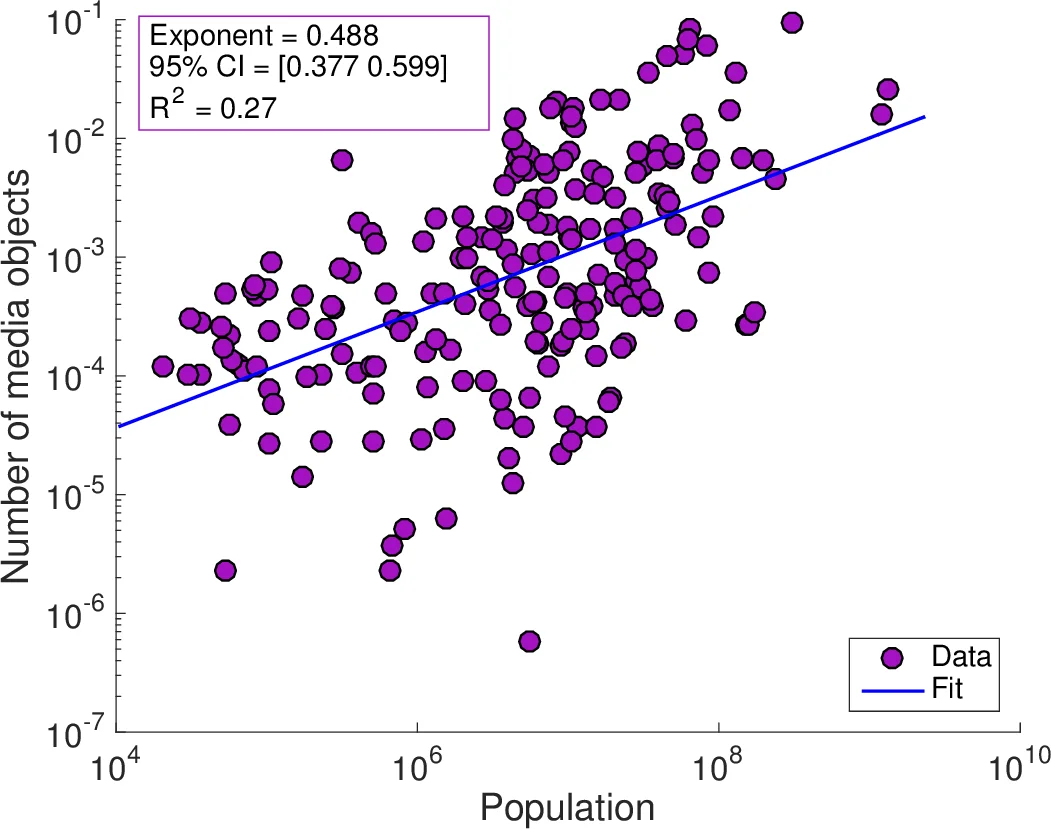
The number of people who decide to share their photographs publicly increases every day, consequently making available new almost real-time insights of human behavior while traveling. Rather than having this statistic once a month or yearly, urban planners and touristic workers now can make decisions almost simultaneously with the emergence of new events. Moreover, these datasets can be used not only to compare how popular different touristic places are, but also predict how popular they should be taking into an account their characteristics. In this paper we investigate how country attractiveness scales with its population and size using number of foreign users taking photographs, which is observed from Flickr dataset, as a proxy for attractiveness. The results showed two things: to a certain extent country attractiveness scales with population, but does not with its size; and unlike in case of Spanish cities, country attractiveness scales sublinearly with population, and not superlinearly.
💡 Research Summary
This paper investigates how “country attractiveness” – measured as the total number of media objects (photos and videos) uploaded by foreign Flickr users – scales with two fundamental country characteristics: population and land area. Using the Yahoo! Webscope YFCC‑100M dataset, the authors extracted 43.8 million geo‑tagged media items created between 2004 and 2014. After discarding non‑geotagged records (≈50 % of the original set) and fixing 652 malformed timestamps, they performed reverse geocoding to assign each media item to a country. Because Flickr does not provide users’ home countries, the authors inferred a user’s residence as the country where that user generated the largest number of media objects and spent the most days. Only the activity of users whose home country could be identified was retained for the analysis of “foreign” activity.
The authors model country attractiveness (A) as a power‑law function of population (p) and area (s): A = a·p^β and A = a·s^β. By fitting linear regressions on log‑log transformed data, they obtain β ≈ 0.78 (95 % CI 0.68‑0.88) for population with R² ≈ 0.27, and β ≈ 0.26 (95 % CI 0.16‑0.35) for area with R² ≈ 0.12. Both exponents are below 1, indicating sublinear scaling: as a country’s population doubles, its Flickr‑based attractiveness increases by less than a factor of two, and the dependence on land area is even weaker.
To explore regional heterogeneity, the world is divided into eleven macro‑regions (e.g., Northern America, Western Europe, Baltics, etc.). In Northern America (4 countries) and Western Europe (25 countries) the fits are exceptionally strong (R² ≈ 0.99 and 0.94, respectively) with β values of 0.777 and 0.715, confirming robust sublinear scaling. Other regions, such as Asia (excluding the Near East) and Sub‑Saharan Africa, display much lower R² (≈0.26 and 0.28) and smaller β (≈0.36 and 0.64), suggesting that population explains far less of the variance in attractiveness there.
The authors also examine correlations between the goodness‑of‑fit (R²) and various country‑level indicators (population density, coastline length, urban population share, etc.). The strongest correlation is with GDP (r = 0.678), implying that wealthier nations tend to exhibit clearer scaling patterns, possibly because higher economic activity translates into more tourism infrastructure and higher Flickr usage.
In the discussion, the paper contrasts its findings with earlier city‑level studies that reported superlinear scaling of attractiveness (β ≈ 1.5). The authors argue that at the country level, constraints such as limited tourism infrastructure, geographic dispersion, and policy differences may dampen the amplification effect seen in cities. They acknowledge several limitations: Flickr users are not a representative sample of global travelers; the home‑country inference method may misclassify some users; and the dataset lacks temporal granularity to capture seasonal or event‑driven spikes.
The conclusion emphasizes that country attractiveness, as captured through Flickr foreign‑user activity, scales sublinearly with both population and area, with pronounced regional variations and a notable link to GDP. Future work is suggested to integrate additional social‑media platforms, official tourism statistics, and dynamic time‑series analyses to refine the scaling models and improve their applicability for urban planners and tourism managers.
Comments & Academic Discussion
Loading comments...
Leave a Comment