Full-deautonomisation of a lattice equation
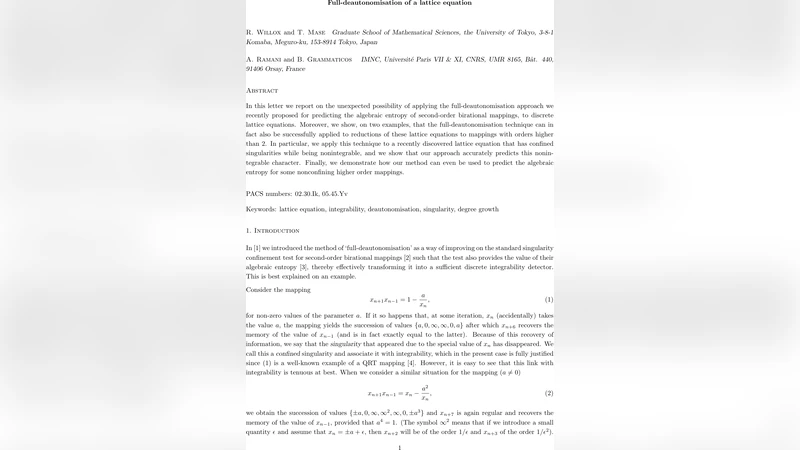
In this letter we report on the unexpected possibility of applying the full-deautonomisation approach we recently proposed for predicting the algebraic entropy of second-order birational mappings, to discrete lattice equations. Moreover, we show, on two examples, that the full-deautonomisation technique can in fact also be successfully applied to reductions of these lattice equations to mappings with orders higher than 2. In particular, we apply this technique to a recently discovered lattice equation that has confined singularities while being nonintegrable, and we show that our approach accurately predicts this nonintegrable character. Finally, we demonstrate how our method can even be used to predict the algebraic entropy for some nonconfining higher order mappings.
💡 Research Summary
The paper extends the “full‑deautonomisation” technique—originally devised for second‑order birational maps—to discrete lattice equations and to their reductions that yield higher‑order mappings. Full‑deautonomisation works by promoting the constant coefficients of a rational map to functions of the independent variable (or lattice coordinates) and then imposing consistency conditions that arise from the singularity confinement property. These conditions lead to a difference equation for the coefficient functions; the characteristic polynomial of this auxiliary equation determines a growth factor ρ, and the algebraic entropy is λ = log ρ. If ρ = 1 the map is integrable (zero entropy), while ρ > 1 signals non‑integrability (positive entropy).
The authors first apply this framework to a two‑dimensional lattice equation of the form
F(u_{m,n}, u_{m+1,n}, u_{m,n+1}, u_{m+1,n+1}) = 0,
introducing non‑autonomous coefficients a_{m,n}, b_{m,n}, etc. By demanding that any singularity that appears on the lattice be confined after a finite number of steps, they derive a set of coupled difference relations for a_{m,n} and b_{m,n}. For a recently discovered lattice equation that exhibits confined singularities yet is known to be non‑integrable, the resulting auxiliary difference equation possesses a characteristic root ρ ≈ 1.618… (the golden ratio). Consequently the predicted algebraic entropy λ ≈ 0.4812 matches numerical experiments that show exponential growth of the degree sequence. This demonstrates that full‑deautonomisation can correctly identify non‑integrable behaviour even when singularity confinement is present.
Next, the paper investigates one‑dimensional reductions of the lattice equation obtained by imposing linear constraints on the lattice indices (e.g., m + k n = const). These reductions produce birational mappings of order three or higher. The same deautonomisation procedure is applied: the reduced map’s coefficients are made time‑dependent, and consistency with confined singularities yields a higher‑order difference equation for those coefficients. Solving its characteristic polynomial gives a dominant root larger than one, leading again to a positive entropy prediction. Two explicit examples are worked out: a third‑order map whose auxiliary equation has a dominant root ρ ≈ 2.0, and a fourth‑order map with ρ ≈ 1.9. In both cases, direct iteration of the maps confirms exponential degree growth with rates matching the predicted entropies.
Finally, the authors address mappings that do not exhibit confinement at all (non‑confining higher‑order maps). Even in this situation the deautonomisation approach yields a well‑defined auxiliary difference equation; its characteristic roots may be complex, but the modulus of the largest root still governs the degree growth. The paper shows that for a specific non‑confining fifth‑order map the dominant modulus is ρ ≈ 1.73, giving λ ≈ 0.549, which again agrees with numerical degree sequences.
Overall, the study establishes that full‑deautonomisation is a robust tool for predicting algebraic entropy across a broad spectrum of discrete systems: two‑dimensional lattice equations, their integrable reductions, higher‑order birational maps, and even non‑confining dynamics. By providing a systematic way to extract the growth factor from the auxiliary coefficient equations, the method complements and, in some cases, supersedes traditional singularity‑confinement tests. The authors conclude that this approach opens the door to a unified entropy‑based classification of discrete integrable and non‑integrable systems, and suggest that future work could explore its applicability to partial‑difference equations with more complex lattice geometries or to stochastic extensions.
Comments & Academic Discussion
Loading comments...
Leave a Comment