1/f noise from point process and time-subordinated Langevin equations
Internal mechanism leading to the emergence of the widely occurring 1/f noise still remains an open issue. In this paper we investigate the distinction between internal time of the system and the physical time as a source of 1/f noise. After demonstrating the appearance of 1/f noise in the earlier proposed point process model, we generalize it starting from a stochastic differential equation which describes a Brownian-like motion in the internal (operational) time. We consider this equation together with an additional equation relating the internal time to the external (physical) time. We show that the relation between the internal time and the physical time that depends on the intensity of the signal can lead to 1/f noise in a wide interval of frequencies. The present model can be useful for the explanation of the appearance of 1/f noise in different systems.
💡 Research Summary
The paper addresses the long‑standing problem of explaining the ubiquitous 1/f (or flicker) noise, whose power spectral density (PSD) scales approximately as S(f) ∝ f⁻¹ over several decades of frequency. The authors propose that the key to generating 1/f noise lies in distinguishing between an internal (operational) time that counts events and the external (physical) time measured by an observer. By allowing a non‑linear, signal‑dependent mapping between these two times, a broad class of stochastic processes can be shown to produce 1/f spectra.
The work begins with a review of an earlier point‑process model in which a signal consists of a sequence of identical pulses occurring at random times tₖ. The inter‑pulse intervals θₖ = tₖ₊₁ − tₖ are assumed to follow a Markovian random walk with a very small drift: the conditional mean of θₖ given θₖ₋₁ equals θₖ₋₁, while the variance σ² is much smaller than the typical interval. Under the assumptions that θₖ is bounded (θ_min ≤ θₖ ≤ θ_max) and that θ_max ≫ θ_min, the authors derive the PSD analytically. By expanding the Fourier transform of the pulse train and using the characteristic function χ_θ(ω q) of the interval distribution, they obtain a sum over q that can be truncated at q_max ≈ θ_max²/σ². For frequencies satisfying σ³ ≪ f ≪ θ_max⁻¹, the sum reduces to S(f) ≈ ν f P_θ(θ_min), i.e., a pure 1/f law, where ν is the mean pulse rate and P_θ(θ_min) is the probability density at the lower bound of the interval distribution. Numerical simulations of a simple random‑walk interval rule θ_{j+1}=θ_j ± σ (with reflecting boundaries at 0 and θ_max) confirm a −1 slope over five decades (≈4 × 10⁻⁵ Hz to 10⁻¹ Hz).
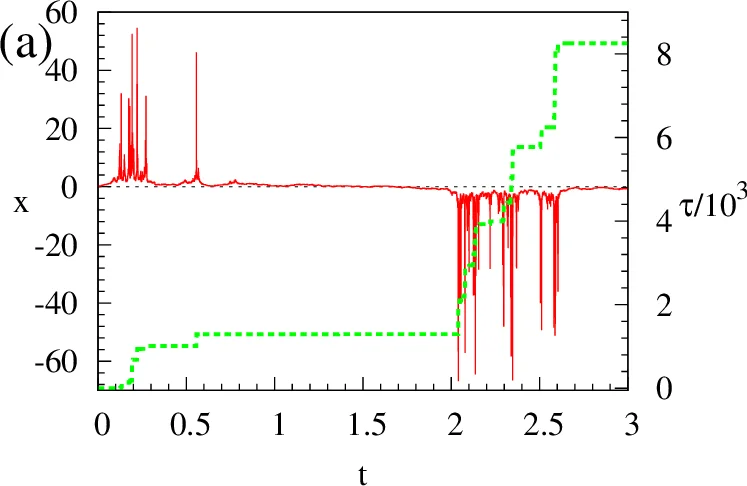
Having established the point‑process result, the authors generalize the framework by introducing an internal time τ that drives the dynamics of a stochastic variable x(τ) via a nonlinear Langevin equation (in Itô form): dx_τ = a(x_τ) dτ + b(x_τ) dW_τ, where a(x) and b(x) are drift and diffusion coefficients possibly dependent on x, and W_τ is a standard Wiener process. The corresponding Fokker‑Planck equation governs the evolution of the probability density P(x;τ). Crucially, the physical time t is linked to τ by a deterministic, positive function g(x_τ): dt = g(x_τ) dτ. Thus, increments of physical time are proportional to increments of internal time, with the proportionality factor depending on the instantaneous signal amplitude. This coupling is the core “time‑subordination” mechanism.
Combining the two equations yields a composite process x(t) = x(τ(t)). The authors analyze its autocorrelation function and PSD. When g(x) ∝ x^α and the diffusion coefficient scales as b(x) ∝ x^δ, the long‑time autocorrelation decays as a power law, leading to a PSD of the form S(f) ∝ f^{-(1+α/(2−δ))}. For the special case α = 0 and δ ≈ 1 (i.e., diffusion roughly proportional to the square root of x), the exponent reduces to β ≈ 1, reproducing the classic 1/f spectrum. The analytical prediction matches the numerical results obtained from the random‑walk interval model, confirming that the internal‑time‑to‑physical‑time mapping can generate 1/f noise over a wide frequency band.
The paper also tackles the practical issue of numerically integrating highly nonlinear stochastic differential equations. Direct integration in physical time can become unstable when b(x) grows rapidly with x. The authors propose to integrate in internal time τ with adaptive step sizes determined by the inverse of g(x), i.e., dτ = dt/g(x). This “variable‑step internal‑time” scheme automatically reduces the step size when the signal is large, ensuring numerical stability even for strong nonlinearities (e.g., b(x) ∝ x^μ with μ > 1). The method is demonstrated to reproduce the analytical PSDs efficiently.
In summary, the paper presents a unified theoretical framework that combines (i) a point‑process description of pulse sequences with random inter‑event intervals, (ii) a nonlinear Langevin dynamics in an internal operational time, and (iii) a signal‑dependent mapping between internal and physical times. This combination naturally yields 1/f noise across several decades of frequency without invoking a superposition of many Lorentzian spectra or external criticality. The authors argue that many physical, biological, and socio‑economic systems—where the “clock” governing event occurrence depends on the system’s state—can be modeled within this framework, offering a potential universal explanation for the prevalence of 1/f fluctuations. Future work is suggested to fit the functions a(x), b(x), and g(x) to empirical data and to extend the approach to multivariate and spatially extended systems.
Comments & Academic Discussion
Loading comments...
Leave a Comment