Associative Yang-Baxter equation for quantum (semi-)dynamical R-matrices
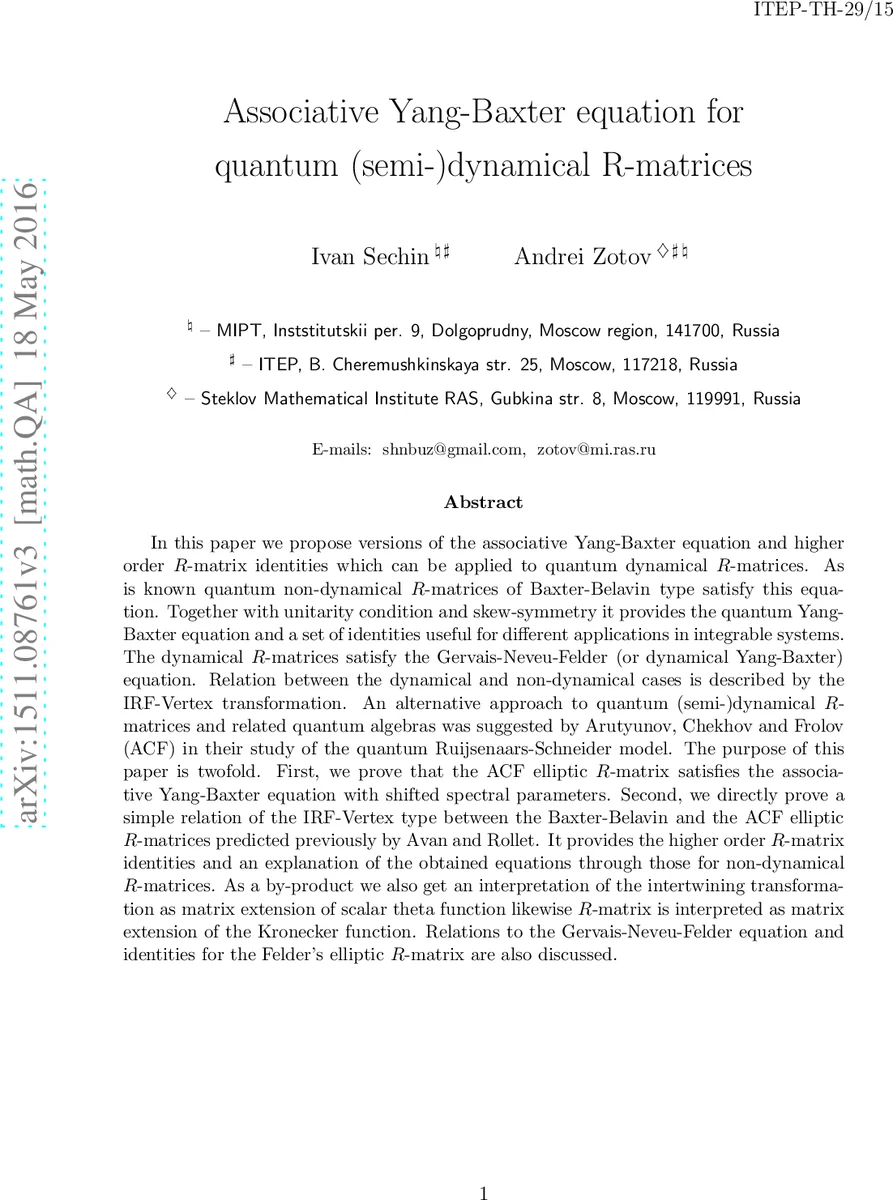
In this paper we propose versions of the associative Yang-Baxter equation and higher order $R$-matrix identities which can be applied to quantum dynamical $R$-matrices. As is known quantum non-dynamical $R$-matrices of Baxter-Belavin type satisfy this equation. Together with unitarity condition and skew-symmetry it provides the quantum Yang-Baxter equation and a set of identities useful for different applications in integrable systems. The dynamical $R$-matrices satisfy the Gervais-Neveu-Felder (or dynamical Yang-Baxter) equation. Relation between the dynamical and non-dynamical cases is described by the IRF-Vertex transformation. An alternative approach to quantum (semi-)dynamical $R$-matrices and related quantum algebras was suggested by Arutyunov, Chekhov and Frolov (ACF) in their study of the quantum Ruijsenaars-Schneider model. The purpose of this paper is twofold. First, we prove that the ACF elliptic $R$-matrix satisfies the associative Yang-Baxter equation with shifted spectral parameters. Second, we directly prove a simple relation of the IRF-Vertex type between the Baxter-Belavin and the ACF elliptic $R$-matrices predicted previously by Avan and Rollet. It provides the higher order $R$-matrix identities and an explanation of the obtained equations through those for non-dynamical $R$-matrices. As a by-product we also get an interpretation of the intertwining transformation as matrix extension of scalar theta function likewise $R$-matrix is interpreted as matrix extension of the Kronecker function. Relations to the Gervais-Neveu-Felder equation and identities for the Felder’s elliptic $R$-matrix are also discussed.
💡 Research Summary
The paper investigates the algebraic structures underlying quantum (semi‑)dynamical R‑matrices, focusing on the associative Yang‑Baxter equation (AYBE) and its higher‑order identities. It begins by recalling that non‑dynamical GL(N, ℂ) R‑matrices of Baxter‑Belavin type satisfy the quantum Yang‑Baxter equation (QYBE) together with unitarity and skew‑symmetry. These three properties imply the AYBE, a quadratic matrix identity originally introduced for constant R‑matrices and later generalized by Polishchuk. The AYBE can be viewed as a matrix analogue of Fay’s identity for the Kronecker function.
Two families of dynamical R‑matrices are then contrasted. The first is the Gervais‑Neveu‑Felder (GNF) type, where the dynamical variables u₁,…,u_N are shifted by operators P^{(k)} in the dynamical Yang‑Baxter equation (1.4). The second is the Arutyunov‑Chekhov‑Frolov (ACF) type, which the authors refer to as “semi‑dynamical”: the spectral parameters z₁, z₂ are shifted by the Planck constant ℏ (denoted ~) while the dynamical variables remain unchanged. This semi‑dynamical formulation leads to a modified Yang‑Baxter equation (1.9) that contains only spectral‑parameter shifts.
The first main result (Theorem 1) shows that the elliptic ACF R‑matrix (1.10) satisfies a shifted version of the AYBE, namely equation (1.22). Here ℏ and an auxiliary parameter η appear symmetrically; setting η = ℏ reproduces the original semi‑dynamical Yang‑Baxter equation, while η = −ℏ yields a cubic identity (1.20) involving the derivative of the Weierstrass ℘‑function. The proof relies on the Fay identity for the Kronecker function φ(ℏ,z) and on the skew‑symmetry property of the ACF matrix (2.1). By multiplying (1.22) with appropriate shifted matrices and using unitarity (1.2), the authors derive the cubic relation (1.23).
The second main result (Theorem 2) establishes an explicit IRF‑Vertex transformation linking the ACF R‑matrix to the non‑dynamical Baxter‑Belavin R‑matrix. The intertwining matrix g(z,u) (1.7) is built from theta‑functions with characteristics; it can be interpreted as a matrix‑valued theta function, i.e., a “matrix extension of the scalar theta function”. Equation (1.24) expresses the Baxter‑Belavin R‑matrix as a similarity transformation of the ACF matrix by g and its inverse, while (1.25) gives the inverse twist matrix \bar R in terms of g. This transformation reproduces the known IRF‑Vertex relation (1.8) between the Baxter‑Belavin and Felder R‑matrices and provides a transparent derivation of higher‑order identities.
Using the IRF‑Vertex map, the authors prove that the ACF matrix satisfies the n‑th order identity (1.26) previously derived for the Baxter‑Belavin case. For n = 3 this reduces to the cubic relation (1.20); for higher n it yields a product of n−1 ACF matrices equal to the identity tensor multiplied by a universal scalar factor involving derivatives of ℘(ℏ).
Section 4 extends the discussion to Felder’s fully dynamical elliptic R‑matrix. By inserting the explicit form of the twist matrix (1.13) into the IRF‑Vertex relation, the authors obtain new identities for Felder’s matrix and clarify its connection to both the GNF equation and the ACF semi‑dynamical framework.
Overall, the paper provides a unified algebraic picture: the semi‑dynamical ACF R‑matrix satisfies a shifted AYBE, and through an explicit IRF‑Vertex transformation it is equivalent to the well‑studied non‑dynamical Baxter‑Belavin matrix. This equivalence explains why the ACF matrix inherits the higher‑order identities, unitarity, and skew‑symmetry known from the non‑dynamical case. The results have immediate implications for quantum integrable systems such as the Ruijsenaars‑Schneider model, for the construction of quantum algebras, and for the analysis of Knizhnik‑Zamolodchikov‑Bernard (KZB) equations. The authors suggest future work on classifying more general semi‑dynamical R‑matrices, exploring the representation‑theoretic meaning of the higher‑order identities, and extending the IRF‑Vertex formalism to other quantum algebras.
Comments & Academic Discussion
Loading comments...
Leave a Comment