Optimal Estimation of Recurrence Structures from Time Series
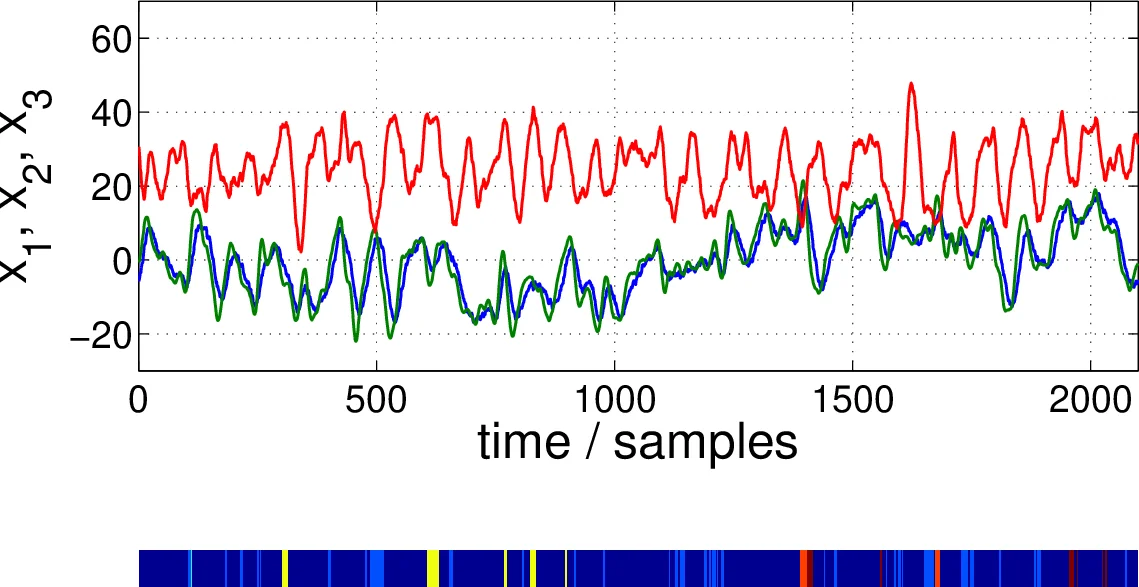
Recurrent temporal dynamics is a phenomenon observed frequently in high-dimensional complex systems and its detection is a challenging task. Recurrence quantification analysis utilizing recurrence plots may extract such dynamics, however it still encounters an unsolved pertinent problem: the optimal selection of distance thresholds for estimating the recurrence structure of dynamical systems. The present work proposes a stochastic Markov model for the recurrent dynamics that allows to derive analytically a criterion for the optimal distance threshold. The goodness of fit is assessed by a utility function which assumes a local maximum for that threshold reflecting the optimal estimate of the system’s recurrence structure. We validate our approach by means of the nonlinear Lorenz system and its linearized stochastic surrogates. The final application to neurophysiological time series obtained from anesthetized animals illustrates the method and reveals novel dynamic features of the underlying system. As a conclusion, we propose the number of optimal recurrence domains as a statistic for classifying an animals’ state of consciousness.
💡 Research Summary
The paper addresses a long‑standing problem in recurrence quantification analysis (RQA): how to choose the distance threshold ε that defines the recurrence matrix R_ij = Θ(ε − ‖x_i − x_j‖). The authors propose a stochastic Markov‑chain model of the recurrence structure and derive an analytical criterion for the optimal ε.
First, for a given ε the recurrence plot is converted into a “recurrence grammar”. Each recurrence (R_ij = 1) is interpreted as a rewrite rule i → j (i > j). By repeatedly applying these rules a symbolic sequence s′ is obtained that consists of a transient “hub” state (label 0) and several metastable recurrence domains (labels 1, 2, …). This symbolic dynamics can be described by an n‑state Markov chain, where n = NRD + 1 (NRD = number of recurrence domains).
The optimal transition matrix P is constrained by three principles: (i) self‑transitions dominate (large trace tr P), (ii) transitions between the hub and any domain are uniformly distributed (maximum‑entropy assumption), and (iii) there are no direct transitions between distinct domains. Under these constraints P depends only on two parameters q (hub → domain) and r (domain → hub). As q, r → 0 the matrix approaches the identity, reflecting a perfectly deterministic recurrence structure.
To quantify how well a particular ε matches these ideals the authors define a utility function
u(ε) = ½
Comments & Academic Discussion
Loading comments...
Leave a Comment