Understanding Innovation to Drive Sustainable Development
Innovation is among the key factors driving a country’s economic and social growth. But what are the factors that make a country innovative? How do they differ across different parts of the world and different stages of development? In this work done in collaboration with the World Economic Forum (WEF), we analyze the scores obtained through executive opinion surveys that constitute the WEF’s Global Competitiveness Index in conjunction with other country-level metrics and indicators to identify actionable levers of innovation. The findings can help country leaders and organizations shape the policies to drive developmental activities and increase the capacity of innovation.
💡 Research Summary
The paper “Understanding Innovation to Drive Sustainable Development” presents a data‑driven investigation of the determinants of national innovation, leveraging the World Economic Forum’s Global Competitiveness Index (GCI) and the World Bank’s World Development Indicators (WDI). The authors treat the Innovation pillar of the GCI, derived from the Executive Opinion Survey, as the ground‑truth measure of a country’s innovation performance (output). As inputs they assemble 462 WDI metrics and 162 non‑innovation GCI metrics covering the period 2007‑2014.
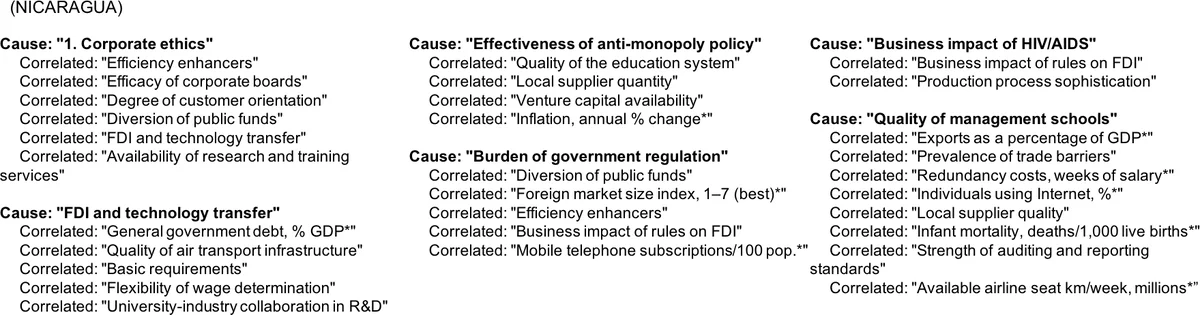
First, a causal analysis is performed using Granger‑causality. For each country, past values of the input metrics (lags of up to three years) are used to predict future innovation scores. Variable selection and coefficient estimation are carried out with a group‑lasso sparse linear regression (Sindhwani & Lozano, 2010), which forces all lagged values of a given metric to be selected together, thereby respecting the temporal structure of the series. Model complexity is tuned via an approximate Cp criterion. The approach identifies, for example, several non‑innovation GCI variables that Granger‑cause the innovation score for Nicaragua, and the authors also list up to ten highly correlated auxiliary variables for each causal factor.
Second, the authors build predictive models using Random Forests (RF). Two experiments are reported: (i) using only the non‑innovation GCI variables, the model achieves an R² of 0.93; (ii) using only the WDI variables, the model reaches an R² of 0.88. All predictors are standardized, and missing values are imputed with zero. The RF’s inherent ability to capture non‑linear interactions and to provide variable importance scores makes it suitable for interpreting the drivers of innovation.
Third, the paper introduces a contribution‑analysis framework. By tracing the decision path of the RF for each country, the contribution of each predictor to the final innovation score (cₓᵢ) is computed, yielding a high‑dimensional vector
Comments & Academic Discussion
Loading comments...
Leave a Comment