Diffusion paths between product life-cycles in European phonographic markets
We have investigated the product life-cycles of almost 17 000 hit singles performed on the 12 biggest national phonographic markets in Europe including: Austria, Belgium, France, Germany, Ireland, Italy, Netherlands, Norway, Spain, Sweden, Switzerlan…
Authors: Andrzej Buda, Andrzej Jarynowski
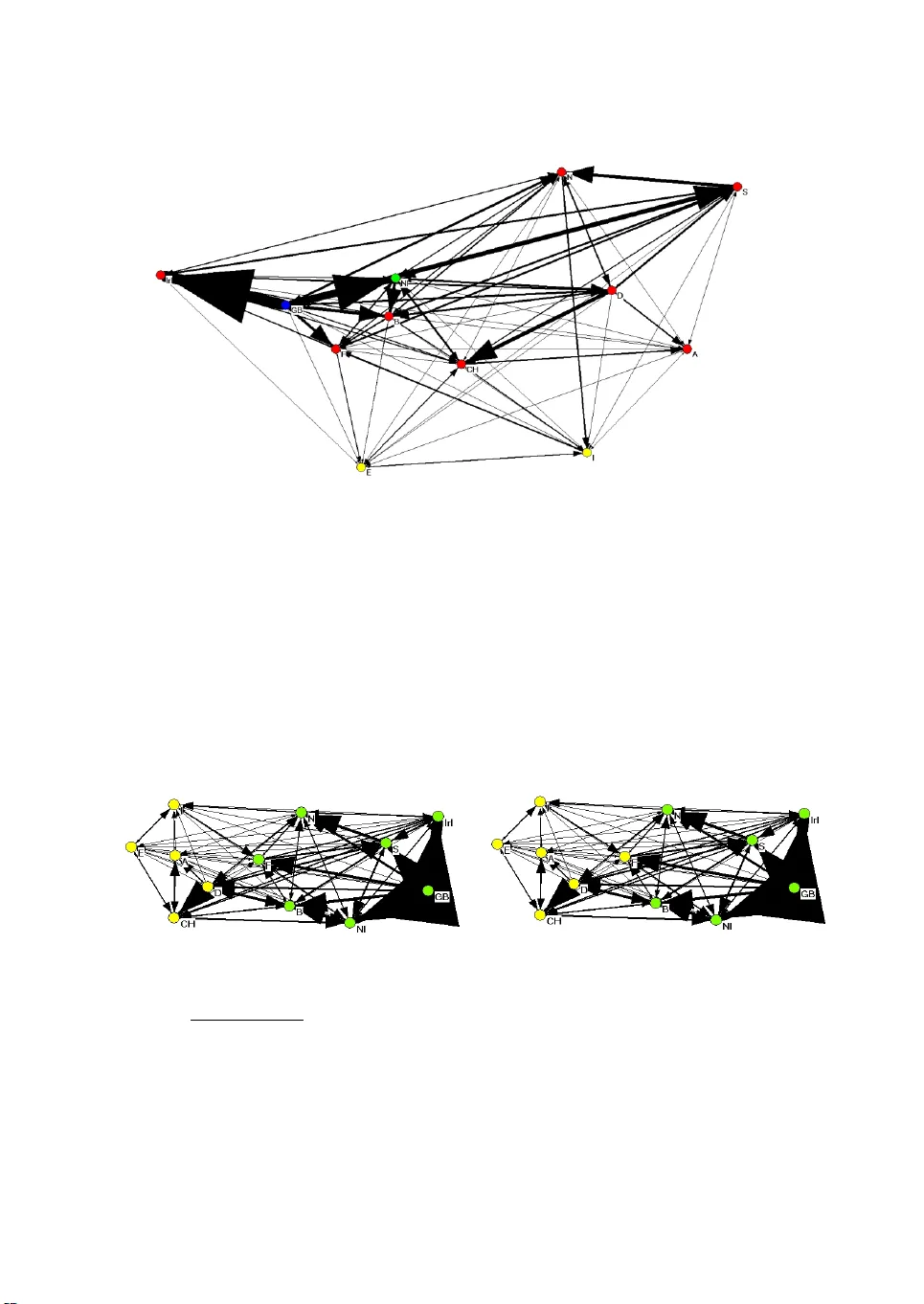
DIFFUSION PATHS BET WEEN PRODUCT LIFE-CYCLES IN EUROPEAN PHONOGRA PHIC MARKET Andrzej Buda#, And rzej Jaryno wski #* # Institute of Interdi sciplinar y Research, Wrocła w , P oland * Smolucho wski Institute of Physics, Jagiello nian University, Krakó w , P oland We h ave investigated th e product life-cycles of almost 17 000 hit singles performed on the 12 biggest national phonographic markets in Europ e includin g: Austria, Belgiu m , France, G ermany, Ireland, Ital y, Neth erlands, No rway, Spain, Sweden, Switzerland and the United Kingdo m. We hav e considered weekly singles charts fro m the last 50 years ( 1966 -2015) in ea ch country. We analyze the spread of hit singles po pularity (chart to pping) as an ep idemiological pro cess performed on various European cou ntries. Po pular hit singles ar e contagious fro m one cou ntry to another. T hus, we co nsider ti me delays bet ween the initial hit si ngle relea se and reaching the highest position on co nsecutive natio nal si ngles charts. We crea te directed network of countries representing tra nsitions o f hit singles po pularity between countries. It i s o btained by simulating the most likely paths a nd picking up the m ost frequent lin ks. A country o f initial hit si ngle release is cons idered as a source of in fection. Our algorith m build s up spannin g trees by attaching new nodes. The probab ility of attachment depends on: 1) new node's immunity 2) infectivity of previous no des from the tree. Thus we obtain network of pop ularity spread with: a hub – the UK, a bridge – the Netherlands and outliers – Italy and Spain. We have found a character istic to pology of hit singles pop ularity spread . T he positive correlation bet w een this network a nd geographic o r cultural grid- map of Europe is also o bserved. However, the network o f popularity spread has so me typical pr operties of complex networks. 1. Introduction Statistical properties of the global phonographic market has bee n already investigated well b y methods of econophysics where the value of an artist ha s bee n defined by w eekly albums sales. This system is more predictable than financial markets and more complex b ecause of record labels, ar tists, mass media a nd additional seasonal groups of collective cu stomers that buy lo ng -playing records. Thus, product li fe-cycles e xpressed by traj ectories of wee kly albu ms sales reach th e maximum in the first week of record sales after the premiere and decrea se affected by random processes (Jarynowski and B uda, 2014) . However, there is another part of phonographic market represented b y songs released as a hit singles. T he spread of hit singles p opularity over countrie s reminds classical product life-c ycles b ecause the o fficial definitio n of pop ularity i n ca se of songs i s more co mplex. Natio nal c harts have bee n usually based on weekly p hysical singles sales, but smaller markets have also compiled official national char ts according to official air plays o n the rad io or TV. On the Interne t era ( 2003 until now), al most al l natio nal hit singles charts are mostly based o n digital streaming of songs ( mp3, r ingtones, etc.) Popularit y of son gs as a compilation of t hese factors i s complex, so in our research we dec ided to measure this phenomena from eco nomic point of view (value of a song is measured weekly by positions on national charts). We have investigated traj ectories of almost 17 000 hit sing les performed on the 12 biggest national pho nographic markets in Europe including: Aus tria (A), Belgium (B), France ( F), Ger many (D ), Ir eland (IRE), Italy (I), Netherlands (NL), Norway (N), Spain (E), S weden (S), Switzerland ( CH) and t he United Kingdo m (GB). We have co nsidered weekly singles charts fro m the last 50 y ears (1966 -2015) in each country. The pro cess of information spread have been alread y investigated and described from socio logical and co mpu tational science 's point of view where European music charts network, positive correlation with geo graphical and cultural distance network has bee n explored in various ages (Buda an d Jarynowski, 2015) . In this paper, we conti nue our research a nd focus on ec onomic pro perties a nd interactions between natio nal markets. Classic prod uct li fe -cycle theory i s defined by stages that depend o n diffusion of innovatio ns (includ ing: innovator s, earl y adopters, early majority, late majority a nd laggards) (Roge rs, 1962) . In case of hit- singles, the national charts are uncomparab le b ecause o f co mplexity ( different methods o f compilatio ns in ea ch countr y, size o f a market, etc.). But if we consider stages of popularity f or a single perfor med on various countries (that represent innovators, early ad opters and late adop ters), the product life -cycle may be described epidemiologically b y SI models ( Anderson and Ma y , 199 2). Our inspiration a lso comes fro m geographical dep endencies between currencies where the rate r eturns usually affects other currencie s i n t he neighbourhood because of triangular arbitrage and the existence of the Epp 's effect o n much longer ti me scales ( Rogers, 196 2) . Like in the foreig n exc hange markets, popular hit singles are contagious fro m on e country to a nother. Th us, we describe stages o f prod uct life -cycle in terms o f epidemiology and consider time delays b etween the initial hi t single relea se a nd reaching the highest po sition on consecutive national singl es charts. Our aim is to show paths o f interactions bet w een the 12 bigge st national markets in E urope and detect how one country af fect another. 2. Data analysis At the ver y begi nning, it i s necessary to define the state of p opularity for a song as the highest position in a national singles chart. For example, 'We Fo und Love' performed b y B arbadian singer Rihanna i n 2 011 initially entered the si ngles charts on October the 8 th . Table 1. Higher and higher chart positions in the national charts b y R ihanna's 'We Found Love' within 8 w eeks. After reaching the top p osition, cells are m atched in black because a countr y is infected. Country 1 st week 2 nd week 3 rd week 4 th week 5 th week 6 th week 7 th week 8 th week A - - - 12 12 4 B 3 CH 3 3 2 2 2 1 D - - - 1 E 15 14 14 9 9 9 5 3 F 1 GB - 1 I - - - 7 4 4 IRE - 3 1 N 1 NL 14 3 S 2 2 2 2 1 In this ca se, the source of infection w as Belgium, but in the first week France and Nor way had been alread y i nfected. Italy and Sp ain were the last countries t hat fulfilled this spr ead of global popularity. I f we consider the ti me dela y between the first week of entering the charts and the wee k of reachi ng the highest positions, we will obtain the map of Europe (Fig. 1) according to investigated data set (1966 -2015) of hit singles. Statisticall y, the UK, the Netherla nds and B elgium usually start the infectio n. Figure 1 . Mean (left) and median (right) time of achieving t he highest positions on the charts (Buda and Jarynowski, 2015 ). For each song, it is possible to detect the Mini mum Spanning T ree - MST (Fig. 2) according to the matrix of individual time delays defi ned by distances: dxy = | t x – t y | (1) where t x and t y repr esents weeks of reac hing the highest positions in countries X a nd Y. Deterministic construction of a chain of events like MST does not reveal unique solution. It is d egenerated, b ecause i n the sa me t ime more than one co untry could adopt new single (see ABBA's case on Fig. 2). The MST also w orks as a Markovian process, and the history i s going to be forgotten. We pr ovide an algorith m to retrieve set of allowed trees, where an actual connection depends o n the whole histor y . Fig. 2 The Minimum Spa nning Tree based on matrix of tim e -delays between countries for ABBA's single 'Dancing Queen' (19 76). The source of infection was in Sweden. 2. Results In o ur resear ch, we have detected the sources of in fections (initial co untries) for all the 50 most p opular hit singles that finally affected the whole Euro pe (1966 -2015). Then we have created the most likely paths of infection. Our algor ithm b uil ds up spanning trees for each hit -single 1000 tim es b y attaching new nodes: 1) We choose source of infecti on - countr y o f initial release (e.g. ABB A's song 'Dancing Quee n' comes from Sweden) [Fig. 2]; 2) We attach next i n row node to the source (e.g. Belg ium and the UK simultaneously are attac hed to Sweden) [Fig. 2]; 3) The next o nes (X) ar e added to one of the previou s nodes (respectively to the size of a market in a previous node). T he probability o f attachment is inversely proportional to d iff erence bet ween time dela ys according to for mula: (2) where: Px - y - pro bability that new node X will be attached to node Y N Y - market size of node Y N AVR - average market size in Europe In W estern E uropean co untries, a phonographic market si ze N Y may b e take n as a population Y size [10]. P robability o f attac hment increases in inverse pro portion to time dela ys (memor y effect). We w eight eac h link in invers e pro portion on s teps of simulation to valuate fashion adoption in earl y steps (early ado pters). Tab le . 2 Node's degree calculated via simulation o f popularity spread degree out in A 23 36 B 60 65 CH 45 63 D 75 53 E 16 27 F 43 50 GB 192 36 I 17 36 Irl 43 89 N 49 65 Nl 74 94 S 55 78 Thus, we ob tain a dir ected network o f p opularity spread with: a hub – the UK, a bridge – the Netherlands a nd outliers – Italy and Spain (Fig. 3). We have found a characteristic topology o f hit singles popularity spread. It is clearl y visible fro m which countr y viruse s are able to be contagious to another. There is no surprise tha t the UK has the strongest ability to cr eate (but not receive) viruses (due to hig hest out degree – T ab.2) from all over the European world. The Netherlands are most likely to adopt (be infected) be new fashion (due to highest in de gree – Tab.2). Fig. 3 The directed European network of popularity spread based on matrix of time - delays between countrie s. Network of popularit y spread with: a hub – the UK, a bridge – the Netherlands and outliers – Italy and Spain. The trees based on matrix o f ti m e d elays r eflect non uniqueness. It occurs eve n for deterministic process of attach ment. Clusterization and co mmunity detection (modularity) can bring t w o subnet w orks: – Scandinavia, Benel ux, UK, Ireland and Ger many – Spain, Italy, Switzerland and Austria The first one contains countries that easy catc h all infectio ns, the seco nd one is more conservative. Ho wever, France belongs once to infectious co mmunity once to resistance co mmunity. Th e position of France in directed networks (Fig. 4) dep ends on the algorithm. Fig. 4 The directed France misclassified - once in resistance communit y once in infectious community. Left: Louvain algorithm. Right: VO S Clustering. 4. Conclusions In this pap er we have sho wn the structural dependencies between various local European phonographic markets. We have built epidemiological simulation to extract the most i mportant viral co mponent o f the syste m. W e have received network of popularity spread with: a h ub – the UK, a bridge – the Netherlands and outliers – Italy and Spain. The most influential countr y is the United Kingdo m t hat infects others i n early steps of prop agation due to the highest out -degree [T ab.2]. However, the UK is immune to forei gn hit-singles, e specially from non English speaking countries. T his node has one of the lowest in -de gree in the whole E urope [Tab.2]. On the other hand, The Netherlands a voided to be the i nitial so urce o f infection and could adopt foreign hit -singles quic kly, no matter where the y co me from. The Dutch phonographic market is similar to Europ ean bridge (broker) (Przybyła and Weron, 2014) because o f its high in-degree. These results reveal interactions between local ph onographic markets in Europe b ecause the pro cess o f popularity sp read has some typical properties of co mplex networks (ev idence o f a hub). Diffusion an d spreading processes has been investigated on empir ical and random networks ( Leskov ec et all, 2007), (Bo ss et all, 2 004) . We o bserve that the network of co untries b reaks do wn into 2 well -defined clusters [Fig. 4] of early and late ad opters like other systems which has associated a meaningful taxo nomy ( Paulus and Kristoufek, 2015) . Ho w ever, the role of France in European market is still w orth t o explain. Accord ing to our results, France belongs once to infectious co mmunity, once to resistance community. T his behaviour may be a result of broadcasting regulations in France wh ere the spr ead of popularity through r adio o r T V for non -French songs is strictl y li mited to 50%. These li mits have influence on hit -singles sales too. Thus, the Fre nch pho nographic market is resista nt, but it is ab le to adopt quickly t he most po pular foreign songs. In our research, however, we are limited to direct paths o f in teractio ns without considering any external fields. References Anderson, RM. May, R. (1992) Infec tious Diseases of Humans: Dynamics and Control, Oxfo rd: Oxford U niversity Press. Boss, M. Elsinger, H. Summer, M. Thur ner, S. (2004) . Network t opology o f the interbank m arket. Quantitat ive Finance, 4(6 ), 677-684. Buda, A. Jarynowski, A. (2015) Exploring patterns in European singles charts, Network Intelligence Conferenc e (ENI C), 2015 Second European, 135-139. Jarynowski, A. Buda, A. (2014) Dynamics of popstar record sales on phonographic market – stochastic model, Acta Physica Polonica B (PS) 2 (7). Leskovec, J. Adamic, L. and Huberman, B. (2007) The dynamics of viral mark eting, ACM Trans. Web, v ol. 1, issue 1. Paulus, M. Kristoufek, L. (2015) Worldwide clustering of the c orruption perception, Physica A: Statistical Mechan ics and its Applica tions 428 (2015): 351- 358. Przybyła, P. Sznajd -Weron, K . Weron, R. (2014) Diffusion of innov ation within an agent-based model: Sp insons, independence and advertising. Advances in Complex Sy stem s, 17(01), 1450004. Rogers, EM. (1962) Diffusion Of Innovations (1st ed.) . New York: Free Press of Glencoe . .
Original Paper
Loading high-quality paper...
Comments & Academic Discussion
Loading comments...
Leave a Comment