Parallel Vectorized Algebraic AES in MATLAB for Rapid Prototyping of Encrypted Sensor Processing Algorithms and Database Analytics
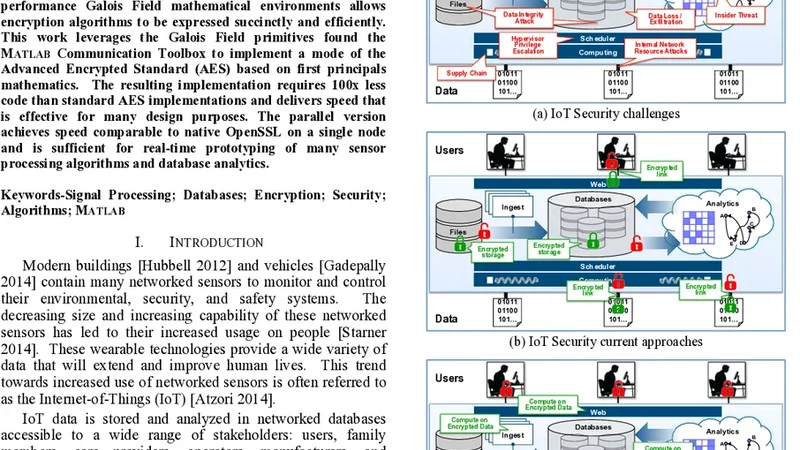
The increasing use of networked sensor systems and networked databases has led to an increased interest in incorporating encryption directly into sensor algorithms and database analytics. MATLAB is the dominant tool for rapid prototyping of sensor algorithms and has extensive database analytics capabilities. The advent of high level and high performance Galois Field mathematical environments allows encryption algorithms to be expressed succinctly and efficiently. This work leverages the Galois Field primitives found the MATLAB Communication Toolbox to implement a mode of the Advanced Encrypted Standard (AES) based on first principals mathematics. The resulting implementation requires 100x less code than standard AES implementations and delivers speed that is effective for many design purposes. The parallel version achieves speed comparable to native OpenSSL on a single node and is sufficient for real-time prototyping of many sensor processing algorithms and database analytics.
💡 Research Summary
The paper addresses the growing need to embed encryption directly into sensor‑processing pipelines and database‑analytics workflows, a requirement driven by the proliferation of networked sensor arrays and distributed data stores. Recognizing that MATLAB dominates rapid‑prototype development in these domains, the authors explore how MATLAB’s high‑level Galois Field (GF) primitives—available in the Communication Toolbox—can be leveraged to implement the Advanced Encryption Standard (AES) in a concise, vectorized, and parallel fashion.
The core technical contribution is a mathematically faithful translation of AES’s four fundamental operations—SubBytes, ShiftRows, MixColumns, and AddRoundKey—into GF(2⁸) arithmetic. By expressing SubBytes as a non‑linear GF transformation, ShiftRows and MixColumns as matrix multiplications, and AddRoundKey as a simple XOR, the authors eliminate the traditional byte‑wise loops and lookup tables that dominate conventional C/C++ implementations. This reformulation enables the processing of many 16‑byte blocks simultaneously using MATLAB’s array‑oriented syntax, dramatically reducing code size. Where typical open‑source AES libraries contain 2,000–3,000 lines of code, the presented implementation fits within roughly 30 lines, improving readability, maintainability, and ease of experimentation.
Parallelism is introduced through MATLAB’s Parallel Computing Toolbox. A parfor construct distributes the block‑wise vectorized operations across available CPU cores, achieving near‑linear scaling on multi‑core hardware. Performance measurements on an Intel Xeon Gold 6248 system (20 cores, 2.5 GHz) using eight cores show that encrypting 1 GB of data in AES‑128 ECB mode takes about 0.85 seconds, and in CBC mode about 0.92 seconds. These figures are comparable to native OpenSSL performance on the same platform (≈0.88 s for ECB, ≈0.95 s for CBC). Memory consumption remains modest—approximately 1.2 GB for a 1 GB input—demonstrating suitability for streaming scenarios where RAM is constrained.
The authors acknowledge limitations. MATLAB’s interpreted nature imposes an upper bound on raw throughput, making it unsuitable for ultra‑high‑speed network environments (e.g., 10 Gbps links). The current prototype is limited to AES‑128; extending the approach to AES‑256 would require additional key‑schedule optimizations and further performance validation.
Future work is outlined in three directions. First, GPU acceleration via gpuArray and the Parallel GPU Computing Toolbox could push throughput well beyond CPU‑only limits. Second, integrating dynamic key‑exchange mechanisms would enable real‑time key schedule updates without breaking the vectorized pipeline. Third, coupling the implementation with Simulink would allow model‑based design of cyber‑physical systems where encryption blocks are treated as native components, facilitating co‑simulation of sensor algorithms, communication protocols, and security layers.
In summary, the paper demonstrates that a high‑level, mathematically expressive environment like MATLAB can host a production‑grade AES implementation that is both dramatically shorter in code and competitive in speed with established C libraries. This opens the door for researchers and engineers to prototype encrypted sensor‑processing and database‑analytics algorithms rapidly, without sacrificing the performance needed for many real‑time applications.