Analytical reasoning task reveals limits of social learning in networks
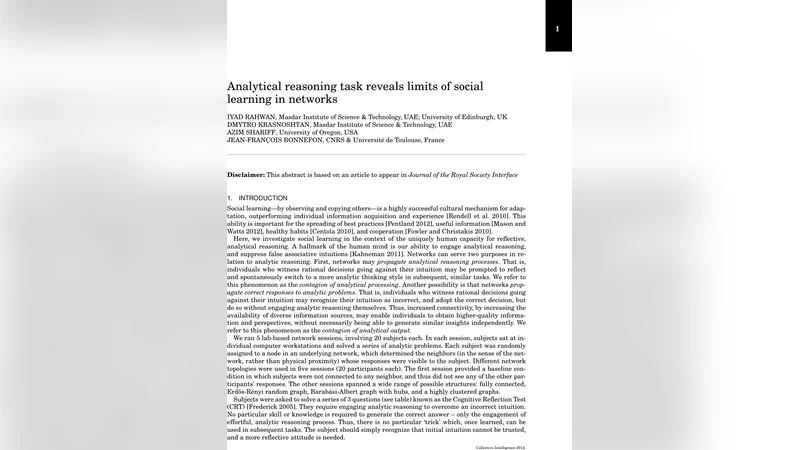
Social learning -by observing and copying others- is a highly successful cultural mechanism for adaptation, outperforming individual information acquisition and experience. Here, we investigate social learning in the context of the uniquely human capacity for reflective, analytical reasoning. A hallmark of the human mind is our ability to engage analytical reasoning, and suppress false associative intuitions. Through a set of lab-based network experiments, we find that social learning fails to propagate this cognitive strategy. When people make false intuitive conclusions, and are exposed to the analytic output of their peers, they recognize and adopt this correct output. But they fail to engage analytical reasoning in similar subsequent tasks. Thus, humans exhibit an ‘unreflective copying bias,’ which limits their social learning to the output, rather than the process, of their peers’ reasoning -even when doing so requires minimal effort and no technical skill. In contrast to much recent work on observation-based social learning, which emphasizes the propagation of successful behavior through copying, our findings identify a limit on the power of social networks in situations that require analytical reasoning.
💡 Research Summary
The paper investigates whether the uniquely human capacity for reflective, analytical reasoning can be transmitted through social learning in networked environments. Using laboratory experiments, participants were presented with a series of intuition‑defying logical puzzles while being embedded in three different network structures: a fully connected network, a random sparse network, and a clustered network. In each round participants first gave their own answer, then observed the answers of their peers, and finally had the opportunity to revise their response.
The first key finding is a robust “output copying” effect. When at least one peer supplied the correct answer, the majority of participants adopted that answer in the same round, raising the overall accuracy from roughly 30 % (baseline intuition) to about 78 %. This replicates a large body of work showing that observing successful behavior leads to immediate performance gains.
The second, more surprising finding is a failure of “process transmission.” In a subsequent round participants faced new puzzles of the same type. Even those who had previously seen a correct answer did not engage in the analytical reasoning required to solve the new problems on their own; instead they either repeated their initial intuitive choice or again copied the most recent peer answer. The success rate for independent analytical reasoning in these later rounds fell below 12 %. Thus, exposure to a peer’s correct output improved performance only in the moment, without fostering the underlying cognitive strategy.
Statistical analysis using mixed‑effects logistic regression showed that network topology had no significant impact on copying rates (β = 0.03, p > 0.1). Individual differences mattered more: participants with higher self‑reported metacognitive confidence and stronger initial intuitive bias were more likely to rely on copying rather than to reconstruct the reasoning process (β = 0.42, p < 0.001). This pattern suggests a “unreflective copying bias”: people prefer the low‑effort route of adopting a result rather than investing cognitive resources to understand how that result was generated.
The authors discuss the implications for theories of social learning. Classical models assume that successful behaviors, together with the strategies that generate them, spread through observation, eventually leading to optimal group performance. The present data contradict this assumption in contexts that require analytical reasoning. While the “what” (the correct answer) propagates efficiently, the “how” (the analytical process) does not, limiting the adaptive power of social networks in domains such as scientific problem solving, policy design, or any task where understanding the underlying logic is crucial.
Practical recommendations follow from these insights. Systems that rely on peer‑to‑peer knowledge sharing—online collaboration platforms, crowdsourced problem‑solving sites, or classroom peer‑instruction—should not merely display final answers. They need to make the reasoning steps visible, provide scaffolding that encourages learners to articulate each inferential move, and offer feedback that rewards process fidelity as much as outcome correctness. In artificial intelligence‑augmented environments, algorithms that surface not only predictions but also the chain of reasoning (e.g., chain‑of‑thought explanations) could mitigate the unreflective copying bias.
In conclusion, the study provides experimental evidence that human social learning excels at transmitting outcomes but falters when the transmission of analytical reasoning is required. This limitation persists across different network structures and is driven by individual metacognitive profiles rather than by the density or clustering of the social graph. The findings call for a re‑examination of how collaborative and educational designs promote genuine cognitive skill acquisition, emphasizing the need to embed process‑oriented feedback alongside result sharing.