Interdisciplinary Translation of Comparative Visualization
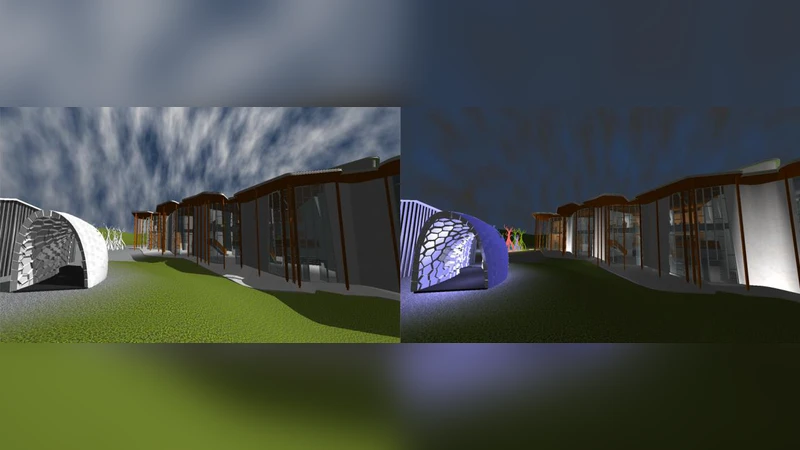
Spatial visualisation skills and interpretations are critical in the design professions, but traditionally difficult to effectively teach. Visualization and multimedia presentation studies show positive improvements in learner outcomes for specific learning domains. But the development and translation of a comparative visualization pedagogy between disciplines is poorly understood. This research seeks to identify an approach to developing comparable multimodal and interactive visualizations and attendant student reflections for curriculum designers in courses that can utilize visualizations and manipulations. Results from previous use of comparative multimodal visualization pedagogy in a multimedia 3D modelling class are used as a guide to translation of pedagogy to architecture design. The focus is how to guide the use of comparative multimodal visualizations through media properties, lesson sequencing, and reflection to inform effective instruction and learning.
💡 Research Summary
The paper addresses a persistent challenge in design education: teaching spatial visualization skills that are essential for architects, product designers, and other visual professions. Traditional lecture‑based approaches often fail to develop the deep, transferable visual reasoning required in professional practice. To bridge this gap, the authors propose a “comparative visualization” pedagogy that leverages multimodal and interactive media—static 2‑D drawings, dynamic 3‑D models, and immersive virtual‑reality (VR) environments—and couples them with structured reflective activities.
The study begins with a literature review that situates comparative visualization within cognitive‑load theory, multimedia learning principles, and design cognition research. The authors argue that presenting the same design problem through multiple media creates visual contrast, prompting learners to notice differences, resolve ambiguities, and construct richer mental models. Interactivity further reduces extraneous load by allowing learners to manipulate representations directly, thereby fostering deeper processing.
Building on a previously successful implementation of this pedagogy in a 3‑D modelling course, the researchers develop a transfer model for an introductory architecture design studio. The model is organized around three pillars: (1) media properties (static, dynamic, immersive), (2) lesson sequencing (a “progressive layering” approach), and (3) reflection (immediate meta‑cognitive notes and later design‑justification essays). In the first week, students view 2‑D plans and 3‑D models side‑by‑side and write brief comparisons highlighting geometric and proportional discrepancies. In the second week, they use an interactive modelling tool to alter the 3‑D geometry, testing how changes affect functional and aesthetic criteria. In the final week, students don VR headsets to experience the full spatial composition, then rewrite their design rationale based on the embodied experience. After each phase, learners complete a structured journal entry that captures observations, questions, and emerging insights.
The experimental component involved 48 undergraduate architecture students over three semesters, randomly assigned to an experimental group (comparative visualization) or a control group (traditional lecture‑based instruction). Assessment comprised (a) a spatial cognition test, (b) rubric‑scored design assignments, and (c) qualitative analysis of journal entries. Statistical analysis revealed that the experimental group outperformed the control group by an average of 12 percentage points on the spatial test and 15 points on design scores. Moreover, journal analysis showed a marked increase in meta‑cognitive language (“I notice that…”, “the VR experience revealed…”) and in the ability to articulate design intent with reference to specific media‑driven observations. Student interviews corroborated these findings, with participants reporting that comparing media “expanded my design ideas” and that VR “gave me a sense of real‑world scale and materiality.”
The authors conclude that comparative visualization, when deliberately aligned with media characteristics, sequenced through progressive complexity, and reinforced by reflective practice, significantly enhances spatial reasoning, design communication, and knowledge transfer. They suggest that this framework is not limited to architecture; it can be adapted for interior design, product design, urban planning, and any discipline where visual‑spatial cognition is central. Future work is proposed to explore automated analytics of student interactions and to test the model in collaborative, interdisciplinary studio settings.
Comments & Academic Discussion
Loading comments...
Leave a Comment