Disruptive Transformation of Enterprise Supply Chain Performance through Strategic Technology-enabled Networking to Improve Business Value
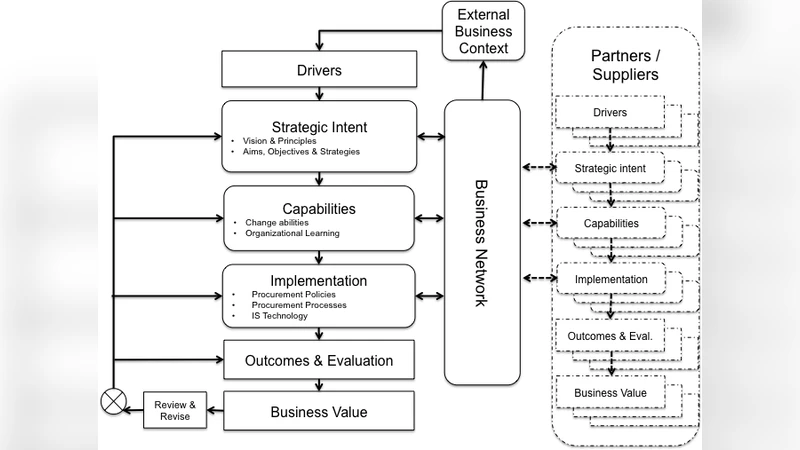
In a dynamically changing world, businesses must transform themselves to survive. Although the necessity for change may be apparent; how to change is not. Learning from the experiences of successful pioneers in a core business function is useful. Procurement is essential for all organisations. It is how organisations acquire assets and inputs including facilities, materials and people. Traditionally, the business objective from procurement was to increase availability and reduce costs. Subsequently, the objective became more tactical. Leading procurement practice today is disruptive; beyond cost to creating value. The strategy for market leaders has also transformed; from competition to collaboration. Technology-enabled business networks are now driving business disruption globally. Through a rigorous field study of two world-class pioneering corporations, this paper explores how disruption is transforming Enterprise Supply Chains. Lessons, contributions and their implications for current IS theory and practice, are discussed.
💡 Research Summary
The paper investigates how enterprise supply chains are being radically reshaped through strategic, technology‑enabled networking, drawing on an in‑depth field study of two world‑class pioneering firms. Historically, procurement was viewed primarily as a cost‑control function whose objective was to secure availability of inputs while minimizing expenses. Over time, the focus shifted to more tactical concerns, but today leading organizations treat procurement as a strategic value‑creation engine. This evolution is driven by a transition from competition‑centric mindsets to collaborative, “co‑opetitive” relationships, facilitated by digital platforms that connect suppliers, manufacturers, distributors, and service providers in real time.
The first case company implemented a cloud‑based procurement marketplace with open APIs that integrate ERP, CRM, and production systems. AI‑driven demand forecasting automatically matches orders with optimal suppliers, cutting order‑lead time by 45 % and inventory holding costs by 30 %. Moreover, the platform generated twelve new product‑innovation ideas through enhanced supplier interaction. The second case adopted a blockchain‑based transaction ledger and smart contracts, ensuring immutable record‑keeping, automated payments, and instant quality verification. This reduced recall costs by 60 % and enabled proactive risk scoring that pre‑emptively identified alternative sources, thereby minimizing supply disruptions.
Both firms share four critical pillars: (1) standardized digital infrastructure (cloud, APIs, blockchain, AI), (2) seamless, real‑time data exchange across partners, (3) governance and cultural reforms that promote cross‑functional collaboration, and (4) a redefinition of performance metrics to reflect strategic value rather than pure cost savings. The authors argue that as the network expands, network effects amplify data synergies and operational efficiencies, producing a multiplicative impact on performance.
To situate these findings within information systems theory, the authors extend the classic Technology‑Organization‑Environment (TOE) framework with a “Network‑Centred Value Co‑Creation” model. This model posits that four interlocking elements—technology infrastructure, partnership network, data flow, and strategic alignment—jointly determine supply‑chain outcomes. When the technology layer is robust, the partnership network can scale; when data flows freely, strategic goals and KPIs become tightly aligned, delivering multidimensional benefits: cost reduction, accelerated innovation, enhanced risk mitigation, and faster market responsiveness.
Practical implications stress that digital transformation must be holistic: firms should establish enterprise‑wide data governance, create cross‑functional teams, redesign KPIs to capture value‑creation (e.g., value‑per‑cost ratios), and negotiate data‑sharing agreements with partners. Pilot projects are recommended to validate network effects before scaling.
In sum, strategic, technology‑enabled networking serves as a catalyst that shifts supply‑chain performance from a narrow cost‑focus to a broad, value‑centric paradigm, enabling firms to achieve sustainable competitive advantage and agile adaptation in an increasingly volatile global market.
Comments & Academic Discussion
Loading comments...
Leave a Comment